Tested records

20 Minecraft Survival Island Seeds: The Full Coordinate Table

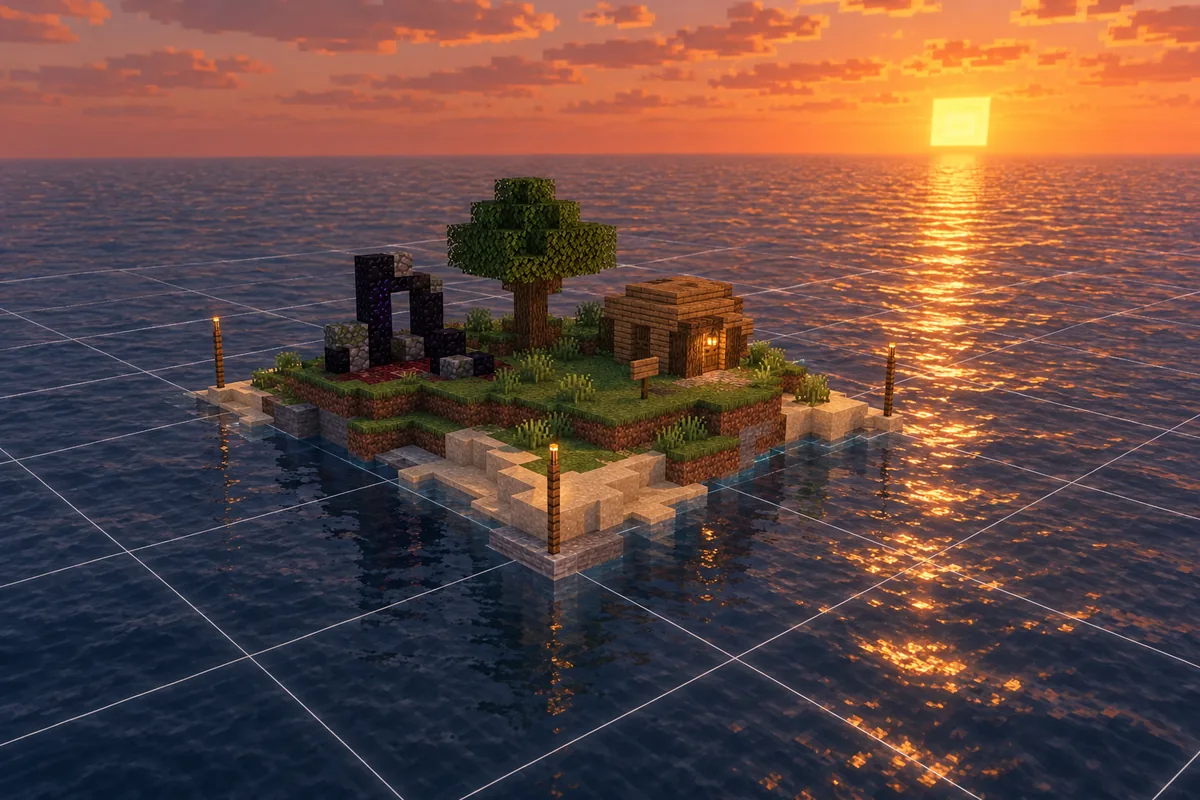
A small voxel survival island with one oak tree, a wooden hut and a ruined portal, ringed by open ocean, with a faint surveyor grid laid over the water and three thin reference posts marking the X and Z axes.
Three of the twenty rows below carry three-axis coordinates, seven carry two-axis coordinates, and one is written as a /tp command. The other nine carry only a description — which is what you get, not a guess that sends you to the wrong block.

Every seed we have loaded and checked, in one place — with the coordinates that were actually written down, the edition and version each one was checked on, and nothing filled in where nothing was recorded.

The short answer

Twenty rows, nineteen different seed codes, and eleven of them come with coordinates you can teleport to. If you only take one number away: on Java 1.20–1.21, 2016000 puts a village at -24, 64, 12 with a stronghold at -21, 42, 18 directly below it. On Bedrock, that same code gives you open water.

Three picks by edition, straight out of the table below:

Scroll to the table for all twenty. Nothing on this page was generated by a tool — these are in-game notes.

The complete coordinate table

This is the whole record. The Tag column is what the tester marked the seed with after playing it, not a score — we do not rate seeds with numbers. Where a structure was written down as a description rather than a set of coordinates, the description is what you get; we have not converted it into numbers we did not measure.

# Seed code Edition Version checked Coordinates recorded in-game Tag
1 2016000 Java + Bedrock Java 1.20–1.21 Spawn: 0, 63, 0 / Village: -24, 64, 12 / Stronghold: -21, 42, 18 / Diamonds: -32, 11, 25 / Desert temple: -320, 64, 180 / Jungle temple: 450, 63, -270 Speedrun-capable Stronghold under village Diamonds near spawn
2 2016000 Bedrock only Bedrock 1.20.5 Spawn: 0, 62, 0 (ocean) / Shipwreck: 0, 58, 120 / Mushroom island: -300, 64, 0 / Ocean monument: 0, 40, -400 Ocean spawn No trees Shipwreck at spawn line
3 -706198004 Bedrock Bedrock Two islands, 1 tree on the small island, ruined portal, cave on the large island, shipwreck with planks and a treasure map One tree Ruined portal Shipwreck with planks
4 -665393669 Bedrock Bedrock More trees, land-based ocean ruins with a chest holding a stone axe and a treasure map, iron ore and two overlapping chests below, badlands with a ruined portal Land-based ocean ruins Stone axe in chest Iron below
5 -1463564255 Java Java 1.15 Barren island, small mineshaft / Shipwreck 1: 120, 54, -202 / Shipwreck 2: 393, 56, 25 Barren island Two shipwrecks pinned Mineshaft
6 -1276503895 Regional edition / Bedrock Regional edition + Bedrock Barren island, few trees and sugar cane, underground diamond exposed to air next to a lava pool, ruined portal on a nearby island, glacier, ocean monument, shipwreck in an underwater canyon Exposed diamond Lava pool Not on Java
7 -8350249385580253962 Java Java 1.18+ Spawn: -150, 250 / Witch hut: -325, 325 / Ocean monument: -300, 150 / Pillager outpost: 600, 200 / Warm ocean: 550, 1100 / Nether fortress: -150, 0 / Bastion: 100, -100 / Quad monument: -3100, -1100 Quad witch hut Quad monument Warm ocean Server-grade
8 3387664876512721018 Java Java 1.18+ Witch hut: 200, 150 / Ocean monument: -250, 150 / Pillager outpost: -225, -325 / Warm ocean: 0, -500 / Nether fortress: 250, 0 / Bastion: -250, 50 / Quad monument: -3650, 950 Quad witch hut Quad monument Warm ocean Server-grade
9 4188583766222650532 Java Java 1.18+ Witch hut: 350, 350 / Ocean monument: 350, -250 / Pillager outpost: -350, 0 / Warm ocean: 0, -250 / Mushroom island: -300, -500 / Nether fortress (near): 0, -150 / Nether fortress (quad): -100, 200 / Bastion: 150, 0 / Dual monument: 3850, -4150 Most structures pinned Dual monument Mushroom island Two fortresses
10 -9147459640944998301 Java Java 1.18+ Spawn: 0, -550 / Witch hut: 150, -950 / Ocean monument: 200, -350 / Pillager outpost: 600, -900 / Warm ocean: -850, -1250 / Mushroom island: 150, 750 / Bastion: -300, 50 / Quad monument: 450, 950 Rejected: over-distance
11 -4217104969789286797 Java Java 1.18+ Witch hut: 0, 0 / Ocean monument: 0, 250 / Pillager outpost: 300, 0 / Warm ocean: 1100, 0 / Nether fortress: 0, 150 / Bastion: 300, 250 / Dual monument: none Rejected: no dual monument
12 -1056083236240939372 Java Java 1.18+ Spawn: -625, 150 / Witch hut: -800, 275 / Ocean monument: -650, 350 / Pillager outpost: -800, 550 / Warm ocean: 175, 800 / Bastion: 100, -450 / Dual monument: -150, 1500 Rejected: crossroads too far
13 6900926224957998486 Java Java 1.18+ Spawn: 200, 350 / Witch hut: 350, 350 / Ocean monument: -200, 150 / Pillager outpost: 200, 800 / Warm ocean: -400, 350 / Bastion: 500, -50 / Dual monument: -350, -2100 Rejected: bastion too far
14 39720048960 Java + Bedrock Java 1.18–1.21.2 / Bedrock 1.18–1.21.50 Island teleport: /tp -576 ~ 80 — ice peaks, dark forest, jungle, bamboo, stone shore, lush cave Six biomes Lush cave Both editions
15 2589021139 Java + Bedrock Java 1.18+ / Bedrock 1.18+ Large jungle island, cocoa beans and bamboo, nearby shipwreck and ocean ruins Jungle island Cocoa and bamboo Shipwreck
16 32 Java + Bedrock Java 1.18+ / Bedrock 1.18+ Small grass island, few trees and sheep, underground cave system with a spawner Small grass island Sheep Spawner cave
17 354089350 Java + Bedrock Java 1.18+ / Bedrock 1.18+ Resource-rich island, dense trees and animals, underground cave with redstone, diamonds and a lava lake Dense trees Animals Redstone and diamonds
18 -1103547699 Java + Bedrock Java 1.18+ / Bedrock 1.18+ Extra-large island, mineshaft, gold, shipwreck, ocean ruins, lava pool Extra-large Mineshaft and gold Shipwreck
19 6390326396262027557 Java + Bedrock Java 1.18+ / Bedrock 1.18+ Mountain island, rich initial resources, underground ancient city with a warden Mountain island Ancient city Warden
20 2013 Unknown Not recorded Ocean island, 7 trees, no passive mobs, 3 wheat seeds from grass, underground mineshaft 7 trees No passive mobs Legacy, untested on modern versions

Four things worth knowing before you copy anything out of it:

The completeness audit: what these records do and do not tell you

Seed lists everywhere hand you a code and a sentence. What almost none of them tell you is how complete the coordinate record behind that sentence actually is. So here is the honest audit of our own table, because it changes how much you can trust each row.

Of the 20 rows:

Tier What it means Rows Count
A — pinned At least one structure has numbers attached. You can teleport, or at least navigate to a known point. 1, 2, 5, 7, 8, 9, 10, 11, 12, 13, 14 11
B — descriptive The tester wrote down what the island had, not where. Useful for deciding, useless for teleporting. 3, 4, 6, 15, 16, 17, 18, 19, 20 9

Two consequences fall out of that split, and they are the reason we publish the audit instead of quietly rounding the numbers up.

First: a description is not a coordinate. Row 3 says “two islands, 1 tree, ruined portal, shipwreck with planks and a treasure map.” That is a genuinely useful summary of what you are getting into — and it gives you nothing to type into a teleport command. If you need to reach that shipwreck, you are walking the coastline. Rows 3 and 4 are the two most-played island entries in the whole set and both sit in the descriptive tier, which is worth knowing before you plan a route around them.

Second: the pinned rows do not agree on how many axes they use. Rows 1 and 2 record three numbers — X, Y and Z — so you can land on an exact block. Rows 7 through 13 record two — X and Z — which drops you at the surface above the structure and leaves you to dig or swim down. Row 14 is a third form again: a /tp command with ~ standing in for height, meaning “keep whatever Y you have now.” Three different conventions in one table, because three different testers wrote them down. We have left all three as recorded rather than normalising them into numbers nobody measured.

The rule we apply to our own table: if a coordinate was not written down at the time of testing, the cell says what was seen instead. We do not back-fill it later, and we do not estimate it. A blank is more useful to you than a guess that sends you to the wrong block.

Two seeds, mapped in full

One row wins on precision, one wins on coverage. Both are Java, both were recorded in-game, and both are worth reading side by side because they show what a complete island record looks like at each extreme.

Speedrun God Seed — 2016000

Java 1.20–1.21 Speedrun-capable 3-axis record Stronghold under village

  • Spawn0, 63, 0
  • Village-24, 64, 12
  • Stronghold-21, 42, 18
  • Diamonds-32, 11, 25
  • Desert temple-320, 64, 180
  • Jungle temple450, 63, -270

This is the most precise record in the table: all six entries carry X, Y and Z. Read the first three together and the shape of the seed appears on its own — the village sits at Y 64 and the stronghold sits at Y 42 with an X/Z only a few blocks away, which is what “stronghold under the village” means in numbers. The diamonds at Y 11 are at cave depth, not at the surface.

One number here is derived rather than measured: the village at -24, 64, 12 is roughly 27 blocks from the spawn at 0, 63, 0 by straight-line distance on X and Z. Everything else in this card is as recorded. The Bedrock twin of this same code is row 2, and it is an empty ocean — the full comparison is on its own page.

Dual Monument and Mushroom Island — 4188583766222650532

Java 1.18+ Most structures pinned Dual monument Mushroom island Two fortresses 2-axis record

  • Witch hut350, 350
  • Ocean monument350, -250
  • Pillager outpost-350, 0
  • Warm ocean0, -250
  • Mushroom island-300, -500
  • Nether fortress near0, -150
  • Nether fortress quad-100, 200
  • Bastion remnant150, 0
  • Dual monument3850, -4150

Nine pinned structures — the widest coverage of any single seed in the set. Two things stand out when you read the list as a whole. The dual monument at 3850, -4150 is an order of magnitude further out than everything else on the card, so it is a planned expedition rather than a neighbour. And there are two Nether fortresses recorded, at 0, -150 and -100, 200, which is unusual enough to be worth the trip on its own.

Every entry here is 2-axis: X and Z only, no Y. Teleporting puts you at the surface above the structure. This seed also clears the server-grade standard, so it works for a shared world as well as a solo one.

How to read a Minecraft coordinate

A coordinate is three numbers, in this order: X is east–west, Y is height, Z is north–south. Negative X moves west, negative Z moves north, and Y 63 is roughly sea level in the overworld.

When a row gives you all three, you can go straight to the block:

Java: /tp -24 64 12

Bedrock: /tp -24 64 12

When a row gives you only two, supply your own height. /tp 350 ~ -250 keeps your current Y and moves you to the right column of blocks, which is the safe way to approach an ocean monument you have not mapped yet — arriving at the surface beats arriving inside a wall of water.

Two habits that save time on an island specifically. Teleport commands need cheats enabled, so if you are playing survival without them, the coordinates are still doing work: they tell you which direction to sail before you commit to a boat trip you cannot easily undo. And write the coordinate down before you leave spawn — an island looks identical to the one three hundred blocks away, and the one thing you cannot recover from memory is where you started.

The first-day route, read off a coordinate table

A coordinate list does not change what you need on day one. It changes the order you go and get it in, because you stop searching and start travelling.

  1. Chop trees first, and stop before the last one. Wood is the ceiling on everything else — no planks means no pickaxe, no furnace, no door. On an island with a single tree, leave a sapling standing and replant it before you touch anything else.
  2. Check the ruined portal chest if the table lists one. Rows 3, 4 and 6 all record a ruined portal. A chest there is free supplies, and a portal frame with enough obsidian already in it can be lit without mining a single block.
  3. Go to the shipwreck, do not hunt for it. Rows 2 and 5 have shipwreck coordinates written down. Planks from a shipwreck chest are your wood supply on an island with no trees, and the treasure map in those chests is how you find land.
  4. Then dig, and use the Y numbers when you have them. The useful underground finds in this table — exposed diamond on row 6, iron under the land-based ocean ruins on row 4, the diamond vein at Y 11 on row 1 — are all below the surface, and a recorded Y tells you how far down to go.

If your row sits in the descriptive tier, steps 2 and 3 become searches again. That is the practical cost of a description instead of a coordinate, and it is why the audit above matters more than the count of seeds does.

Using these coordinates on a shared world

On a server, a coordinate table stops being a convenience and becomes infrastructure — it is how you decide where the spawn settlement goes before anyone builds anything. The four seeds that were measured against a distance standard and turned down are rows 10 to 13; the ones that cleared it are rows 7, 8 and 9, and the sheet they were judged against is on the server-grade page.

The one caveat that applies to every row on this page: coordinates are edition-specific. A Java coordinate pasted into a Bedrock world — or the other way round — points at a different world entirely, because the terrain under it was generated differently. Match the edition column first, then the version column.

A good seed is better with people on it. If you want to host a server and explore these islands together — Java or Bedrock — Shockbyte is a low-cost host that sets up in minutes. Use code LAUNCH for 25% off your first month. If you sign up through that link, I may receive a commission at no extra cost to you. It does not change what you pay.

Frequently asked questions

Do Minecraft island seed coordinates work on both Java and Bedrock?

No — coordinates are edition-specific, because the terrain they point into was generated by a different algorithm. Java and Bedrock do not share world generation, so a coordinate recorded on Java lands somewhere unrelated in a Bedrock world even when the seed code is identical. Rows 1 and 2 in the table above are the clearest proof: the same code, 2016000, gives a village at -24, 64, 12 on Java and an ocean spawn at 0, 62, 0 on Bedrock. Match the edition column before you copy anything.

How do I teleport to a structure using these coordinates?

Open the chat window and type /tp X Y Z, using the numbers from the table — for example /tp -24 64 12 reaches the village on seed 2016000 in Java. If a row only lists two numbers, use ~ for the missing height, as in /tp 350 ~ -250, which keeps your current Y and moves you to the right spot on the surface. Cheats must be enabled on the world for the command to work.

Why do some seeds in the table have no numbers next to their structures?

Because the tester wrote down what the island contained rather than where each thing sat, and we publish the record as it was written instead of converting descriptions into coordinates nobody measured. Nine of the twenty rows are in this descriptive tier — rows 3, 4, 6, 15, 16, 17, 18, 19 and 20. They still tell you whether a seed is worth loading; they just do not give you anything to teleport to.

What do you do if your survival island has no trees?

Search for a shipwreck first — planks from a shipwreck chest are your wood supply before any tree appears on the island. On seed -706198004 (Bedrock), the small island has exactly one tree and a ruined portal, and the tester note reads “I checked the ruined portal chest and found useful items.” Sugar cane cannot be eaten and kelp is not named in that row, so the shore is not your food bridge while you wait for a second tree, and the rule learned the hard way is to leave at least one sapling standing before you chop the last one.

Is a bigger island better than one with more trees?

No — a small island with one mature tree beats a huge island with none. Wood is your ceiling: you cannot craft a pickaxe, a furnace or a door without planks, and plank supply scales with tree count, not island size. Row 3 in the table is a small island with a single tree and it was still played through, because the shipwreck and the portal chest supplied what the surface did not.

What makes an island seed good for a multiplayer server?

Four structures inside a 256-block radius and a warm ocean — that is the standard used on this site. Quad witch huts give you four witch-farm hubs, a quad ocean monument cluster gives you four guardian farms, a bastion remnant gives you a gold source, and a warm ocean keeps boat lanes from freezing. Seed -8350249385580253962 (row 7) hits that template; rows 10 to 13 missed it and were rejected after mapping.

What does it mean when a row in the seed table lists coordinates with a tilde (~)?

It means the tester recorded the X and Z only and left the height to be filled in by the player at load time, because the exact Y was not written down during the play session. Three seeds in our table use this format — 2016000 on Bedrock has the full -300, 64, 0 with the height, while 4188583766222650532 and -9147459640944998301 use X and Z only. In-game, /tp -300 ~ -500 drops you at the surface above the island rather than inside it, and cheats must be enabled on the world for the command to work.

How do tester coordinates translate to actual blocks in another world?

They translate exactly when both runs use the same edition and the same game version — the seed number is the input, the world generator is deterministic, and the same coordinates appear in the same place. They break when Java and Bedrock run the same code (different generators give different worlds), when a game version changed terrain generation between two saves, or when the tester turned off structures in the world settings.

Is there a Minecraft island seed that is long and narrow instead of round and wide?

Not in our records. None of the twenty rows in the table records the outline, length or width of an island, so we cannot point you at a long narrow one. What the table does hold is position and contents: coordinates to structures, and a short line describing what the island had on it. The nearest anyone came to shape is a size word, not a measurement, on row 18 (-1103547699) tagged extra-large island and row 16 (32) described as a small grass island. Four rows carry coordinates to a mushroom island, which is a second landmass but again only a position. If you want a specific outline, the honest route is the one in the first-day section: generate the world, then walk the shoreline rather than cutting inland, because the shape of the island is the one thing no seed list can tell you before you load it.

What is in Minecraft seed 777, 999 or 666?

We do not know, because we have never loaded any of them, and we are not going to tell you what is in a seed we have not tested. These three short codes keep coming up in search because they look as though they should mean something. Short codes do exist in our table: 32 on row 16 is a small grass island with sheep and a cave spawner, and 2013 on row 20 is an ocean island with seven trees and no passive mobs. Neither is 777, 999 or 666, and row 20 is also the one row in the table with no edition and no version recorded. A three-digit code buys you nothing in particular: the generator reads the number the same way whatever its length, so a short code is not a special code.

Why does the same seed code appear twice in this table?

Because 2016000 was recorded twice, once as Java + Bedrock and once as Bedrock only, and the two records describe two different worlds. Row 1 is Java 1.20 to 1.21, spawn 0, 63, 0, with a village at -24, 64, 12 and a stronghold at -21, 42, 18. Row 2 is Bedrock 1.20.5, spawn 0, 62, 0 in open ocean, with a shipwreck and a mushroom island at -300, 64, 0, tagged no trees. It is the only code that appears on two rows anywhere in the table, and it is the clearest example of why a Java + Bedrock label is a claim rather than a test: the same number went into two generators and came out as two islands that share nothing.

Which island seed on this page has the most structures pinned to coordinates?

Nine structures, on seed 4188583766222650532 (Java 1.18+) — the widest coverage of any single seed in this table. Every entry on that card is two-axis, X and Z with no height, so a teleport puts you on the surface above the structure rather than inside it. Two details are worth planning around: the dual monument at 3850, -4150 sits an order of magnitude further out than anything else on the card, so treat it as an expedition rather than a neighbour, and two separate Nether fortresses are recorded at 0, -150 and -100, 200. If you want three-axis precision instead of coverage, seed 2016000 is the only card here where all six entries carry X, Y and Z.

Do the rejected rows still have coordinates worth copying?

Yes — rows 10, 11, 12 and 13 were tested and turned down for server use, and every coordinate they carry is published exactly as recorded. A rejection here is a judgement about distance, not about whether the world is playable: row 10 was rejected as over-distance, row 11 for having no dual monument, row 12 because the crossroads was too far out, and row 13 because the bastion was too far. All four remain perfectly good single-player seeds. The reasons are spelled out in full on their own page.

How far is the village from spawn on seed 2016000?

About 27 blocks, measured straight-line on X and Z from the spawn at 0, 63, 0 to the village at -24, 64, 12 — and it is the only number on this page that we derived rather than read off the tester’s notes. Everything else in that card is as recorded in-game. The same seed also carries a stronghold at -21, 42, 18, which is what “stronghold under the village” means in numbers: two blocks apart on X and Z, twenty-two blocks apart in height. On Bedrock that same code is row 2, and it is open ocean.