The short answer
We do not publish speedrun seeds. We publish 49 island seed records, and we went back through all thirty-three pages to find out how much distance information they actually contain: 39 limit-word statements in 15 pages, and only seven distinct distances behind them. One page writes a budget of more than one number — the server-grade standard, four numbers, written for four players and not for a clock. One number converts overworld blocks into Nether blocks, and one number is the only distance that ever got a seed rejected. Those three are the speedrun-relevant contents of this site, and they are all on this page.
- The only record with a timed run attached:
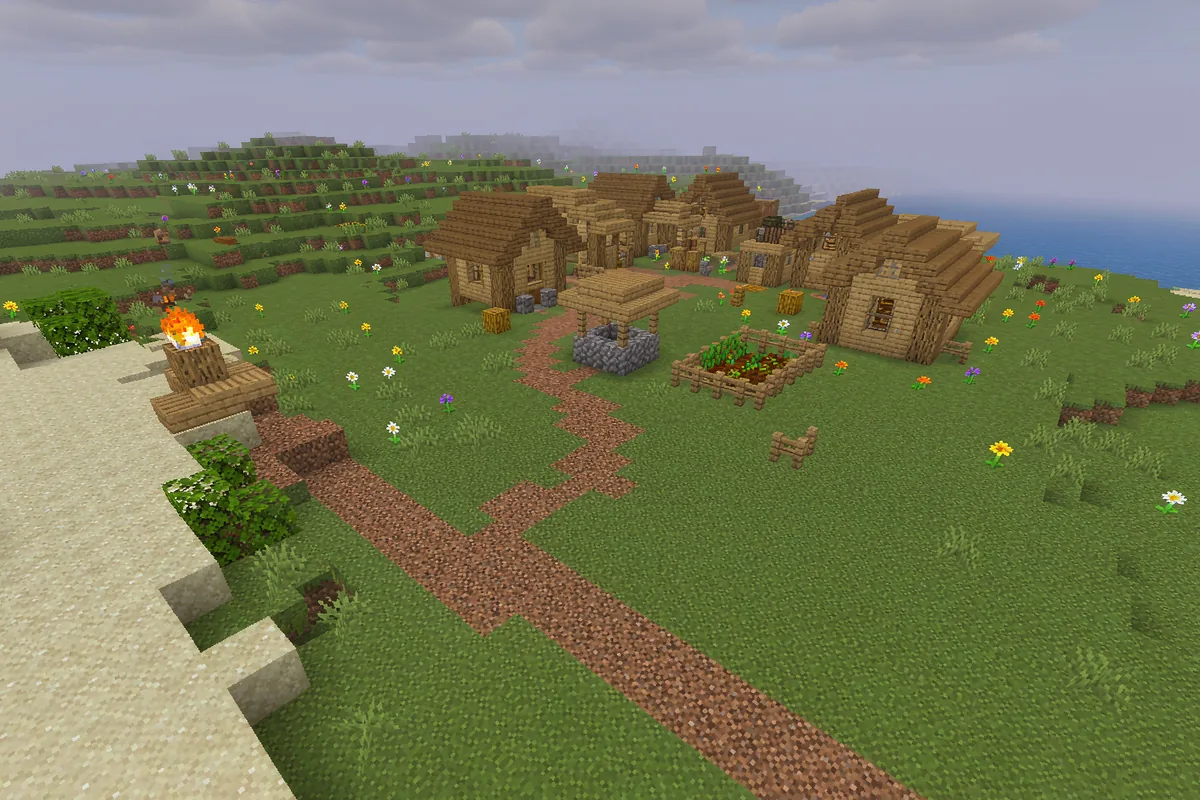
2016000 — Java 1.20–1.21, spawn 0, 63, 0 with oak and birch within ten blocks, village at -24, 64, 12 about 27 blocks away, stronghold eleven blocks under the village well, run log ending with the portal activated at 27 minutes. Village 27 blocks from spawn Stronghold 11 blocks down Timed run logged Not an island spawn
- The only budget of four numbers on the site: the server-grade standard — witch hut within 256 blocks, ocean monument within 1000 blocks, pillager outpost within 600 blocks, plus a second warm ocean or a second monument in another direction. Four numbers at once Pass or fail test Built for a server, not a clock
- The only overworld-to-Nether conversion: a quad ocean monument at -3100, -1100 — over 3,000 blocks out on the surface, about 388 blocks of Nether travel by the tester's own note. 388 blocks of Nether travel Distance as travel time Needs a highway that does not exist yet
- The only number that ever killed a seed:
-9147459640944998301 — Java 1.18+, mushroom island, quad monument, witch hut, pillager outpost, rejected on the tester's own words, slightly over one thousand blocks. Rejected: over distance Quad monument Mushroom island
- The only budget written for the first five minutes: a shipwreck within 200 blocks, one of four checks on the rejected-seeds page. 200 blocks First five minutes A check, not a measurement
The codes on this page — 2016000; -9147459640944998301; 4188583766222650532; -1276503895
How we counted, before you read any number on this page
Every figure below comes from scanning this site's own pages, not from the game. The rule comes first so you can check us.
What counts as a limit-word statement. A figure written in digits, followed by blocks, with a limit word immediately in front of it: within, over, under, less than, more than, at least, no more than, beyond, further than. Within 500 blocks counts. Over 3,000 blocks counts. That rule returns 39 statements across 15 pages, and those 39 hold seven distinct numbers: 10, 200, 256, 500, 600, 1000 and 3000.
What is a distance but not a limit-word statement. About 27 blocks away, eleven blocks down, 300 blocks west, about 388 blocks of Nether travel. Every one of those is a real distance and every one is in the table below, but none has a limit word in front of it, so none is counted as a statement above. They are four more numbers, and they are the four that make the table eleven rows instead of seven. We list them rather than drop them, because two of the four are the most useful distances on the site.
What does not count. Coordinates on their own, seed codes, version numbers, Y levels, and anything in a navigation bar or a footer.
What a record is. Forty-nine of them: twenty rows in the coordinate table and twenty-nine archive cards from 2011 to 2019. The scan covers the pages, which is where the distance writing lives; the records are what the numbers are about.
The thing we are not doing. We are not estimating how long anything takes in someone else's run. The only clock number on this site is the one attached to 2016000, it was logged by the tester who made it, and we are not generalising from it.
The eleven distances: seven behind a limit word, four that describe one seed
Thirty-nine statements, fifteen pages, seven numbers behind a limit word. The table lists all eleven distances we publish, because the four without a limit word are not less useful — a village 27 blocks out and a stronghold 11 blocks down are the reason the only timed run we hold finished in 27 minutes. Read down the column and the shape of the site becomes obvious: most of these numbers describe one seed once and are never used again.
| Distance |
What it budgets |
Where it lives |
Budget or one-off |
| 10 blocks |
Oak and birch at spawn |
Spawn biome note on 2016000, repeated on several pages |
Measurement |
| 11 blocks |
Stronghold depth under the village well |
2016000 Java, stronghold at -21, 42, 18 |
Measurement |
| 27 blocks |
Spawn to village |
2016000 Java, village at -24, 64, 12 |
The most useful number we publish |
| 200 blocks |
Shipwreck or second food source |
First-five-minutes check on the rejected seeds page |
Budget: a rule you can apply |
| 256 blocks |
Witch hut |
Server-grade standard |
Budget |
| 300 blocks |
Spawn to mushroom island, west |
2016000 Bedrock, island at -300, 64, 0 |
One-off |
| 388 blocks |
Quad monument, as Nether travel |
Quad monument at -3100, -1100 |
Conversion |
| 500 blocks |
Surrounding small islands |
Card for -1276503895, not the row |
One-off |
| 600 blocks |
Pillager outpost |
Server-grade standard |
Budget |
| 1,000 blocks |
Ocean monument on one side, rejection on the other |
Server-grade budget; rejection line on -9147459640944998301 |
Budget and verdict |
| 3,000 blocks |
Quad monument, overworld surface distance |
Server-grade page |
One-off, then converted |
Four of the eleven are budgets you can apply to a seed you have not loaded yet: 200, 256, 600 and 1000. Three more sit behind a limit word without being budgets — 10 and 500 are measurements, and 3,000 is a rejection verdict. One is a conversion. The rest describe a single record once.
The only page with a real budget
One page on this site asks four distance questions at the same time and requires all four to pass. It is the server-grade standard, and the numbers are: a witch hut within 256 blocks, an ocean monument within 1000 blocks, a pillager outpost within 600 blocks, and a second warm ocean or a second monument in another direction.
The reason all four are required matters before you borrow the numbers, because it explains why this is not a speedrun budget. A multiplayer server is four players spending the same first night, and any single missing structure forces a longer walk for whoever lands in that quadrant. The budget exists to make the worst case survivable for the group, not to make the best case fast for one person.
That difference is the whole gap between what this site has and what a speedrun seed needs. A server budget asks is anything too far. A speedrun budget asks is everything close enough, in order, on a clock. Ours answers the first question and has never been pointed at the second.
388 blocks: the one number that thinks in travel time
A quad ocean monument sits at -3100, -1100. On the surface that is over three thousand blocks from spawn, which on its own is a disqualifying distance by any standard on this site. It survived review for one reason: the tester noted that Nether travel compresses the trip to about 388 blocks.
This is the single most speedrun-shaped sentence in our records, because it is the only place where we stopped measuring distance in blocks and started measuring it in travel time. It is also the only place where one trip carries two honest numbers — three thousand and three hundred and eighty-eight — and both are true.
The catch is the one a speedrunner will spot immediately: the compression only exists once the highway does. Four hundred blocks of Nether travel is a short hop after the portal and the tunnel are built, and a building project before that. The number is real and the discount is conditional.
The number that got a seed thrown out
Seed -9147459640944998301 on Java 1.18+ holds a mushroom island, a quad ocean monument, a witch hut and a pillager outpost. By the contents test it is a headline seed. The record says it was rejected anyway, and it says why in the tester's own words: slightly over one thousand blocks.
This is the only time on this site that a distance number changed the fate of a record rather than decorating it. It is the clearest evidence we have that distance is not a detail: the same features at a different spacing would have made the list, and the spacing is the only thing that was measured.
Compare it with 4188583766222650532, which carries nine coordinates, two Nether fortresses, a bastion and a mushroom island and stayed in. Same kind of haul, different spread, opposite outcome. The difference is written down, and it is the difference between a seed you can route and a seed you have to commute to.
The closest thing to a speedrun seed we have
Village at Spawn, Timed Run — 2016000
Edition and version: Java 1.20–1.21. Spawn: 0, 63, 0, plains with oak and birch within ten blocks. Village: -24, 64, 12, about 27 blocks away, twelve houses, two forges, one church, two farms. Stronghold: -21, 42, 18, eleven blocks down under the village well, end portal room with three eyes already placed. The run log: twelve oak blocks chopped, pickaxe and sword made, village reached in about five minutes, iron chestplate taken from the forge, wheat traded for emeralds, ender eyes bought from the librarian, twelve eyes total, portal activated at 27 minutes. Why it is here: it is the only record on this site with a clock attached, and the clock was only short because the two distances were short — twenty-seven blocks to the village, eleven down to the stronghold. Village 27 blocks from spawn Stronghold 11 blocks down Three eyes pre-placed Timed run logged Not an island spawn
The Same Code on Bedrock — 2016000
Edition and version: Bedrock 1.20.5. Spawn: 0, 62, 0, ocean, no trees. Mushroom island: -300, 64, 0, recorded as 300 blocks west. Shipwreck: 0, 58, 120. Why it is here: it is the same number as the record above and a completely different problem — every single thing on this row is 120 blocks or further from where you land, so the wood for the boat is on the island you cannot reach without the boat. Mushroom island 300 blocks west No land at spawn No trees recorded
Nine Coordinates, Kept — 4188583766222650532
Edition and version: Java 1.18+. What is on it: witch hut 350, 350; ocean monument 350, -250; pillager outpost -350, 0; warm ocean 0, -250; mushroom island -300, -500; Nether fortress near 0, -150; second fortress; bastion 150, 0; dual monument 3850, -4150. Why it is here: it is the row that passed the spread test -9147459640944998301 failed, and it is the only row in the table where a distance word and a coordinate sit on the same line. Two fortresses Nine coordinates Word plus number Unbounded version
Five Hundred Blocks, on the Card — -1276503895
Edition and version: Bedrock, recorded as not working on Java. Terrain as written: barren island, a few trees and sugar cane, a diamond vein exposed beside a lava pool, a ruined portal on a nearby island, a glacier, an ocean monument, a shipwreck in an underwater canyon. The number: several small islands within 500 blocks — written on the card, not on the row. Why it is here: it is the cleanest example of our own inconsistency — one layer has the word nearby, the other has the number 500, and no single record has both. Ruined portal Diamonds exposed to air 500 blocks, on the card Nearby with no number on the row
Which Clock Are You Racing?
A distance is not a time. Before any number below is worth carrying into a run, you have to know which category you are running, because the category decides what that number costs you.
Three ways to start a world
The same walk to a temple is three different facts depending on how the world was created:
| How the world starts | What it means for the numbers on this page |
|---|
Set seed
You enter a known seed before the world exists, having explored it beforehand for loot, the Nether fortress, the stronghold, and where you land. | A fixed cost. You can walk the route before the clock starts and decide whether it is worth starting at all. Every coordinate table on this site is a set-seed document. |
Random seed
You open a new random world, and restarting after a look around is allowed. | A rejection filter. The number does not say how fast a run is, it says whether to keep the world. |
Filtered seed
A 1.16 seed from a pool checked in advance: a repairable ruined portal near spawn with a looting sword, a close bastion and fortress in the Nether, and a close stronghold in the ocean when the return portal is built near the fortress. | Already paid for. The distances that matter are guaranteed short, so an island spawn is a handicap rather than a feature. |
This is why -9147459640944998301 reads two ways. On this site it was rejected for slightly over one thousand blocks. In a random-seed run that sentence is a reset. In a set-seed run it is a route note: a boat, a stack of wood, and a decision about whether a quad monument is worth the crossing. Rejected: over distance Quad monument Readable two ways
The version bucket comes before the seed
Timed runs are split into four version buckets. Each one has a version people actually play, and none of them is the newest version on your launcher:
| Bucket | Version usually played | What the bucket locks in |
|---|
| Pre 1.9 | 1.7.2 or 1.8.9 | No elytra, and pre-1.9 combat. |
| 1.9 – 1.12 | 1.11.2 or 1.12.2 | Elytra exists; the ocean is still the pre-1.13 ocean. |
| 1.13 – 1.15 | 1.15.2 | Post-1.14 villages and villagers. |
| 1.16+ | 1.16.1 | Bartering is run on 1.16.1, because piglins trade pearls more often there than in any later version. |
So a seed list without a version is not a run list. Our own table is mixed: the record with the timed run is Java 1.20–1.21, the record with nine coordinates is marked 1.18+ with no upper bound, and the most detailed Bedrock card is recorded as not working on Java at all. Copy the code without the version and you are comparing two different worlds.
Same code, different route
Three strategies in the guide are tagged by edition, and the tags are the part island lists never print:
- Village strategy — Bedrock only. It works because strongholds generate under villages in Bedrock: throw an eye, walk that way to a village, stand in the middle of it and dig down.
- Monument strategy — Java only.
- Insomniac strategy — Java only.
That is the exact shape of our 2016000 record on Java: village about 27 blocks from spawn, stronghold eleven blocks under the village well, portal lit at 27 minutes. It is a good island seed, and it is also, structurally, a Bedrock route that happens to exist on Java. The same number on Bedrock 1.20.5 drops you in open ocean at 0, 62, 0 with no trees, and the nearest land is a mushroom island 300 blocks west. Two records, one code, two games.
What the clock measures
The guide mentions in-game time once, as a progress check on one route: your IGT, or in-game time, should be around six to eight minutes when you reach a known point. It never states when the clock starts or stops, because those rules belong to the category, not to the world. A page like this one therefore cannot tell you a run is fast. It can only tell you what the ground will charge you before the clock matters: 27 blocks to a village, eleven blocks down to a stronghold, 525 blocks to a jungle temple, 388 blocks of Nether travel once a highway exists. Judge the seed on those, then judge the run on the rules.
Five checks before you call any seed a speedrun seed
- Ask for the number, not the word. Of our forty-nine records, the ones that say nearby almost never say how near. If a list will not give you a figure with a unit, you cannot route it.
- Check whether a budget is written down anywhere. Ours is written on exactly one page, the server-grade standard, and it was built for four players. A page with no stated budget has no standard it can fail.
- Find out which distance decided the seed. On
-9147459640944998301 it was slightly over one thousand blocks. That one number overwrote a mushroom island and a quad monument. Ask what the equivalent number is on the seed you are looking at.
- Separate surface distance from travel distance. Three thousand blocks and 388 blocks are the same trip on our server-grade page. The second number is only available after the highway exists.
- Check the edition before you copy the code.
2016000 is a twenty-seven-block walk to a village on Java and open ocean with no trees on Bedrock. One number, two generators.
Running these with other people
The four-number budget on the server-grade page is the right shape for a group and the wrong shape for a clock. Seed 4188583766222650532 is the one that works for both: nine coordinates, two fortresses, a bastion and a mushroom island close enough that one camp can service several of them. Seed -9147459640944998301 is the one that does not: the same haul, spread slightly over a thousand blocks, rejected by the person who measured it.
If you want to run one of these with other people on Java or Bedrock, Shockbyte is a low-cost host that sets up in minutes — use code LAUNCH for 25% off your first month. If you sign up through that link, I may receive a commission at no extra cost to you. It does not change what you pay.
Frequently asked questions
Do you publish Minecraft speedrun seeds?
No. This site publishes 49 island seed records, and not one of them is a speedrun seed. What we do have is one record with a timed run attached to it: seed 2016000 on Java, whose run log ends with the End portal activated at 27 minutes. If you arrived here looking for a leaderboard seed, the honest answer is that we do not have one, and the rest of this page explains exactly which distance numbers we do have instead.
How many distances does this site actually state?
Seven distinct distances sit directly behind a limit word, across 39 statements in 15 of the 33 pages. Those seven are 10, 200, 256, 500, 600, 1000 and 3000 blocks. Four more numbers describe one seed each with no limit word in front of them: 11, 27, 300 and 388 blocks. Everything else we publish about distance is a word without a number behind it.
What is the only real distance budget on this site?
The server-grade standard on our server seeds page, and it is the only place we wrote more than one budget number at once: a witch hut within 256 blocks, an ocean monument within 1000 blocks, a pillager outpost within 600 blocks, and a second warm ocean or a second monument in another direction. It was written for four players sharing one first night, not for a speedrun.
What is 388 blocks of Nether travel?
The only overworld-to-Nether conversion anywhere in our records. A quad ocean monument sits at -3100, -1100, which is over three thousand blocks from spawn on the surface and about 388 blocks of Nether travel by the tester's own note. It is the one number on this site that measures distance in travel time rather than in blocks.
Why was a seed with a mushroom island and a quad monument rejected?
Because the tester measured it. Seed -9147459640944998301 on Java 1.18+ carries a mushroom island, a quad ocean monument, a witch hut and a pillager outpost, and the rejection line in the record reads slightly over one thousand blocks. A seed can hold everything a list would headline and still fail on the distance between spawn and the thing you need.
Which record on this site is closest to a speedrun seed?
Seed 2016000 on Java 1.20 to 1.21. Spawn is 0, 63, 0 with oak and birch within ten blocks, the village at -24, 64, 12 is about 27 blocks away, the stronghold sits eleven blocks under the village well, and the run log ends with the portal activated at 27 minutes. It is also the only seed we record on both editions, and on Bedrock the same code gives open ocean with no trees and a mushroom island 300 blocks west.
Do these island seeds work on Java and Bedrock?
Only one is recorded on both, and it gives two different worlds. Seed 2016000 on Java lands you beside a village about 27 blocks from spawn; the same code on Bedrock 1.20.5 puts you in open ocean at 0, 62, 0 with no trees and the nearest land a mushroom island 300 blocks west. Check the edition and version before you blame the code.
Can I use an island seed from this site in a speedrun?
Yes, as a set seed run, and only as a set seed run. Typing a known seed into the world creation screen is what the rules call a set seed, which is a separate category from random seed. The 27-block village and the stronghold under the well are a route you can learn before you start, not a filter you apply to random worlds. If you want to race random seeds, treat the coordinates on this page as a reason to reset rather than as a plan.
Which version should I open an island seed on for a timed run?
The version your category is locked to, not the newest one you own. Timed runs are split into pre 1.9, 1.9 to 1.12, 1.13 to 1.15, and 1.16+, usually played on 1.7.2 or 1.8.9, 1.11.2 or 1.12.2, 1.15.2, and 1.16.1 respectively. Our record with the timed run was tested on Java 1.20 to 1.21, later than the version the top bucket is usually played on, and the Bedrock card does not transfer to Java at all.