Minecraft Mushroom Village Seeds: The One Village in 20 Rows Is Never on a Mushroom Island
The short answer
Across the twenty seed rows in our record, exactly one names a village and three name a mushroom island — and no row names both. That is the whole answer to “mushroom village seed”, and it is not a claim about the game. It is a count of what our testers wrote down. The reason the two never meet is also countable: only six of the twenty rows record where you actually land, so for the other fourteen, “how far is it” is a question our data cannot answer.
The only village row we hold:2016000 — Java 1.20–1.21. Challenge: none, this is the easiest row in the table. What you get at spawn: a village at -24, 64, 12 recorded as twelve houses, two blacksmith forges, one church and two farms, roughly 27 blocks from the recorded spawn.
The same code on the other edition:2016000 — Bedrock 1.20.5. Challenge: no land at spawn. What you get at spawn: open ocean, and the village is gone — the record says no trees and no village. What replaces it is a mushroom island at -300, 64, 0.
The mushroom island with the most structures around it:4188583766222650532 — Java 1.18+. Challenge: unrecorded. What you get at spawn: nine structure coordinates, more than any other row, including a mushroom island at -300, -500 — but no spawn point, so none of the nine can be measured against where you land.
The mushroom island that got the seed rejected anyway:-9147459640944998301 — Java 1.18+. Challenge: too far. What you get at spawn: a mushroom island at 150, 750 and a quad ocean monument at 450, 950, and it was still turned down.
If you want a village start, this is the only row that gives you one:2016000 on Java — and it is the same code that gives you a mushroom island on Bedrock. One number, two worlds, never both features in the same one.
The four rows that decide this whole question — village: 2016000 on Java; mushroom islands: 2016000 on Bedrock, 4188583766222650532 and -9147459640944998301 on Java
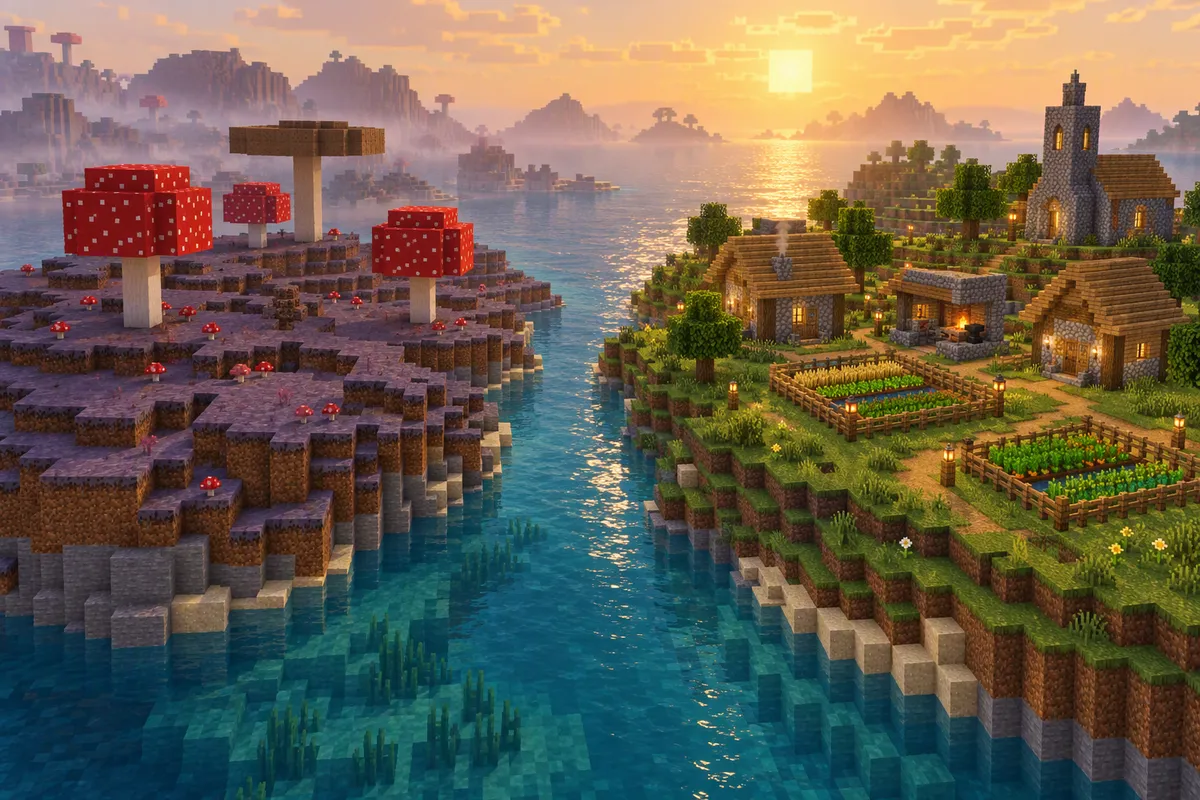
The two features this page counts, drawn side by side and separated by water. In our records they have never appeared on the same row.
Why “mushroom village” has no matching row in our record
A mushroom island is the safest place in the game to put a base: mushroom fields spawn no hostile mobs, so the base never has to be defended. A village is the fastest possible start: beds, a blacksmith chest, farms already planted, and trades you do not have to build. Put them on one seed and you have the strongest island start there is. That is presumably why people search for it.
Our table does not contain one. Counting the twenty rows straight through gives this:
What the row names
Rows out of twenty
Which rows
A village
1
2016000 on Java 1.20–1.21, at -24, 64, 12
A mushroom island
3
2016000 on Bedrock, 4188583766222650532, -9147459640944998301
Both, on the same row
0
—
Neither
16
Everything else in the table
Read that as a fact about a spreadsheet, not about world generation. We hold twenty rows written by a handful of testers, not a scan of the seed space, so the honest sentence is narrow: we cannot name you a mushroom village seed, and we are not going to invent one to fill the gap. What we can do is explain precisely why our record cannot produce one, because the reason turns out to be more useful than the seed would have been.
The three mushroom island rows came from testers doing farm-structure surveys — witch huts, ocean monuments, Nether fortresses and bastions, with the mushroom island written down as one line among eight or nine. The single village row came from a tester running a timed attempt. Different people, different objectives, different columns filled in. The mushroom island is the safest biome in the game and the village is the best start in the game, and nobody in our record was ever looking for both at once.
The spawn gap: six of twenty rows tell you where you land
Here is the part that decides whether any of the above is reachable. Of the twenty rows, only six carry a Spawn coordinate. The other fourteen name structures without recording the point you arrive at, which means every distance claim you could make about them would be made up.
Row
Edition as recorded
Spawn
Tag
2016000
Java 1.20–1.21
0, 63, 0
Village at spawnSpawn recorded
2016000
Bedrock 1.20.5
0, 62, 0 (ocean)
Mushroom islandSpawn recordedNo village
-8350249385580253962
Java 1.18+
-150, 250
Spawn recorded
-9147459640944998301
Java 1.18+
0, -550
Mushroom islandRejected: over distance
-1056083236240939372
Java 1.18+
-625, 150
Rejected: crossroads too far
6900926224957998486
Java 1.18+
200, 350
Rejected: bastion too far
Three things fall out of those six rows.
Five of the six are Java records and the sixth is the Bedrock side of one code. So the edition you play does not just change the terrain, it changes whether you have a starting coordinate at all.
Three of the six are seeds we turned down.-9147459640944998301, -1056083236240939372 and 6900926224957998486 all carry a spawn point because they were measured to be rejected — the distance was the reason. The best navigation data in our table belongs to the seeds that failed. That is not an accident: a tester only writes down where they landed when they need to prove how far something was. The four rejections are argued out row by row on the rejected island seeds page.
Of the three mushroom island rows, only two carry a spawn.4188583766222650532 — the one with nine structure coordinates, the most of any row — has no spawn recorded at all. It is simultaneously the most detailed row in the table and one where you cannot work out how far anything is. The full field-by-field version of that problem is on the Java seed checklist.
One code carries both features — in two different worlds
The interesting case is 2016000, the only code in our table that appears on two rows. On Java it is the village row. On Bedrock it is the mushroom island row. Same number, two generators, and the two features never share a world.
Edition
Spawn as recorded
What the record names
What it explicitly does not have
Java 1.20–1.21
0, 63, 0
Village at -24, 64, 12, stronghold at -21, 42, 18 beneath the village well, diamond at -32, 11, 25, desert temple, jungle temple
No mushroom island named anywhere on the row
Bedrock 1.20.5
0, 62, 0 — open ocean
Shipwreck at 0, 58, 120, mushroom island at -300, 64, 0, ocean monument at 0, 40, -400
The record states plainly: no trees, no village
That table is the whole mushroom-village problem in two lines. The edition that gives you the village is the edition with no mushroom island. The edition that gives you the mushroom island is the edition where the village does not exist. Switching editions does not move the feature, it swaps it.
It is also the clearest demonstration we have of why the edition question comes before every other question. The Java row is a completed timed run — the tester recorded reaching the End in 27 minutes from that village, with the stronghold eleven blocks under the well. The Bedrock row is a swim. The full side-by-side, including what happens when a friend sends you the code without saying which edition they were on, is on Java vs Bedrock.
The distances we can stand behind, and the ones we cannot
Everything below is arithmetic on two recorded coordinates. Where the tester wrote the distance down, we say whose it is. Where they did not, we say so too, because the difference matters if you are planning a trip around it.
Feature
Seed and edition
From
Distance
Whose number is it?
Village
2016000, Java
Spawn 0, 63, 0 to -24, 64, 12
About 27 blocks
Ours — worked out from the two recorded coordinates, not written down by the tester
Mushroom island
2016000, Bedrock
Spawn 0, 62, 0 to -300, 64, 0
300 blocks
The tester’s — the record describes it as 300 blocks west
Mushroom island
4188583766222650532, Java
No spawn recorded
Cannot be measured
Nobody’s — the row has no landing point to measure from
Mushroom island
-9147459640944998301, Java
Spawn 0, -550 to 150, 750
About 1,300 blocks
Ours — 150 on one axis and 1,300 on the other, from two recorded coordinates
The last row is worth being careful with. The tester’s rejection line for that seed reads “Slightly over 1000 blocks, has mushroom island and quad ocean monument” — but it does not say which structure the thousand referred to, and we are not going to attribute that number to the mushroom island when the row also carries a warm ocean and a quad monument further out. Reachability beat structure count, and that was enough to turn the seed down. The four rejections and the exact line each one failed on are on the rejected seeds page.
So the practical version: the only mushroom island distance we can quote from a tester is 300 blocks, and it is on Bedrock. The only village distance we have is roughly 27 blocks, and it is on Java. Neither of those belongs to a seed that has both features.
What we will not claim
The gap this page is about is a gap in our own record, and we would rather publish the gap than paper over it.
We are not claiming mushroom island villages do not exist. We hold twenty rows. The correct sentence is that none of our twenty names both, not that no seed does.
We are not claiming a village and a mushroom island cannot generate together. We have not scanned for it, and the eight distances above are the only ones we can defend.
We are not filling in the fourteen rows without a spawn. Every one of them names structures with nothing to measure them from. Any distance on those rows would be invented, so there is no distance column on them.
We are not giving the “slightly over 1000 blocks” line to the mushroom island. The tester wrote the number without naming the structure it referred to.
We are not scoring anything. There is no rating on this page and no difficulty out of ten. “Safest biome” and “best start” are descriptions of what mushroom fields and villages do, not scores we assigned to a seed.
What we do have is a coordinate for every one of these features, and the edition each one was recorded on — which is on the full coordinate table, where all twenty rows carry the release they were tested against. The three mushroom islands also have a page of their own: the mushroom biome seeds covers them with the version trap and the judging checklist attached.
The standard: five checks before you call anything a mushroom village seed
This is the sequence we run on a row before repeating any claim off it. It is deliberately written so that a row fails it quickly.
#
Check
What a pass looks like
How our own twenty rows do
1
Does the row name a village?
A village coordinate and some detail — houses, forges, what was in the chests
1 of 20
2
Does it name a mushroom island?
A coordinate, not just the word mushroom
3 of 20
3
Does it name both?
Both coordinates on one row, one edition
0 of 20
4
Does it carry a spawn coordinate?
A landing point, so the distance is measurable rather than guessed
6 of 20
5
Is the edition the one you play, and is the version bounded?
A named edition and either a release or a range, not just “1.18+”
15 Java rows and 11 Bedrock rows; most Java rows stop at a floor rather than a release
Check four is the one that quietly decides everything. A seed with a mushroom island 300 blocks away and no boat is a worse start than a seed with a village 27 blocks away, and the only way to know which you have is a landing point. Check it before you commit to a world, not after you have paddled for ten minutes in the wrong direction.
The four rows that decide the question
Every row in our table that names either feature. The tags are what the tester recorded, not a rating.
Speedrun God Seed — 2016000
Only village in the recordVillage at -24, 64, 12Stronghold under the wellSpawn recordedNo mushroom island on Java
EditionJava 1.20–1.21
ChallengeNone — the easiest row we hold
What you getSpawn at 0, 63, 0, a village about 27 blocks away with twelve houses, two blacksmith forges, one church and two farms, a stronghold eleven blocks beneath the village well, and diamond at -32, 11, 25
This is the row people mean when they ask for a village island seed, and it is the only one we can point at. The tester finished the run from it in 27 minutes, which is the fastest finish anywhere in our records.
What it is not is a mushroom island row. Nothing on the Java side of this code names one — the mushroom island is on the Bedrock record of the same number.
Bedrock Ocean Spawn — 2016000
Mushroom island at -300, 64, 0Bedrock 1.20.5Teleport-readyNo villageOcean spawn
EditionBedrock 1.20.5
ChallengeNo land at spawn
What you getOcean spawn at 0, 62, 0, a shipwreck at 0, 58, 120, a mushroom island at -300, 64, 0 recorded as 300 blocks west, and an ocean monument at 0, 40, -400
The same number as the row above and a completely different world. This is the side that has the mushroom island, and it is also the side where the record states plainly that there is no village and no trees.
It is the only Bedrock row in the whole table with coordinates you can paste as they are, height value included. It is also the row where everything is 120 blocks or further from where you land, which is the honest trade: the safest biome in the game, reachable only by boat.
Dual Monument and Mushroom Island — 4188583766222650532
Nine structure coordinatesMushroom island at -300, -500Dual monumentNo spawn recorded
EditionJava 1.18+
ChallengeNot recorded
What you getWitch hut, ocean monument, pillager outpost, warm ocean, mushroom island at -300, -500, two Nether fortresses, a bastion and a dual monument at 3850, -4150
The most detailed row in the table and the clearest example of the spawn gap: nine coordinates, and not one of them can be measured against a landing point because no one wrote the landing point down.
It is also the row that shows what our testers were actually doing when they found mushroom islands — counting farm structures and Nether access. The mushroom island here is one line in a survey, which is exactly why nobody checked how far it was.
Rejected: Over Distance — -9147459640944998301
Mushroom island at 150, 750Quad ocean monumentSpawn recordedRejected: over distance
EditionJava 1.18+
ChallengeToo far to be worth it
What you getSpawn at 0, -550, a mushroom island at 150, 750, a quad ocean monument at 450, 950, plus witch hut, monument, pillager outpost, warm ocean and bastion
The most useful row on this page for learning how to judge one. It has the feature people want — a mushroom island — plus a quad ocean monument, and it was turned down anyway.
The tester’s line reads “Slightly over 1000 blocks, has mushroom island and quad ocean monument”. Structure count did not save it. Reachability beat rarity, and the record does not say which of the distances the thousand referred to, so we are not assigning it to either.
What to do in the first ten minutes when you want a village or a mushroom island
The order below is the one our testers wrote down while playing, with the two features this page is about slotted into it. Nothing here assumes you have both, because our record has never had both.
Settle the edition before you settle anything else. On 2016000 this single question decides whether you get a village or a mushroom island. It is not a detail — it is the difference between the easiest start in our table and an ocean spawn.
Chop trees first, and leave one standing. The rule our testers use is “to get rich, first chop trees”. Wood is the path to tools and tools are the path to everything else, so it comes before the village trip and before the boat.
If you have a village, walk to it before you build anything. On the Java row the village is roughly 27 blocks from spawn. The blacksmith chests there held an iron chestplate, three obsidian, two bread and a saddle — three obsidian is not a portal, but it is three fewer to mine.
If you have a mushroom island, do not relocate on day one. The first-day rule in our notes is to move only if one is within swimming distance. Three hundred blocks is a boat trip, not a swim, and it needs a boat you have not built yet.
Check the ruined portal chest before you mine obsidian. Counting the frame first tells you whether you need to mine at all. The full argument is on the obsidian route page.
If there is no wood, no village and no wreck in sight, leave. Paddling toward land is not giving up. Everything after day ten is measured in Nether blocks rather than overworld blocks anyway.
If you are picking one of these for a shared world
One village is a start for one player. Four players arriving at twelve houses will strip it before the first night is over, and the two farms will not have grown back. On a shared world the village stops being a base and becomes a supply stop, and the mushroom island becomes the base, because no hostile mobs spawn there and nobody has to build walls.
That is the combination people are searching for, and it is the combination our record cannot supply. The closest we can offer is a rule instead of a seed: put the farms and the portal at the village, put the beds at the mushroom island, and make sure every player is on the same edition and the same release before anyone joins. A version difference produces exactly the mismatch you get between Java and Bedrock — same code, different terrain, and somebody insisting the seed does not work.
A good seed is better with people on it. If you want to host one and run these islands together, Java or Bedrock, Shockbyte is a low-cost host that sets up in minutes. Use code LAUNCH for 25% off your first month. If you sign up through that link, I may receive a commission at no extra cost to you. It does not change what you pay.
Frequently asked questions
Is there a Minecraft seed with a mushroom island village?
Not in our records. One of our twenty seed rows names a village, three name a mushroom island, and no row names both. That is a fact about what our testers wrote down, not a claim that no such world exists — we hold twenty rows, not a scan of every seed.
Which Minecraft seeds have a village?
One of the twenty rows in our table: seed 2016000 on Java 1.20–1.21, with a village at -24, 64, 12 recorded as twelve houses, two blacksmith forges, one church and two farms. The Bedrock record of the same code explicitly says no village.
Why do so few of your seed rows record a spawn point?
Because most of them were written to survey structures rather than to navigate from a landing spot. Six of our twenty rows carry a Spawn coordinate; the other fourteen give you structure positions with nothing to measure them from, so any distance claim about those fourteen would be invented.
How far is the village on seed 2016000 from spawn?
About 27 blocks, measured on Java between the recorded spawn at 0, 63, 0 and the recorded village at -24, 64, 12. That distance is our arithmetic from two recorded coordinates rather than a number the tester wrote down.
Can I use a mushroom island as my base and a village as my farm?
Not on any seed we can name, because no row in our record carries both. What you can do is pick one per edition: seed 2016000 gives you the village on Java and the mushroom island on Bedrock, in two different worlds from the same number.
What should I check before calling a seed a mushroom village seed?
Check the edition column first, because that is what separates the two. Then check whether the row names a village, whether it names a mushroom island, whether it carries a spawn coordinate that makes any distance measurable, and whether the version range covers the release you actually play.
That one village row is also the only village record in the whole site: across all forty-nine records we publish, exactly two name a village and neither one is on an island, while the table records seven witch huts and seven pillager outposts against that single village.