Three island codes you can type exactly as they are
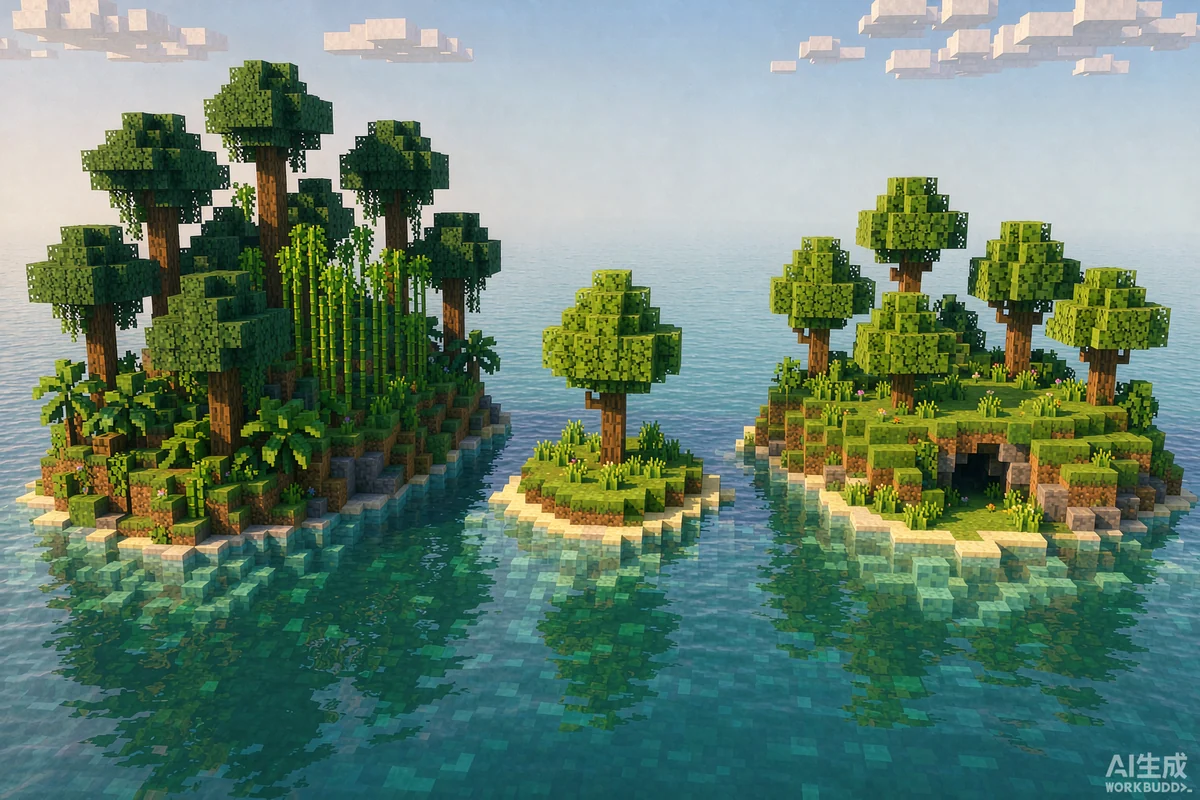
2589021139 is the jungle one: Java and Bedrock 1.18 or later drop you on a large jungle island with cocoa beans and bamboo, a shipwreck and ocean ruins close by. 32 is two characters long and still a real world: a small grass island, a few trees, sheep, and a cave system with a spawner under it, on 1.18 or later in both editions. 354089350 is the rich one: dense trees and animals above ground, and a cave underneath with redstone, diamonds and a lava lake.
| Code | Edition and version | What you land on |
|---|---|---|
2589021139 | Java and Bedrock, 1.18 or later | Large jungle island; cocoa beans and bamboo on it; shipwreck and ocean ruins nearby |
32 | Java and Bedrock, 1.18 or later | Small grass island; a few trees; sheep; cave system with a spawner underneath |
354089350 | Java and Bedrock, 1.18 or later | Island with dense trees and animals; cave below with redstone, diamonds and a lava lake |
- All three are digits only, and that is the point of this page. A code made of digits is used exactly as written, so nothing stands between the number you copy and the world you get. Digits only No conversion
- All three are recorded for both editions, which is rarer than it sounds: the terrain matches across Java and Bedrock for the same code, while structures and features are placed differently. Java + Bedrock
- One of the three is only two characters long —
32is a complete world, not a fragment of one, and short codes are the ones people wrongly "repair" by adding digits. Two characters - No code here carries a score. The game publishes none and this site does not invent one; the labels are the features the record actually names. No scores
Jungle island with cocoa and bamboo — 2589021139 Java + Bedrock 1.18+ Cocoa on the island Shipwreck nearby
Two characters, sheep, and a spawner below — 32 Java + Bedrock 1.18+ Sheep at spawn Spawner underfoot
Dense island, animals above, diamonds below — 354089350 Java + Bedrock 1.18+ Animals Diamonds in the cave
A seed code is one number with two doors
Every seed question comes back to one thing: the game builds from a number, and there are two ways to get that number in. Type digits and the digits are the number. Type anything else — a word, a phrase, a digit string with a letter in it — and the game converts your text into a number first, then builds from that. The conversion is the String.hashCode() method, and it produces a 32-bit integer, so text seeds reach only a subset of the worlds that numeric seeds can reach: 2 to the power of 32 of them.
Two consequences follow, and both of them change how you should read any seed list. The first is that a word has no descriptive power at all. A seed is a value read into an algorithm, not the name of a world, so typing a biome name does not give you a world built around that biome, and it does not put you inside that biome either. The second is that a word seed and a number seed are the same kind of object once the game has read them. If you want to hand your world to somebody else, the number is the thing to hand over.
There is a pair you can test this with in about a minute, because the game's own documentation records both halves of it. Java Edition 1.13 uses the seed 1458140401, which is what you get by typing 18w22a into the seed box. The literal text is a snapshot name; the number is the world it produces. A second pair from the same source: thewildupdate produces -1696067516, the world used for 1.19.
| What goes in the box | Which door it takes | What the game builds from |
|---|---|---|
2589021139 | Digits only, inside the numeric range | The number itself, 2589021139 |
18w22a | Contains letters, so the text route | 1458140401 |
thewildupdate | Contains letters, so the text route | -1696067516 |
| Digits followed by a space, on 22w03a or later | Read as text, then trimmed | The digits you meant |
| Digits followed by a space, before 22w03a | Read as text, nothing trimmed | The hash of the whole string, space included |
| A number too large for the numeric range | Falls out of range, so the text route | Its hash, not your digits |
That table is the whole page in miniature: the same box, six entries, three different outcomes. The rest of this page is about spotting which one you are in.
Three ways a good-looking code opens a different world
None of these three failures looks like a failure. In each case the game accepts what you typed, creates a world, and says nothing. That silence is why people conclude the seed list is wrong when the list was fine and the entry was not.
One character that is not a digit
A single stray character moves the whole entry from the numeric door to the text door. A trailing space from a copy and paste, a comma as a thousands separator, a full stop at the end of a sentence — each of these turns a number into a string, and a string gets hashed. The trimming change in snapshot 22w03a removed the space version of this on current builds, but builds older than that kept it, and no version ever trimmed a comma or a full stop.
The check: after the world loads, run /seed. In Java Edition that command works in singleplayer worlds even with cheats switched off, and it prints the number the game is actually using. Compare it against what you typed. Same number, right world; different number, you took the other door. One minute
One capital letter
Hashing is case sensitive, so glacier and Glacier are two different entries and two different worlds. The game's documentation leans on exactly this distinction: the Beta 1.3_01 PC Gamer demo world is opened by typing glacier, written all in lowercase, and it is described there as all lowercase precisely because the older famous seed with the same letters has a capital G. Same letters, different case, different world.
The check: the same /seed command. Then write the number down and use that from now on. A word has to be reproduced exactly, character by character, including case; a number only has to be copied. One minute
A number too long to be stored
There is a fixed range for numeric seeds, and an entry that falls outside it is not clamped to the nearest legal value — it is treated as text and hashed. So a code that is one digit too long does not open a slightly different world. It opens a world derived from a hash of your digits, which has no relationship to the number you were trying to enter. This is the failure that produces the strangest reports, because the code is genuine, the list is genuine, and the world still does not match.
The check: the number /seed prints back will be short and unrelated to the digits you typed. If it looks nothing like your code, the entry never became a number. One minute
And the fourth, on old builds only
Until snapshot 22w03a, entering 0 created a random world, as if you had entered nothing. That snapshot made zero a normal seed. If a guide from before 2022 tells you a seed of zero is impossible, it is describing that old behaviour rather than the current one.
| What you see | Which failure it is | What fixes it |
|---|---|---|
| The world loads but the terrain is nothing like the description | A stray character, so the entry was hashed | Clear the box, paste again, then read /seed |
| A word seed gives a different world to a friend who typed the same word | Case or spacing differs between the two entries | Share the number from /seed, not the word |
/seed prints a number with no resemblance to your code | Your number fell outside the numeric range | Use a code that fits, or accept the hash and share it as-is |
| You typed 0 and got a random world | Build older than 22w03a | Update, or create the world with a string that hashes to zero |
More than one code can open the same world
Because text seeds are converted into a 32-bit integer, and 32 bits hold a fixed number of values, different strings can land on the same integer. When they do, the game builds one world and answers to both codes. Text seeds are therefore not unique names. They are inputs to a function, and a function can repeat an output.
The clearest example is in the game's own documentation, and it is about the one seed value that used to be impossible to enter directly. Before 22w03a you could not create a world with seed 0 by typing 0. You could still create it, by typing a string that hashes to 0: creashaks organzine, pollinating sandboxes, or zsjpxah, which the documentation notes is the shortest of the three. Three different entries, one world, and a fourth way to reach it once the snapshot made 0 legal.
The practical rule that comes out of this is short. Convert once, then share the number. If a list hands you a phrase, open one world with it, run /seed, and keep the digits. From then on your code is portable: it survives a keyboard layout, a copy and paste, a friend's autocorrect, and a page that renders the phrase with a different apostrophe. The Bedrock checklist covers the same verification from the console side, where the seed is read back in the world settings rather than from a command.
What to type, and what proves you got the right world
2589021139 — the jungle island with wood to spare
This is a large jungle island with cocoa beans and bamboo on it, and a shipwreck and ocean ruins close by. Nothing needs to be converted: the code is digits, and both editions are recorded for 1.18 or later. Cocoa Bamboo Shipwreck nearby
What proves it: cocoa pods on the jungle trunks. Cocoa grows on jungle wood and nowhere else, so a jungle that has none is either a different seed or a different version. Bamboo tells you the same thing faster, because it is visible from a distance.
32 — two characters, and a spawner under your feet
A small grass island with a few trees and sheep, and a cave system with a spawner underneath. The code is two characters long, which is exactly why it is worth putting on this page: a short code looks like a typo, so people "repair" it by adding digits, and the world they get is a different one. Sheep Spawner below Barely any wood
What proves it: sheep within sight at spawn, and a cave mouth you can walk into without digging. If you land on a forested mainland with no water behind you, check the box before you check the code.
354089350 — dense above, diamonds below
Dense trees and animals above ground, and a cave system underneath with redstone, diamonds and a lava lake. The record calls it resource-rich, and the reason is the split: the surface gives you wood and food, the cave gives you the materials a normal island start has to trade for. Animals Diamonds below Lava lake
What proves it: animals on the surface on day one, and a cave entrance that reaches deep rather than stopping at a pocket. Lava is the landmark to look for, since it also gives you a light source and a place to burn nothing.
None of the three needs a coordinate to start, which is the difference between a seed you can use and a seed you have to navigate. If you do want the numbers, the coordinate page collects the rows that carry them, and the jungle island page goes deeper on the terrain family behind the first code.
What counts as an island worth keeping
A seed can be beautiful and still be a bad place to spend a week. These are the five things worth checking before you commit a save to one, in the order they cost you time.
| # | Criterion | Why it decides the run |
|---|---|---|
| 1 | Water on every side, and no walk to the mainland on day one | This is the whole premise. An island you can leave on foot is a coastal spawn with a view. |
| 2 | At least one tree, or a structure that yields planks | Wood is the first gate: without it there is no table, no pickaxe, no boat. |
| 3 | A food source you can renew: animals, crops, or a spawner | Sheep and cows are the fast version. A spawner is experience, not dinner. |
| 4 | One structure close enough to farm | A shipwreck, ocean ruins or an outpost turns a thin island into a supply route. |
| 5 | A shoreline you can see, so the first boat trip has a direction | Being alone is the point; being lost is not. |
Criterion three is the one people skip, and it is the one that ends runs. A spawner is a fine thing to find and a poor thing to eat, so an island whose only living thing is a dungeon has no renewable food until you can fish or farm. The island with sheep is the better first day even though the island with diamonds is the better week.
Our own table also keeps a rejected list, and its reasons are worth separating from these five. Those seeds were turned down for server use — a structure too far away, no pair of ocean monuments, a crossroads that took too long — not because the island was unplayable. If you are choosing for yourself rather than for a server, read the rejection reasons as a warning about distance, not about islands.
The first day on the two-character island
32 is the tightest of the three, so it makes the best example of a day plan that does not depend on luck.
| Step | What you do | Why in this order |
|---|---|---|
| 1 | Walk the shoreline once and count the trees before you cut any | The count decides everything else. A few trees is a budget, and a budget you have not counted gets spent twice. |
| 2 | Kill two sheep before you touch a tree | Three wool is a bed, and a bed is the difference between a night you skip and a night you survive. |
| 3 | Cut one tree, craft a table and a wooden pickaxe, then stop cutting | The second tree is for the boat and the fishing rod. The first one is for the tools that let you get stone. |
| 4 | Find the cave mouth and take stone, not ore | Stone tools and a furnace come before any digging for materials. The spawner can wait until you have a sword. |
| 5 | Mark the spawn point, then sleep | An island start is a navigation problem on day two. Day one is only about not losing the first night. |
The spawner underneath is the reason this island is worth more than its surface suggests, but it is not a day-one objective. A dungeon without armour is a way to lose a save you have just started, and the island is small enough that the spawner will still be there tomorrow.
If you are opening the world with other people, the host matters more than the seed: Shockbyte is a low-cost Minecraft host that is set up in minutes, and code LAUNCH takes 25 percent off the first month. If you sign up through that link I may receive a commission at no extra cost to you, and it does not change what you pay.
For the stage after this one, the after day 10 plan picks up where a stripped island forces a decision: a Nether trip or a boat, and which one comes first.
Frequently asked questions
What is a Minecraft seed code?
A seed code is the single number the game reads before it builds anything, so the same code always rebuilds the same terrain on the same edition and version. It is not a name or a label. When you type digits, that number is used as written; when you type anything else, the game converts your text into a number first and builds from that instead.
Can you use a word as a Minecraft seed?
Yes, in Java Edition a word or phrase works, but the game converts it into a 32-bit integer with the String.hashCode() method before generating anything. That limits text seeds to a subset of the worlds, 2 to the power of 32 of them, and it means a word has no descriptive power: typing a biome name does not give you a world built around that biome.
Why did a seed with a space give me a different world?
Because a space is not a digit, so the whole entry takes the text route instead of the numeric one. Up to snapshot 22w03a nothing trimmed it either, and the hash of a digit string with a trailing space is a different number from the number itself. The fix shipped in that snapshot: spaces before and after a provided seed are trimmed now.
Can two different seed codes open the same world?
Yes. Text seeds are converted to a 32-bit integer, and different strings can land on the same integer, which means the same world under two different codes. Seed 0 is the clearest example in the game's own documentation: creashaks organzine, pollinating sandboxes and zsjpxah are three different strings that all produce it.
Is seed 0 random in Minecraft?
It was on older builds, not on current ones. Until snapshot 22w03a, entering 0 created a world with a random seed as though you had entered nothing at all. That snapshot made 0 usable as a normal seed, and the same release trimmed spaces around a typed seed.
Which of these three island codes should I open first?
2589021139, because wood is the first gate on an island and a jungle island carries more of it than the other two, with a shipwreck and ocean ruins nearby for chests. Cocoa is not food by itself — cookies also need wheat and milk — so treat it as a landmark, not a meal. The other two are better once you already have a base plan.