The short answer
Of the 10 Bedrock codes in our record, 8 tell you what is under the island and 2 tell you where a meal comes from. Five name wood. One names iron ore. None names coal, and none names a crop you can eat. If you want one line: load 32 and 354089350, because they are the only two Bedrock codes that record both wood and an animal, and everything below is about what to do when yours is one of the other eight.
- The one to load first:
32— a small grass island with a few trees, sheep, and a cave system with a spawner underneath. Java 1.18+ and Bedrock 1.18+. Sheep on the surface Few trees Spawner below No coordinate - The richer of the two:
354089350— a resource-rich island with dense trees and animals, and a cave holding redstone, diamonds and a lava lake. Java 1.18+ and Bedrock 1.18+. Animals unnamed Dense trees Diamonds below No coordinate - The heaviest documented row, and it has no trees:
2016000— Bedrock 1.20.5, spawn at 0, 62, 0 in open ocean, a shipwreck at 0, 58, 120, a mushroom island at -300, 64, 0, an ocean monument at 0, 40, -400. Four coordinates Ocean spawn No trees recorded No animal recorded - The one to leave alone for a first run:
6390326396262027557— a mountain island with an ancient city and a warden under it. Ancient city Warden below No wood No food No coordinate
This page is not a list to pick from. It is a count of what the ten Bedrock records actually answer about the first ten days, because the field those records were written in is a coordinate field, and a coordinate is not a dinner.
Why the record is rich on structures and poor on food
Every record we publish was written to answer one question: what is in this world. So the field is called Key Coordinates, and what goes into it is the stuff a player would travel to — a temple, a monument, a shipwreck, an exposed diamond, an ancient city. That is why the Bedrock rows in our table read like inventories of treasure and almost never read like inventories of a household.
The imbalance is not a small one. Eight of the ten Bedrock codes mention something underground. Two mention an animal. That is a ratio of four to one, and it runs in the opposite direction to the thing that actually stops people: on a small island, nobody has ever quit on day three because there was no ancient city. They quit because the sheep were not there and the wheat never got planted.
Two of our other pages already measure the structure side of this set. The three-part start page counts tree against ruined portal against shipwreck, and the six-check page counts what has to be true before you load a code at all. Neither of them counts food, and that is the gap this page fills. Nothing further down is a re-run of those counts; where they overlap, the number is the same number, and where this page adds something, it is the animal, crop, fuel and iron column that nobody had tallied.
The ten Bedrock codes, audited on four survival fields
Four fields decide the first ten days: wood for tools, fuel for a furnace, an animal or a crop for food, and iron for a bucket, a boat repair and eventually a portal. The table counts which of the ten codes answers each one. A blank cell means the record is silent, which is not the same as no.
| Seed code | Bedrock version as recorded | Wood on day 1 | Food by day 3–5 | Fuel named | Iron named | Position on record |
|---|---|---|---|---|---|---|
2016000 |
1.20.5 | Silent — spawn is ocean | Silent | No | No | 0, 62, 0 and three structures |
-706198004 |
Bedrock, no number | One tree, plus planks in a shipwreck | Silent | No | No | None |
-665393669 |
Bedrock, no number | More trees | Silent | No | Iron ore below | None |
-1276503895 |
Regional edition plus Bedrock | Few trees | Sugar cane only, not edible | No | No | None |
39720048960 |
1.18–1.21.50 | Implied by dark forest and jungle | Silent | No | No | /tp -576 ~ 80 |
2589021139 |
1.18+ | Implied by jungle island | Cocoa beans and bamboo, not edible raw | No | No | None |
32 |
1.18+ | Few trees | Sheep | No | No | None |
354089350 |
1.18+ | Dense trees | Animals, unnamed | No | No | None |
-1103547699 |
1.18+ | Silent despite extra-large size | Silent | No | No, gold named instead | None |
6390326396262027557 |
1.18+ | Silent — rich is a word | Silent | No | No | None |
The counts, in one line each: wood named on 5 of the 10, implied by a biome on 2 more, silent on 3. An animal named on 2. A crop you can eat named on 0. Fuel named on 0. Iron named on 1. A position given on 2, and only one of those two can be typed straight into a teleport command.
Read the table down the food column and the page's argument makes itself. Eight rows have something to say about what is under the ground. Two have something to say about what is standing on it.
The two rows that name an animal, and what they actually promise
Both of these are Java and Bedrock rows marked 1.18+, which makes them the easiest two codes in the set to load on a modern Bedrock world. Both also name trees, which means both pass the first field. Neither gives a coordinate, so both are descriptions of a layout rather than a destination you can teleport to.
32 — sheep where you spawn
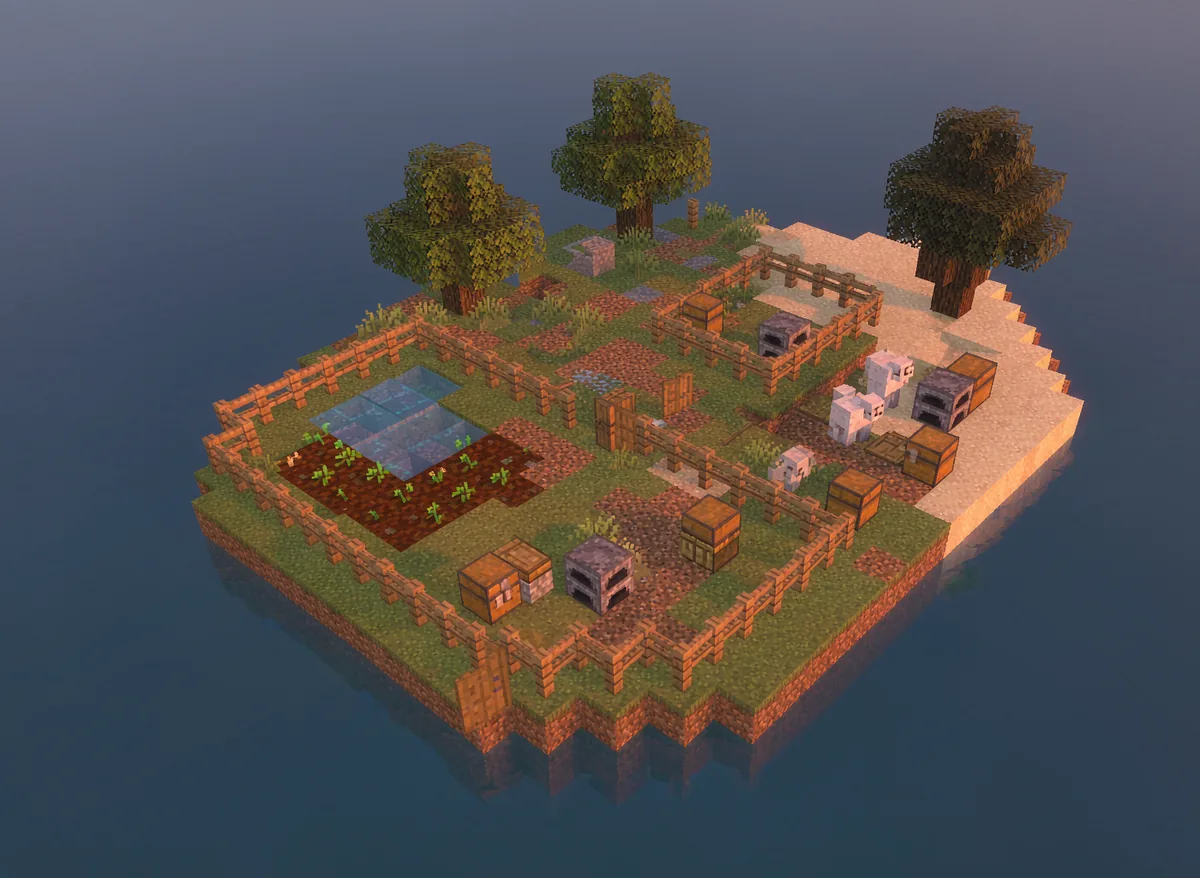
The record reads: a small grass island, a few trees plus sheep, and a cave system with a spawner underneath. The word that matters is sheep, and the word that matters just as much is small, because it tells you the animal is not somewhere you have to go looking. A spawner below is a day-five asset at best and a day-two hazard at worst, and it is the only spawner any of the ten rows names.
354089350 — animals, plural, unnamed
This row is the richest description in the set: a resource-rich island with dense trees and animals, and a cave underneath holding redstone, diamonds and a lava lake. It names animals and then stops, without saying which ones or how many, and that is the same discipline as every other count on this page — animals is not a number. What it does give you is the best wood supply of the two, dense rather than few, and the only diamonds in a Bedrock row that are described as being together with a lava lake.
The three Bedrock codes that say nothing about wood
Five rows name wood outright: -706198004 with one tree and planks in a shipwreck, -665393669 with more trees, -1276503895 with few trees, 32 with few trees, 354089350 with dense trees. Two more imply it through a biome name: dark forest and jungle on 39720048960, a jungle island on 2589021139. That leaves three rows with nothing at all to say about the one resource that gates every other one.
2016000 on Bedrock is the strangest case, because it is the best-documented row we hold and it still fails the first field. It carries four coordinates — a spawn at 0, 62, 0, a shipwreck at 0, 58, 120, a mushroom island at -300, 64, 0 and an ocean monument at 0, 40, -400 — and the spawn is described as open ocean. From those recorded numbers the mushroom island sits exactly 300 blocks from the spawn point, so a food source may well be a 300-block swim away. That figure is derived from the two coordinates, not stated by the record. What the record does not do is name a single tree.
-1103547699 is described as an extra-large island with a mineshaft, gold, a shipwreck, ocean ruins and a lava pool. Size words like extra-large are the subject of a page of their own here, and that page's finding applies directly: a size word is not an inventory. A big island with no tree is a longer walk to the same problem.
6390326396262027557 is the sharpest failure in the set. A mountain island, rich initial resources, an ancient city and a warden underneath. Rich is a word rather than an inventory, and the row that uses it names no tree, no animal, no crop, no fuel and no coordinate. It is the only code here where the danger is better documented than the dinner, and for a first ten days on Bedrock that is the wrong way round.
Sugar cane is not dinner, and the kelp was never in the record
Three of the ten codes name a plant, and it is worth being exact about all three, because this is where our own earlier wording was loose.
-1276503895names sugar cane. Sugar cane makes sugar and paper. It cannot be eaten.2589021139names cocoa beans and bamboo. Cocoa beans go into cookies, and a cookie needs wheat and milk as well; bamboo feeds pandas and crafts into sticks and blocks, not into meals.39720048960names bamboo, as one of six biomes on a multi-biome island. Same answer.
So the plant column produces zero edible crops out of ten codes. That was a correction to a sentence we published on the three-part start page, where the wording ran that sugar cane and kelp along the shore are the food bridge to a second tree. Kelp is edible and sugar cane is not, so the sentence was half right and it credited the wrong plant. The row for -706198004 names a small island with one tree, a ruined portal, a cave and a shipwreck; the row for -1276503895 names sugar cane. Neither row names kelp. That sentence has since been corrected on the three-part start page and on every other page that repeated it, so all five pages now say the same thing. The correction changes the count on this page to the stricter form: no Bedrock record we hold names a crop you can eat without processing it first.
What best bedrock seeds for survival have to answer before day ten
Search that phrase and you get pages that rank codes by what is in them — a monument, a mansion, a quad witch hut. The ranking is fair for what those pages are measuring, and it is the wrong axis for a survival run that starts on a beach with no tools. For bedrock survival seeds the four fields that bite, in the order they bite, are wood, fuel, food and iron, and the order is not negotiable: without wood you cannot cut stone, without fuel you cannot smelt the iron you find, and without food you cannot stay out long enough to find either.
Our ten rows answer those four fields at 5, 0, 2 and 1. That profile is the most useful thing on this page, because it tells you what to do in the first hour regardless of which code you pick. Do not audit the island for structures. Audit it for a tree, a flame and something that moves, in that order, and treat every structure you pass as a bonus that was never going to feed you.
Day one to day ten, in five stages
This is the envelope we run on any Bedrock island before we commit to a base, and each stage is paired with the number of the ten codes that can verify it from the record alone.
- Day 1, before dusk: wood. Punch a tree, make a crafting table, make a wooden pickaxe, and keep at least four planks spare for a door. Verifiable on 5 of 10 codes outright and 2 more through a biome name. On the other three, day one is a survey whether you planned it or not.
- Night 1: a box, not a base. Three walls and a door, or a hole in a hillside. The record cannot help here: 0 of 10 codes say anything about whether the island is big enough to dig into, and a one-tree island is usually a sand island, which does not hold a tunnel.
- Day 2 to 3: stone and a flame. Cobblestone tools, a furnace, and fuel. 8 of 10 codes name something underground, which is why this stage feels safe, and 0 of 10 name coal or charcoal, which is why it is not. The underground is described by what is valuable in this record, not by what burns.
- Day 3 to 5: the food wall. This is the stage that decides the run. 2 of 10 codes name an animal and 0 of 10 name an edible crop. If you are on any of the other eight, your food plan is fishing, a boat to the nearest mainland, or a wheat field you plant on day three and eat from on day six.
- Day 6 to 10: iron and a bed. Iron is named on 1 of 10 codes,
-665393669, as iron ore below with two overlapping chests. A bed needs three wool, wool needs sheep, and sheep are named on 2 of 10. On the other eight, night ten looks like night one until you find animals on the mainland.
Running one of these with other people on Bedrock
Two players on the same Bedrock island change the food column from a count into a queue. The two rows that name animals name them without numbers, and one pen of unnamed animals is not a supply for two players who are both eating. If you are setting up a shared world, 354089350 is the better starting point of the two, because dense trees means the wood budget survives two people building at once, and 32 is the better solo start, because the sheep are at spawn and a small island does not need surveying twice.
One platform note that has nothing to do with seeds and everything to do with these coordinates. Bedrock has no debug screen, so the coordinate readout is a world setting rather than something you press a key for. Turn it on before you judge any row in the table, because eight of the ten give you nothing to navigate by and the two that do are worth nothing if you cannot read your own position. The version-tag page covers the other half of the same problem: which of these rows carries a version number you can trust at all. And if you want the edition comparison rather than the Bedrock-only view, the same code on both editions is a separate question with its own page.
One practical note on hosting. A Bedrock world that two people depend on is better tested on the exact version you will host than on whatever you happen to have installed. Shockbyte is a low-cost host that sets up in minutes. Use code LAUNCH for 25% off your first month. If you sign up through that link, I may receive a commission at no extra cost to you. It does not change what you pay.
Where the rest of the Bedrock data lives
Three neighbouring pages cover the parts of this set that are not about food. The Bedrock island seeds page has the in-game notes for the two codes that were actually loaded and played, -665393669 and -706198004. The six-check page is what to run before you paste a code into a world at all. The full coordinate table is where the three-axis rows and the two-axis rows are separated, which is the filter to run before you spend a morning swimming to a point that turns out to be sea floor.
For the larger question of what happens after the tenth day, when food stops being the wall and obsidian starts being the wall, the after day ten plan picks up exactly where stage five of the envelope above ends.
Frequently asked questions
What is the best Minecraft seed for survival on Bedrock?
Load 32 first. It is one of only two Bedrock codes in our record that name both wood and an animal - a small grass island with a few trees, sheep, and a cave system with a spawner under it - and it is the cheaper of the two, because the sheep are on the surface where you spawn rather than somewhere in a cave. Load 354089350 second if you want the richer island: dense trees and animals with redstone, diamonds and a lava lake below. Neither row gives a coordinate, so both are layouts rather than destinations.
How many Bedrock seeds are on this site?
Eleven rows, which is ten distinct codes, because 2016000 is recorded twice - once as a Java and Bedrock row and once as a Bedrock-only row with a different terrain description. Every count on this page is over the ten distinct codes, not the eleven rows, so a single code cannot be counted twice.
Do any of these Bedrock seeds have a village?
None of the ten. Not one Bedrock row in our record names a village, a village well, or a villager. The structures they name are shipwrecks, ocean ruins, ocean monuments, mineshafts, a ruined portal, a spawner, an ancient city and a mushroom island. If a village is what you need on day one, this is the wrong set of codes, and our village pages explain why island spawns and villages do not overlap in this data set at all.
Can you use the coordinates on these Bedrock seeds in game?
For one of the ten, yes. 2016000 records a Bedrock spawn at 0, 62, 0, which you can type straight into a teleport command. One more, 39720048960, records a location as /tp -576 ~ 80, and a tilde means your own current height rather than a landing point, so it moves you to the right column and leaves the height to you. The other eight give no position at all. On Bedrock there is no debug screen to read coordinates from either - the coordinate display is a world setting, so turn it on before you judge any of these islands.
Which of these Bedrock seeds is worst for the first ten days?
6390326396262027557. It is a mountain island described as having rich initial resources, with an ancient city and a warden underneath it, and that is the whole record: no tree, no animal, no crop and no coordinate. It is the only row in the set where the thing under the island can kill you before the thing on the island can feed you, and rich is a word rather than an inventory.
Do any of these Bedrock seeds give you coal?
Not one of the ten names coal, charcoal, or any fuel at all. Eight of the ten describe what is underground - caves, a mineshaft, an ancient city, exposed diamond, redstone, gold, iron ore, a lava lake - and the underground is described by what is valuable rather than what burns. That matters on day two, because a furnace you cannot light is a rock with a lid.
Is sugar cane a food source on a Bedrock island?
No, and this page corrects our own earlier wording on that point. Sugar cane makes sugar and paper; it cannot be eaten. The plant on those shores that you can actually eat is kelp, and kelp is not named in the record for -1276503895 - the row says a few trees and sugar cane and stops there. So the honest count is that none of the ten Bedrock codes names a crop you can eat without processing it first.