Minecraft Java Seeds: The 6 Checks to Run Before You Load a Code
The short answer
Fifteen of the twenty seeds in our records carry Java — and twelve of those fifteen are versioned only as 1.18+, which is a floor with no ceiling and tells you nothing about the release the code was actually loaded on. Nine of the fifteen carry structure coordinates you can type into the game, five carry no numbers at all, and four were rejected outright with the line each one failed on. That is the honest state of Java seed records, ours included.
The codes worth loading today, after those six checks:
Want the fastest route off the island:2016000 on Java 1.20–1.21 — village at -24, 64, 12 with a stronghold eleven blocks under the well, and one tester finished the run in 27 minutes.
Want the deepest coordinate set we have:4188583766222650532 — nine structure entries including a mushroom island at -300, -500 and a second Nether fortress at -100, 200.
Want four structures inside one radius:-8350249385580253962 — witch hut at -325, 325, ocean monument at -300, 150, warm ocean at 550, 1100.
Want a hard start with two wrecks to work:-1463564255 — barren island, shipwrecks at 120, 54, -202 and 393, 56, 25. Recorded on 1.15, before the overworld overhaul, and not re-checked since.
Want a modern island and can live without numbers:6390326396262027557 — mountain island, ancient city with a warden below, description only.
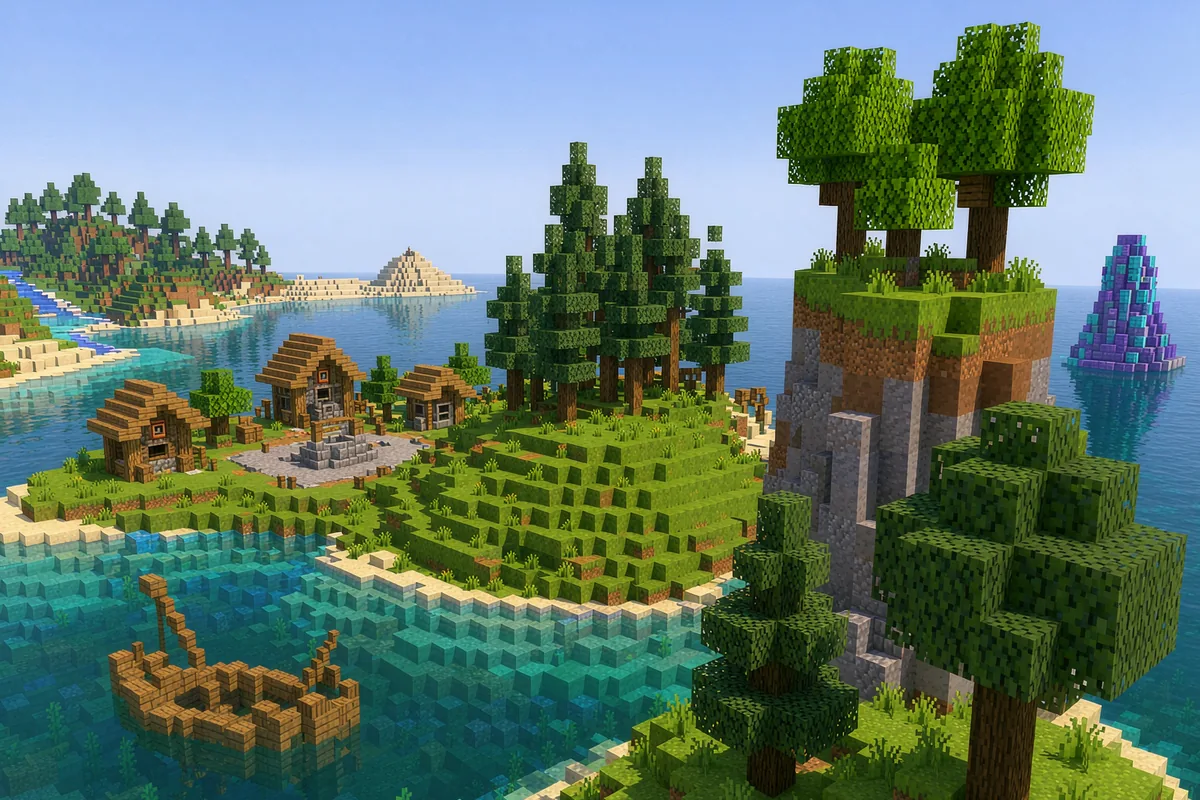
The one Java code in our records with a bounded version range and a completed run attached — seed 2016000, Java 1.20–1.21
Check three: a row you can point at. Four landmarks are visible from this spot — village, wreck, monument, ridge temple — and nine of the fifteen Java rows give coordinates for landmarks like these; the other six give none.
Why a Java seed still needs a checklist
Java is the default assumption of almost every seed list on the web. When a page says “Minecraft seeds” with no edition attached, it usually means Java, because that is where the scanners and the mapping libraries live. So if you are a Java player, the edition question that dominates our Bedrock checklist is already answered for you.
That removes one problem and exposes a different one. Once the edition is settled, the two things that actually decide whether a Java seed record is usable are the version field and whether anyone ever held the seed to a standard. In our own table, both of those are weak, and they are weak in a way that is easy to miss because the rows look complete.
Take the version field. Twelve of our fifteen Java rows say 1.18+. That is not a version. It is a statement that the seed was loaded on some release at or after 1.18, and it stays true no matter how far the game moves, which is exactly why it carries so little information. Only three rows in the whole record carry a version range with an end on it.
The version problem gets worse, not better, on codes from the 2011–2019 era: our audit of nineteen old codes found only seven that name an edition at all.
And take the standard. Four of our fifteen Java rows were turned down after mapping, each with a named reason. That sounds like bad news for those four seeds. It is actually the strongest evidence on this page, because it means those four were measured — and it means the other eleven were published without ever being measured at all. The checklist below is ordered so that you run the cheap checks first and reach that distinction before you spend an hour generating a world.
The fifteen Java rows in our record, and what each one is missing
These are every row in our seed table with a Java version on it. The tag column is the tester’s own conclusion, not a score — we do not rank seeds, and nothing on this page is a rating.
Teleport command /tp -576 ~ 80 — multi-biome island: ice peaks, dark forest, jungle, bamboo, stone shore, lush cave
Teleport command with tildeBounded version range
2589021139
Java + Bedrock
1.18+
Large jungle island, cocoa beans and bamboo, nearby shipwreck and ocean ruins
Description onlyNo coordinates
32
Java + Bedrock
1.18+
Small grass island, a few trees and sheep, cave system with a spawner
Description onlyTwo-digit code
354089350
Java + Bedrock
1.18+
Resource-rich island, dense trees and animals, cave with redstone, diamonds and a lava lake
Description onlyNo coordinates
-1103547699
Java + Bedrock
1.18+
Extra-large island, mineshaft, gold, shipwreck, ocean ruins, lava pool
Description onlyNo coordinates
6390326396262027557
Java + Bedrock
1.18+
Mountain island, rich starting resources, ancient city with a warden below
Description onlyAncient city
Read the third column on its own first. Twelve rows say 1.18+. Three rows carry a range with an end on it, and those three are the only Java rows in the record where you can tell which release the tester was standing on.
The six checks, in the order we run them
None of them takes more than a minute. They are ordered by how cheap they are to run, not by how often they fail — although check two fails on twelve of our fifteen rows, which is more than all the others put together.
Check
The question to ask of the record
What it turns up in our fifteen rows
1. Edition label
Does it name Java alone, or Java alongside Bedrock?
Eight rows are Java only. Seven are Java + Bedrock, which means the code was claimed for both editions rather than checked on both — only 2016000 is split into two rows, one per edition.
2. Version range
Is there a version range with an end on it, or just a floor?
Twelve rows say 1.18+. Three carry a bounded range: 2016000 at 1.20–1.21, -1463564255 at 1.15, 39720048960 at 1.18–1.21.2.
3. Coordinates
Can you type it into the game, or is it a sentence?
Nine rows carry structure coordinates, sixty-two entries between them. One carries a teleport command with a tilde for the height. Five carry no numbers at all.
4. Ever measured?
Was it held to a standard and passed, held and failed, or just published?
Four were held and failed, each with a named reason. The other eleven were published without ever being run through the standard.
5. Pre-overhaul
Was it recorded before the overworld generation overhaul?
One row, -1463564255 at 1.15, and we have not re-checked it on 1.18 or later. One further code in the wider table carries no edition at all and belongs to the 2011–2019 records instead.
6. Code length
Are you assuming a long code means Java?
Do not. Our Java rows run from 32 — two digits — to nineteen-digit codes. Length tells you nothing about edition.
Checks two and four are the ones that matter, and they point in opposite directions. Check two tells you the record is vaguer than it looks. Check four tells you which rows were actually tested — and that is a much shorter list than fifteen.
Check two: 1.18+ is a floor, not a version
Twelve of the fifteen Java rows in our table are versioned as 1.18+. Written out, that means someone loaded the code on a release at or after 1.18 and wrote the world down. It does not say which release, and it cannot go stale, which is precisely the problem: a row that said 1.18+ years ago and a row that says 1.18+ today look identical in a table and may describe worlds generated several releases apart.
Three rows do better. 2016000 is recorded at 1.20–1.21, which is narrow enough to reproduce. 39720048960 is recorded at 1.18–1.21.2 on the Java side, and notably its Bedrock range runs to 1.21.50 — the two editions are not on the same release schedule even for the same code. And -1463564255 is recorded at 1.15, which is a real version and also a warning, covered under check five.
The practical rule: treat 1.18+ as probably still loadable and not as verified on your release. Generate the world, then check the three things that actually break — whether the island is still an island, whether the trees are still there, and whether the nearest structure is still where the record says. The full argument for why the version number is the whole ballgame is on the Java vs Bedrock comparison page.
Check three: nine rows with numbers, five with none
Coordinates are the part of a seed record you can act on, so it is worth being precise about how many there are. Nine of the fifteen Java rows carry them, sixty-two structure entries in total. One more carries a teleport command. Five carry nothing but prose.
Seed code
Structure entries recorded
What the depth is made of
4188583766222650532
9
Two Nether fortresses, two monuments, mushroom island, witch hut, pillager outpost, bastion, warm ocean
The same shape as the row above, and still rejected, on distance
3387664876512721018
7
Everything except a spawn point
-4217104969789286797
7
Six structures and one recorded absence, because the dual monument reads none
-1056083236240939372
7
Spawn, five structures, dual monument
6900926224957998486
7
Spawn, five structures, dual monument
2016000
6
Spawn, village, stronghold, diamonds, desert temple, jungle temple
-1463564255
2
Two shipwrecks and a mineshaft, nothing else
39720048960
1
A single teleport command with a tilde standing in for the height
Two things in that table are worth more than the counts. The first is the row with none in it. -4217104969789286797 records the absence of a dual ocean monument as a fact, which is rarer than recording a presence — a list that only ever writes down what it found cannot tell you what it looked for and did not find. That single word is why the seed was rejected, and it is the most useful field on the row.
The second is what is missing from it. The five rows with no coordinates at all — 2589021139, 32, 354089350, -1103547699 and 6390326396262027557 — are all dual-edition rows, and they are the most recent additions to the record. The newest seeds we have are the least measurable ones we have. If you want numbers, the older rows are where they are.
The format caveats matter too: some rows are three-axis, some are two-axis, and 39720048960 uses a tilde. The complete coordinate table marks which rows are teleport-ready and explains all three formats.
Coordinates are not the only field that goes missing on those rows. The biome field audit counts a different column across the same twenty rows: nine give both a coordinate and a biome, two give a coordinate and no biome, five give a biome and no coordinate, and four give neither — and three of those four are Java rows.
Check four: four of fifteen were rejected, and that is the good news
Four Java seeds in our records failed the server-grade standard after mapping, and each one carries the line it failed on:
Seed code
Failed on
What the mapping showed
-9147459640944998301
Over distance
Spawn at 0, -550 with the warm ocean at -850, -1250 and the quad monument at 450, 950 — eight structures, all too spread out
-4217104969789286797
No dual ocean monument
Dual monument reads none. Six structures recorded, and the one that mattered was not among them
-1056083236240939372
Crossroads too far
Spawn at -625, 150, structures clustered around -800, dual monument at -150, 1500
6900926224957998486
Bastion too far
Bastion at 500, -50 and dual monument at -350, -2100 from a spawn at 200, 350
Those four rows are the most valuable Java rows we have, and the reason is uncomfortable: they are the only ones anybody bothered to measure. The server-grade standard — structures inside a 256-block radius, more than one ocean monument, a bastion within reach, warm ocean access — was written and applied on Java, and every seed run through it was a Java seed. The other eleven Java rows were published without ever being held to anything.
So read the rejections as a statement about the record, not about the seeds. A rejected seed has been walked; a published-only seed has merely been described. The four checks in the order they get applied, and the three Java seeds that cleared them, are on the server-grade island seeds page, and all four failures are on the rejected island seeds page with the full mapping for each.
Check five: one row was recorded before the terrain changed
-1463564255 is the only Java row in our table below 1.18, recorded at 1.15. That matters more than a normal version gap, because 1.18 is where the overworld generation overhaul landed — new terrain shapes, new cave systems, new height limits. A world mapped on 1.15 and a world generated on a later release are not the same world even when the seed is identical.
The record is honest about the terrain, and short: a barren island, a small mineshaft, two shipwrecks at 120, 54, -202 and 393, 56, 25. The tester’s own note on it is the blunt one in the whole table — this is hell difficulty, a true wasteland. That assessment is from a real play session on 1.15.
What we will not claim: we have not re-loaded this code on 1.18 or anything later, so we cannot tell you whether the island is still there, whether the two wrecks still spawn, or whether it now generates as something else entirely. Load it expecting to re-map it yourself. The same refusal applies to the older codes on the 2011–2019 seeds page, none of which have been re-checked on a modern release.
Check six: the length of the code tells you nothing
There is a piece of folk wisdom in seed threads that goes roughly like this: Java codes are the long ones, Bedrock codes are the short ones. It is wrong, and our own table disproves it in both directions.
Our shortest Java row is 32 — two digits, on Java 1.18+, a small grass island with a few trees, some sheep and a cave with a spawner in it. Our longest are -8350249385580253962 and 6390326396262027557 at nineteen digits. In between sit 2016000, 354089350, 2589021139 and 39720048960. Any rule based on digit count would misclassify roughly half the table.
There is also a sign trap. Six of the fifteen Java codes are negative, and dropping or adding a minus sign does not give you a similar world — it gives you a different one. Copy the code character for character, including the sign. The Bedrock checklist carries the same warning from the other side of the table.
Five Java seeds, mapped out
Speedrun God Seed — 2016000
Java 1.20–1.21Speedrun-capableBounded version rangeVillage at spawn
Spawn0, 63, 0 — plains
Village-24, 64, 12
Stronghold-21, 42, 18 — eleven blocks under the village well
Diamonds-32, 11, 25
Desert temple-320, 64, 180
Jungle temple450, 63, -270
This is the best-documented Java seed we have, and the only one with a completed timed run attached to it — one tester finished it in 27 minutes. It is also the only row in the entire table that is deliberately split in two, because the same number on Bedrock puts you in open ocean with no village and no trees.
The reason it is fast is the stronghold. Eleven blocks under the village well is an unusually direct line to the End, and the village itself solves food and beds before you have built anything. If you want a bounded version range, coordinates and a result, this is the row that has all three.
Recorded on Java 1.20–1.21. The Bedrock half of this code is a different world entirely — see the Java vs Bedrock comparison.
Dual Monument and Mushroom Island — 4188583766222650532
Java 1.18+Nine coordinatesDual monumentMushroom islandUnbounded version
Witch hut350, 350
Ocean monument350, -250
Pillager outpost-350, 0
Warm ocean0, -250
Mushroom island-300, -500 — no hostile mobs spawn on the surface
Nether fortress, near0, -150
Nether fortress, quad-100, 200
Bastion150, 0
Dual monument3850, -4150
Nine entries, the deepest row in the record, and the only Java row with two Nether fortresses written down. The mushroom island at -300, -500 is the piece that changes how the seed plays: it is the one biome where hostile mobs do not spawn on the surface, which makes it the safest place to put a second base on any island world.
It is also the clearest example of why check two matters. Nine coordinates of real detail attached to a version field that says 1.18+ and nothing more. Verify the structures before you plan a build around them.
Mushroom island spawns are rare enough that the dedicated page on the biome is worth reading alongside this one — see mushroom biome islands.
Quad Witch Hut Island A — -8350249385580253962
Java 1.18+Quad witch hutEight coordinatesSpawn recorded
Spawn-150, 250
Witch hut-325, 325
Ocean monument-300, 150
Pillager outpost600, 200
Warm ocean550, 1100
Nether fortress-150, 0
Bastion100, -100
Quad monument-3100, -1100
This is the seed to load if you want four structures close enough to farm from one camp. The witch hut at -325, 325 sits within a couple hundred blocks of both the spawn and the ocean monument, which is the arrangement the server-grade standard was written to look for.
The quad monument at -3100, -1100 is the outlier, and it is the useful kind of outlier: more than three thousand blocks in the overworld, which becomes a short trip once a portal pair exists. That exchange rate is what turns a distant structure from a project into an errand.
This row passed the server-grade standard. The seeds that cleared it and the four that did not are on the server-grade page and the rejected page.
Hell Difficulty Island — -1463564255
Java 1.15Two shipwrecksPre-overhaul versionNot re-checked on 1.18+
IslandBarren, with a small mineshaft at one corner
Shipwreck 1120, 54, -202
Shipwreck 2393, 56, 25
Tester noteThis is truly hell difficulty, a true wasteland
Version1.15 — before the overworld generation overhaul
Load this one knowing exactly what it is: a record from 1.15, not a promise about a later release. Two shipwrecks are the entire early-game plan, and wrecks are how island runs get wood, food and a treasure map when the island itself offers nothing.
The mineshaft at the corner is the only other thing on the island. There is no village in the record, no trees worth counting, and no structure set — the row carries two coordinates, not eight.
We have not re-loaded this code on 1.18 or later. If you want a Java seed you can trust on a later release, use 2016000 or -8350249385580253962 above.
This is the row to look at if you want to see what a modern dual-edition record looks like when nobody writes a number down. The description is real and specific — a mountain island with good starting resources and an ancient city underneath — and it is completely unusable if you want to teleport anywhere.
The ancient city is the reason to load it anyway. It is the deepest structure in the game, it carries its own loot and its own risk in the warden, and having one under your spawn island changes the shape of the whole run. Bring a plan for the warden rather than a plan for the loot.
One of five Java rows with no coordinates at all. If numbers are what you need, the older Java-only rows above are where they are.
What to do in the first ten minutes once it loads
The six checks above are what you do before generating a world. This is what you do after, and it is the part every theme page on this site keeps because it is the part that decides whether the seed survives the first night. The order is the one in our testing notes.
Count the trees before you touch anything. One tree means one plank budget and one sapling you cannot afford to lose. Chop most of it, keep one standing. To get rich, first chop trees — that is the rule these notes are built on, and on an island it is the whole opening.
Check the ruined portal chest before you mine. The full argument for that order — chest, then count the frame, then mine — is on the obsidian route page. A ruined portal carries obsidian in its frame, which means you may never have to mine for any. On the brutal Java rows the portal is the difference between a Nether trip on day two and a Nether trip never.
Walk the shoreline, not inland. Both shipwrecks on -1463564255 are in the water, at 120, 54, -202 and 393, 56, 25. On island seeds the structures sit in the ocean more often than on the land.
Settle food on day one or accept that the run is a leaving run. Village rows like 2016000 settle it for you. Barren rows like -1463564255 do not, and on those the recorded advice is to get obsidian and go to the Nether rather than try to make the island self-sufficient.
Write down the coordinate of anything you intend to come back to. Five of our fifteen Java rows are prose precisely because nobody recorded a number while they were playing. Do not add to that count.
If there is no wood, no wreck and no portal in sight, leave. The record’s own line for that case is blunt: you cannot survive at this spawn, you can only brave the ocean and explore. Paddling toward land is not giving up.
Step four is the fork. Food settled means the island is a base; food unsettled means the island is a launch point, and everything after day ten is measured in Nether blocks rather than overworld blocks anyway.
After the portal, and what changes on a shared world
Once a portal pair exists, distance stops being the constraint it was. The clearest number in our records is a quad ocean monument more than three thousand blocks from spawn in the overworld and a short Nether walk by the tester’s own note — and at that exchange rate every description-only Java row on this page becomes an errand rather than a project.
What does not collapse is the version question. On a shared world every player has to be on the same edition and the same game release, because a version difference produces exactly the mismatch you get between Java and Bedrock: same code, different terrain, and a complaint that the seed does not work. With twelve of our fifteen Java rows versioned only as 1.18+, that is not a theoretical risk.
And if you are choosing a Java seed for a server rather than a solo run, know what the record can tell you. Four Java seeds were measured against the server standard and failed; three cleared it; the other eight Java rows were never measured at all. A seed that plays well is a real play result, not a cleared standard.
A good seed is better with people on it. If you want to host one and run these islands together, Java or Bedrock, Shockbyte is a low-cost host that sets up in minutes. Use code LAUNCH for 25% off your first month. If you sign up through that link, I may receive a commission at no extra cost to you. It does not change what you pay.
Frequently asked questions
How do I know whether a Minecraft Java seed was actually tested on Java?
Look for three fields in the record: an edition column that names Java, a version range with an end on it rather than an open-ended floor, and structure coordinates rather than a sentence. Nine of the fifteen Java rows in our own table carry coordinates; three carry a bounded version range; 2016000 is the only one that clearly carries all three.
Does 1.18+ tell me enough about which Java version to load?
No. Twelve of the fifteen Java rows in our records are versioned only as 1.18+, which is a floor with no ceiling, so the record does not tell you whether anyone loaded the code on the release you are running. Only three rows carry a bounded range: 2016000 at 1.20–1.21, -1463564255 at 1.15, and 39720048960 at 1.18–1.21.2.
How many of your Java seeds come with structure coordinates?
Nine of the fifteen, with sixty-two structure entries between them. The deepest is 4188583766222650532 with nine entries, followed by -8350249385580253962 with eight. One more row carries a teleport command with a tilde for the height, and the remaining five carry no numbers at all.
Why were some of your Java seeds rejected?
Four of the fifteen were turned down after mapping, each with the line it failed on: -9147459640944998301 for distance, -4217104969789286797 for having no dual ocean monument, -1056083236240939372 for a crossroads too far out, and 6900926224957998486 for a bastion too far out. All four are Java 1.18 and above.
Can I use a Java seed code on Bedrock?
Not as the same world. The two editions use different world generators, so one code produces two different terrains — 2016000 gives a village and a stronghold on Java and open ocean on Bedrock. The version ranges do not move together either: on 39720048960 the Java range stops at 1.21.2 while the Bedrock range runs to 1.21.50.
Does the length of a seed code tell me which edition it is for?
No. The Java rows in our own table run from a two-digit code, 32, to nineteen-digit codes such as -8350249385580253962 and 6390326396262027557, so a rule based on digit count would misclassify about half of them. The edition field is the only thing that tells you which generator produced the world.
Why does every seed code on this page have a copy button next to it?
Because most of them are far too long to retype. Of the forty-five distinct seed codes published across this site, fourteen run to eighteen or nineteen digits, and sixteen begin with a minus sign that is easy to drop when you type by hand. A copy button is the only thing that makes those codes usable at all — it is not decoration. The short codes are the exception, not the rule.
Which of your seed codes are short enough to type from memory?
Six of the forty-five, meaning seven characters or fewer: 32, 729, 2013, 2016000, lost and Artomix. Everything else on the site is eight characters or longer, and the two longest groups — seven codes at nineteen digits and six more at nineteen digits behind a minus sign — are the ones you should never try to key in manually.
Are the seed codes on your pages all different, or do you repeat them?
They repeat. We publish forty-five distinct codes in total across eighteen pages, and forty-one of those codes appear on more than one page; only four are unique to a single page. We would rather say that plainly than pad a page out with codes nobody has loaded. If you land on a second page and recognise a code, that is the same recorded world, not a new one.