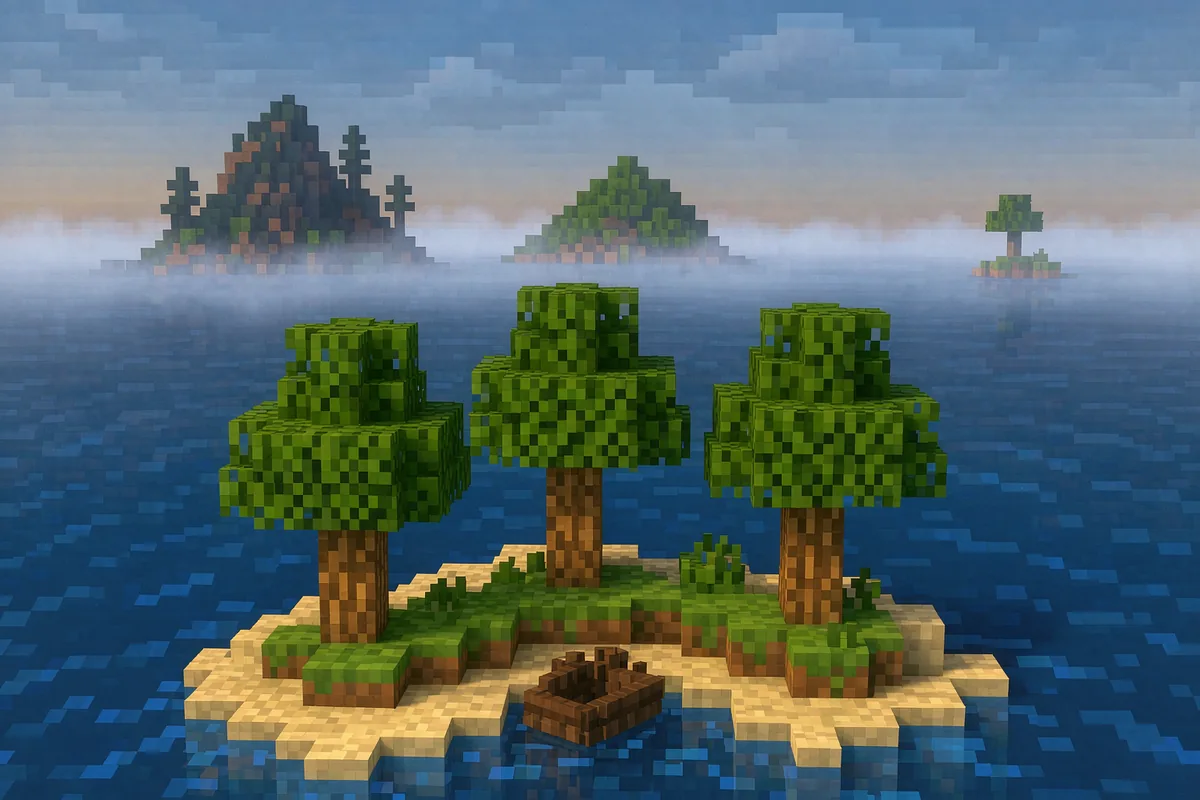
The short answer
This site publishes 49 island seed records — twenty rows in the coordinate table and twenty-nine archive cards from 2011 to 2019. Six of them state a distance as a number, and those six are the only ones you can honestly compare, so they are the only ones we can call best on distance. Three of the twenty rows use a qualitative distance word, and all three use the same word, near or nearby. Two of those three carry no coordinate anywhere on the row, so the word is doing all the work and cannot be checked against anything. Across the 134 seed cards published on this site, 72 of them — 54% — do carry a distance word, but only 20 carry a number with a unit. The gap between those two counts is the whole finding: distance is present on this site in enormous quantity, and almost none of it is in a field you can sort by.
- The only seed recorded on both editions, and the only one with a completed timed run:
2016000 — Java 1.20–1.21, spawn 0, 63, 0, village at -24, 64, 12, about 27 blocks away, stronghold eleven blocks beneath the village well. One tester finished it in 27 minutes. Village at spawn Distance stated as a number Speedrun-capable Not an island spawn
- The same code on Bedrock, as a distance problem:
2016000 — Bedrock 1.20.5, ocean spawn at 0, 62, 0, mushroom island at -300, 64, 0 recorded as 300 blocks west, shipwreck at 0, 58, 120. Every single thing on this row is 120 blocks or further from where you land. Mushroom island 300 blocks west Teleport-ready No land at spawn No trees recorded
- The only row where a distance word sits next to a number:
4188583766222650532 — Java 1.18+, nine coordinates, and the line Nether Fortress (near): 0, -150. One row in twenty has both halves. Two fortresses Mushroom island Server-grade Near plus coordinate
- The seed that had everything and was still rejected for distance:
-9147459640944998301 — Java 1.18+, mushroom island at 150, 750, quad ocean monument, witch hut, pillager outpost. The tester's own words: slightly over one thousand blocks. Rejected: over distance Mushroom island Quad monument
- The two rows where the word has nothing behind it:
-1276503895 and 2589021139 — one says ruined portal (nearby island), the other nearby shipwreck + ocean ruins. Neither row carries a single coordinate. Ruined portal Shipwreck Nearby with no number No coordinate
The five codes worth copying, in order — 2016000; 4188583766222650532; -9147459640944998301; -1276503895; 2589021139
How we counted, before you read any number on this page
Every figure below counts records, not worlds. That distinction decides the whole page, so the rule comes first.
What a record is. Forty-nine of them. Twenty rows in the coordinate table, each one a seed somebody wrote down after loading it, with a seed code, an edition, a version and whatever structures they found. Twenty-nine archive cards from 2011 to 2019, each one a seed code plus the terrain the person who found it described. Forty-nine records, and no invented entries among them.
What counts as a qualitative distance word. Sixteen words and phrases: near, far, close, adjacent, next to, in sight, out of sight, walk, swim, minute, short, reach, distance, away, opposite, side by side. Each is matched as a whole word with its ordinary inflections, so nearby counts under near and walking under walk. Nothing else counts. A coordinate is not a distance word, and a number is not a distance word.
What counts as a number. A figure followed by a unit — blocks, or metres. 300 blocks west is a number. A long way off is not. Coordinates such as -24, 64, 12 are recorded separately as coordinates, because a coordinate only becomes a distance once you have two of them and know which is the origin.
Which column a word sits in. For the twenty rows we read the coordinate column only, which is where every structure and every distance note on those rows lives. For the cards we read the whole card, because a card has no columns. That difference is not a mistake and it is not hidden: it is the reason the two layers produce two different rates, and the section further down says so in both directions.
The six distances written as numbers: the only ones you can rank
Best is a comparison, and a comparison needs a number. Six distances on five seeds qualify. Everything else on this site is either a coordinate with no distance written against it, or a distance word with no number behind it.
| Seed |
What the distance is |
The number as recorded |
Distance word on the same record |
2016000
Java 1.20–1.21 |
Spawn to village |
About 27 blocks — spawn 0, 63, 0 to village -24, 64, 12 |
None. The number stands alone. |
2016000
Java 1.20–1.21 |
Village to stronghold, downward |
Eleven blocks — stronghold at -21, 42, 18, beneath the village well |
None. |
-1463564255
Java 1.15 |
Origin to shipwreck one |
120 on one axis, 202 on the other — wreck at 120, 54, -202 |
None. Measured from the world origin, because no spawn was recorded. |
2016000
Bedrock 1.20.5 |
Spawn to mushroom island |
300 blocks west — island at -300, 64, 0 |
None on the row. The card adds that everything here is 120 blocks or further. |
-1276503895
Bedrock |
Island to the small islands around it |
Within 500 blocks — on the card, not on the row |
Nearby, on the row, which is where the number is missing. |
-9147459640944998301
Java 1.18+ |
Spawn to the structures that disqualified it |
Slightly over one thousand blocks — the tester's own words |
None. The number is the reason for the rejection. |
Read the last two rows together, because they are the same story told twice. Seed -1276503895 says nearby on the row and within 500 blocks on the card: one source has the word, the other has the number, and neither has both. Seed -9147459640944998301 is the reverse case and the more painful one — it holds a mushroom biome and a quad ocean monument, which is exactly the combination a seed list puts in a headline, and it was rejected anyway on a distance someone actually measured.
One caveat that has to sit next to this table: these six numbers do not measure the same thing. Three of them are spawn-to-structure, one is structure-to-structure downward, one is island-to-archipelago, and one is measured from the world origin because the row has no spawn on it at all. They are the only comparable figures we have, and they are still only comparable in the loose sense that all six are distances in blocks.
The three rows that say how far: all three use the same word
Three of the twenty rows contain a qualitative distance word. We checked sixteen words and phrases against all twenty rows. Only one of the sixteen ever appears, and it appears three times, on three different rows, twice as nearby and once as near.
| Row |
Seed |
What the row says |
Coordinate on the row |
| 6 |
-1276503895
Bedrock |
Barren island, few trees and sugar cane, underground diamond exposed to air with a lava pool, ruined portal (nearby island), glacier, ocean monument, shipwreck in an underwater canyon |
None. The word is the entire distance statement. |
| 9 |
4188583766222650532
Java 1.18+ |
Witch hut, ocean monument, pillager outpost, warm ocean, mushroom island, Nether Fortress (near): 0, -150, second fortress, bastion, dual monument |
Nine of them. The only row where the word and the number sit on the same line. |
| 15 |
2589021139
Java and Bedrock 1.18+ |
Large jungle island with cocoa beans and bamboo, nearby shipwreck + ocean ruins |
None. The word is the entire distance statement. |
The middle row is the exception that proves the shape of the problem, and it is worth slowing down on. Nether Fortress (near): 0, -150 is the only place in twenty rows where somebody wrote a distance word and then gave you the number it was about. Everywhere else on this site, the two halves live in different sentences, in different layers, on different pages — which is why a reader has to hold both halves in their head at once to know anything.
The rows either side of it are the normal case and the reason we cannot rank them. Ruined portal (nearby island) tells you the portal is on another island. It does not tell you how far that island is, whether you can swim it, whether you need a boat, or whether you would find it before nightfall. There is no coordinate on the row to measure from, so there is no experiment you can run to make the word more precise. The word is the record, and the record cannot be improved without loading the world again.
For completeness, the other thirteen words in our list return zero on all twenty rows: far, close, adjacent, next to, in sight, out of sight, walk, swim, minute, short, reach, distance, away, opposite and side by side all score nothing at the row level. Eleven of the twenty rows carry a numeric coordinate; nine carry none; and of the three rows with a distance word, two are in the no-coordinate group.
The card layer: 72 of 134 carry a distance word, 20 carry a number
The rows are coordinates. The cards are sentences, and sentences behave differently. Across the 134 seed cards published on this site, 72 — 54% — contain at least one of the sixteen distance words.
| What is on the card |
Cards out of 134 |
Share |
| A qualitative distance word |
72 |
54% |
| A number with a unit |
20 |
15% |
| Both a word and a number |
19 |
14% |
| A word and no number |
53 |
40% |
| A number and no word |
1 |
1% |
| Neither |
61 |
46% |
Those five rows are mutually exclusive: 53 plus 19 plus 1 plus 61 is 134. The single most common state of a card on this site is a distance stated in words with no number anywhere on it, at 53 cards, and the second most common is no distance at all.
Here is the word frequency across all 134 cards, in full, including the zeros.
| Word |
Times across 134 cards |
Note |
| distance |
27 |
The most common, and most of these are field labels rather than descriptions. |
| near |
25 |
Includes nearby. The same word the three rows use. |
| far |
17 |
Eight of the seventeen are the field label How far, not prose about a place. |
| reach |
14 |
Reachable, reach — usually about whether you can get there at all. |
| short |
13 |
A short walk, a short code. Several of these are about the seed code, not a distance. |
| close |
8 |
Close enough to farm from one camp. |
| next to |
8 |
Placement rather than measurement. |
| minute |
8 |
Time, not distance — most of them from the one completed run. |
| walk |
5 |
Includes walking. |
| away |
5 |
Almost always next to a number: twenty-seven blocks away. |
| opposite |
4 |
Direction, and often about two signals disagreeing rather than two places. |
| swim |
1 |
One card, the 300-block open-water crossing. |
| side by side |
1 |
Two dungeons sharing a wall. |
| adjacent |
0 |
Never used. |
| in sight |
0 |
Never used. |
| out of sight |
0 |
Never used. |
Two entries in that table are inflated and we would rather say so than leave them standing. Eight of the seventeen far matches are the field label How far printed on a card, which asks a question rather than answering one. Several of the thirteen short matches are about the seed code being short enough to remember, and several of the eight minute matches are the recorded finish time of one run rather than a distance to anywhere. A stricter reading would lower all three. We are publishing the loose count with the inflation named, because a corrected number produced by silently dropping the inconvenient matches is worse than a loose number with the caveat attached.
Why the two layers disagree: 15% against 54%
Three rows out of twenty is 15%. Seventy-two cards out of 134 is 54%. Both numbers are on this page, they differ by a factor of more than three, and neither is wrong.
The reason is format, and it is worth stating plainly because it is the kind of thing that looks like a contradiction until you see how the two layers are built. A table row is a coordinate list. Its job is to tell you where things are, and there is no slot in Witch Hut: 350, 350 / Ocean Monument: 350, -250 for the word nearby. A card is prose. Its job is to tell you what the place is like, and prose about an island reaches for far, near and a short walk the way prose about anything does. The same person who wrote nearby shipwreck and ocean ruins on a card wrote 350, 350 on a row, and neither entry is the other entry.
We are publishing both rather than picking the flattering one, and the practical consequence is this: if you want to know how far something is, the row will usually give you the material to work it out and the card will usually give you the opinion. On two of the three rows that use a distance word, neither is available, and those are the two rows you should treat as unranked.
What we will not claim
- We are not ranking these seeds. Six distances on five seeds is not a leaderboard. No score, no tier, no top ten, and no ordering that would require inventing the numbers we do not have.
- We are not converting a distance word into a number. Nearby is not 200 blocks and a long way off is not 2000. Any figure attached to those words would be ours, not the tester's.
- We are not treating a coordinate as a distance. Eleven rows carry coordinates and none of them carries a distance except where two points let one be worked out. A coordinate tells you where, not how far.
- We are not claiming the missing numbers exist somewhere else. A row with no distance on it has said nothing about distance. Silence is not a hidden measurement.
- We are not estimating how rare a real island seed is. We have not scanned for one. Any rate would be borrowed from someone else's scan and presented as ours.
- We are not smoothing the two layer counts into one. 15% and 54% both stay on this page, with the reason they differ.
Five checks before you call a seed the best
Five questions, in the order we run them on a record before repeating a distance off it. Each one is answerable from the record itself, in about a minute, without loading a world.
| Check |
The question |
What it catches |
How our records score |
| 1 |
Is the distance a number, or only a word? |
Nearby sold as if it were measured |
6 of 49 give a number; 53 cards give a word with no number |
| 2 |
If there is a number, what is it measured from? |
Distances measured from the world origin because no spawn was recorded |
1 of the 6 — -1463564255, measured from origin |
| 3 |
Is there a second point to measure against? |
Single coordinates presented as distances |
11 of 20 rows carry coordinates; only 2016000 on Java carries a spawn and a target both |
| 4 |
Do the row and the card agree? |
A word on one layer and a number on the other, never both |
1 row has both — 4188583766222650532; -1276503895 has each on a different layer |
| 5 |
Was the seed rejected for distance, or never checked? |
Seeds with headline structures that fail on the walk to them |
4 rejections on record, and -9147459640944998301 failed on distance alone |
Check 2 is the quiet one and it catches the most. Seed -1463564255 records two shipwrecks at 120, 54, -202 and 393, 56, 25, and the distance we can quote from it is measured from the world origin, because the row never recorded where you spawn. That is not the same number as the distance you would walk, and presenting it as if it were would be the easiest way on this page to publish a figure nobody measured.
The six records, in full
Speedrun God Seed — 2016000
Edition and version: row one of the coordinate table, Java 1.20–1.21. Spawn: 0, 63, 0, recorded as plains with oak and birch within ten blocks. Village: -24, 64, 12, about 27 blocks away, recorded as twelve houses, two blacksmith forges, one church and two farms. Stronghold: -21, 42, 18, eleven blocks beneath the village well. Also on the row: diamonds at -32, 11, 25; desert temple at -320, 64, 180; jungle temple at 450, 63, -270. Distance word on the row: none. Why it is here: it is the one record where a spawn and a target are both written down, so the distance can be worked out rather than guessed, and it carries the only completed timed run we have — one tester finished in 27 minutes. It is also, honestly, not an island: the spawn is a plains village, and it sits in this set because the same code is the clearest distance contrast on the site. Village at spawn Distance stated as a number Speedrun-capable Both editions listed Not an island spawn
Bedrock Ocean Spawn — 2016000
Edition and version: row two of the coordinate table, Bedrock 1.20.5, the same code as the row above and a different world. Spawn: 0, 62, 0, open ocean, no trees and no land. Shipwreck: 0, 58, 120. Mushroom island: -300, 64, 0, recorded as 300 blocks west. Ocean monument: 0, 40, -400. Distance word on the row: none, though the card adds that every single thing here is 120 blocks or further from where you land. Why it is here: it is the same seed as the best-documented Java row and it is the worst-documented walk on the site — a mushroom island three hundred blocks away with no wood on the spawn island to build a boat out of. Mushroom island 300 blocks west Teleport-ready No land at spawn No trees recorded
Dual Monument and Mushroom Island — 4188583766222650532
Edition and version: row nine of the coordinate table, Java 1.18+. What is on it: witch hut 350, 350; ocean monument 350, -250; pillager outpost -350, 0; warm ocean 0, -250; mushroom island -300, -500; Nether fortress, near 0, -150; nether fortress quad -100, 200; bastion 150, 0; dual monument 3850, -4150. Distance word on the row: one, and it is attached to a coordinate. Why it is here: it is the only row in twenty where the word and the number sit on the same line, which is the entire point of this page in one row. Two fortresses on one seed also removes the worst part of fortress hunting. Two fortresses Mushroom island Server-grade Near plus coordinate Unbounded version
Mushroom Island, Rejected for Distance — -9147459640944998301
Edition and version: row ten of the coordinate table, Java 1.18+. What is on it: spawn 0, -550; mushroom island 150, 750; witch hut 150, -950; ocean monument 200, -350; pillager outpost 600, -900; warm ocean -850, -1250; bastion -300, 50; quad monument 450, 950. Why it failed: the tester's own words — slightly over one thousand blocks. Why it is here: it is the painful one. Everything a seed list would put in a headline is present, and the distance between them is what disqualified it, which is the clearest evidence on this site that a distance number is not a decoration. Rejected: over distance Mushroom island Quad monument Playable solo
Diamond-to-Portal Island — -1276503895
Edition and version: row six of the coordinate table, Bedrock, recorded as not working on Java. Terrain as written: barren island, a few trees and sugar cane, a diamond vein exposed to open air beside a lava pool, a ruined portal on a nearby island, a glacier, an ocean monument, and a shipwreck in an underwater canyon. Coordinate: none recorded. The number, on the card instead: several small islands within 500 blocks. Why it is here: it is the cleanest split on the site — the row has the word, the card has the number, and no single record has both. Ruined portal Diamonds exposed to air Lava pool Nearby with no number No coordinate
Jungle Challenge Island — 2589021139
Edition and version: row fifteen of the coordinate table, Java and Bedrock, 1.18+. Terrain as written: a large jungle island with cocoa beans and bamboo, a nearby shipwreck and ocean ruins. Coordinate: none recorded. Distance word: nearby, with no number and no coordinate anywhere on the row. Why it is here: it is the second of the two rows where the word is the whole distance statement, and it is the one that shows the pattern is not an accident of one bad row. Jungle island Shipwreck Ocean ruins Nearby with no number No coordinate
First day on an island when the distance word has no number
Most of the records on this site tell you something is nearby without telling you how near, so the first day has to be planned as if the distance were unknown. The order below is built from what the records actually say — trees, shipwrecks, portals, water — rather than from a number none of them carries.
- Assume nearby means more than a swim until proven otherwise. Two of the three rows that use the word carry no coordinate at all, so the word cannot be checked. On
-1276503895 the portal is on another island and the card puts the surrounding islands within 500 blocks — far enough that leaving without a boat is a decision, not a shortcut.
- Build the boat before you need it. On
2016000 Bedrock the nearest land is a mushroom island 300 blocks west and the spawn has no trees on it. That is the trap in one line: the wood you need for the boat is on the island you cannot reach without the boat.
- Chop the last tree last, and keep a sapling.
-706198004 records exactly one tree on the small island. Wood is the ceiling on everything you can craft, and one tree is one mistake away from no wood at all.
- Treat the shipwreck as the real starting chest. Planks from a wreck are wood you did not have to grow. The wreck on
-706198004 carries planks and a treasure map, and the one 120 blocks out on 2016000 Bedrock is the only structure on that row you can reach before you have a boat.
- Do not plan a route to a structure you only have a direction for. In badlands nearby and on a neighbouring island are directions. They will get you facing the right way and they will not tell you whether you arrive before dark.
- Write the number down when you get there. Six numbers in forty-nine records. If you load
2589021139 and walk to that shipwreck, the single most useful thing you can add is how far it was — that is the only way this count moves.
- Check the edition and version before blaming the code.
2016000 gives a village twenty-seven blocks away on Java and open ocean on Bedrock. Same number, two generators.
Running these with other people
Distance is the first thing a group disagrees about, because everyone lands in the same place and then has to decide who walks. Seed 4188583766222650532 is the shape that settles it: nine coordinates, two nether fortresses, a mushroom island and a bastion, close enough that one camp can service several of them. Seed -9147459640944998301 is the shape that does not: the same headline features, spread slightly over a thousand blocks, rejected by the tester who measured it.
If you want to run one of these with other people on Java or Bedrock, Shockbyte is a low-cost host that sets up in minutes — use code LAUNCH for 25% off your first month. If you sign up through that link, I may receive a commission at no extra cost to you. It does not change what you pay.
Frequently asked questions
What is the best Minecraft island seed on this site?
We do not rank them, because distance is the field we do not have. Six of our forty-nine records state a distance as a number, and those are the only ones you can compare: 2016000 puts a village about twenty-seven blocks from spawn on Java, and the same code puts a mushroom island three hundred blocks west on Bedrock. Everything else is either a coordinate with no distance written, or a distance word with no number behind it.
How many of your records say how far something is?
Three of the twenty table rows, and all three use the same word. Seventy-two of the one hundred and thirty-four seed cards on this site do, which is fifty-four per cent. The two figures count different layers: a table row is a list of coordinates, a card is a sentence someone wrote about the terrain.
Why do your two counts disagree, 15% against 54%?
Because they are counting two different kinds of writing, not two samples of the same thing. The twenty-row table records coordinates, and there is no room in a coordinate list for the word nearby. The cards are prose, and prose about an island naturally reaches for far, near and a short walk. The disagreement is a fact about format, and we report both numbers rather than publishing the one that looks better.
Which seed gives a distance word and a number on the same line?
Exactly one: 4188583766222650532 on Java 1.18+, whose row reads Nether Fortress (near): 0, -150. It is the only row in the table where a qualitative word sits next to a coordinate. The other two rows that use the word, -1276503895 and 2589021139, carry no coordinate anywhere on them.
Why was a seed rejected for distance instead of being listed as one of the best?
Because the tester measured it. Seed -9147459640944998301 on Java 1.18+ carries a mushroom island, a quad ocean monument, a witch hut and a pillager outpost, and the tester's own words on the row are slightly over one thousand blocks. A seed can hold everything a list would headline and still fail on the distance between spawn and the thing you need.
Do these island seeds work on both Java and Bedrock?
Only one of them is recorded on both, and it gives two different worlds. Seed 2016000 on Java 1.20 to 1.21 lands you at 0, 63, 0 with a village about twenty-seven blocks away; the same code on Bedrock 1.20.5 puts you in open ocean at 0, 62, 0 with no trees and no village. Check the edition and the version before you blame the code.
Can I open these island seeds on a console?
Yes, but only the records that name Bedrock, because every console runs Bedrock Edition rather than Java. A record that names Java only tells you what one PC player saw; it does not promise your console will put the same coastline in front of you. Paste the code exactly as it is printed, minus sign included — dropping the sign gives a different world, not a similar one.
How do I know whether a code was tested on the edition I am playing?
Read the version label on the row first, then the code. The clearest example on this page is 2016000, which is recorded separately as Java 1.20 to 1.21 and as Bedrock 1.20.5, and the two entries describe different worlds. If a row carries no edition at all, treat it as untested on yours rather than as compatible — the Java vs Bedrock breakdown explains what actually changes between the two.
How can I check a seed myself instead of trusting a list?
Open a new world with the code, turn coordinates on, and look for the first landmark the record names — not the second or the third. If that landmark is not within the distance the record states, the code has drifted from the version it was written on, and no amount of retyping will bring it back. It takes about five minutes per seed and settles the question faster than any list can.