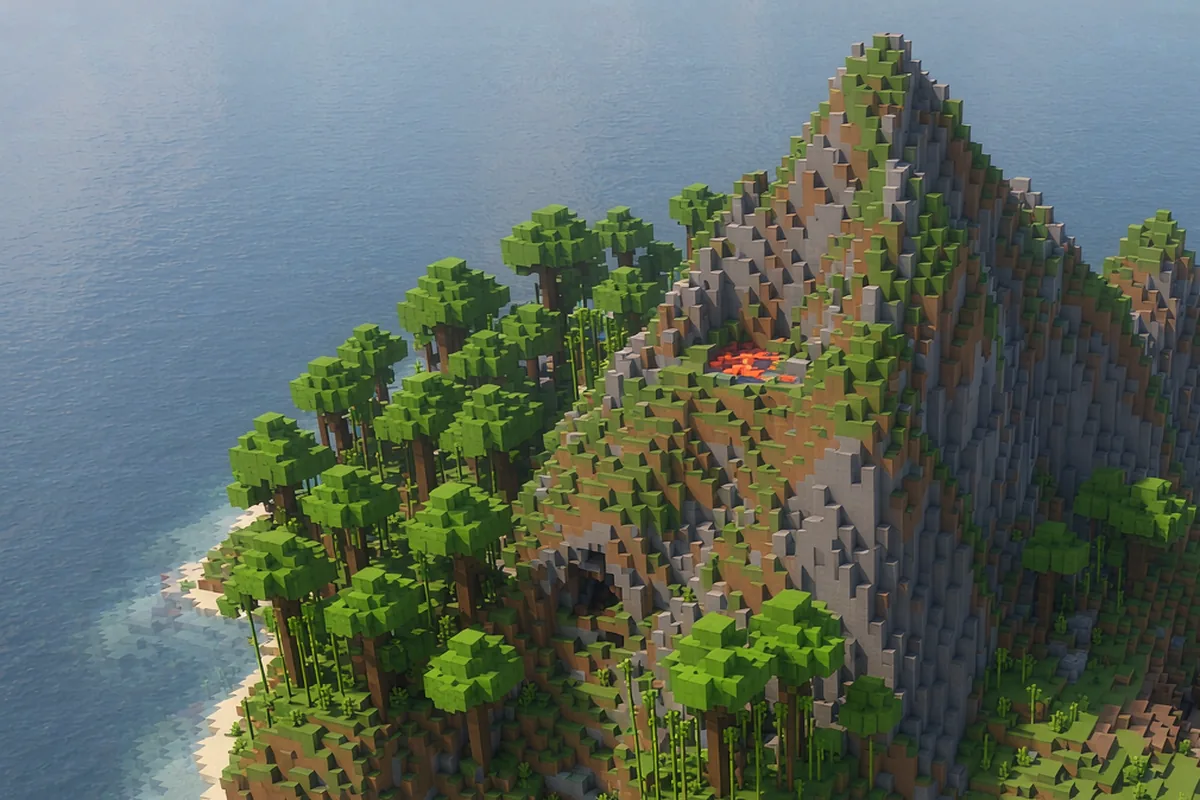
The short answer
The largest island in our records is -1103547699, and the reason is a single word rather than a number. It is tagged extra-large island, a word that appears twice anywhere on this site and both times on this one seed. We then searched all 213 records for anything that actually measures an island, and found zero: no length, no width, no area, no radius. 67 records use a size word, 36 put that word in front of island, and not one of them says how big large was.
- The only extra-large record:
-1103547699— Java and Bedrock 1.18+, a mineshaft, gold, a shipwreck, ocean ruins and a lava pool. Row eighteen of the coordinate table. Extra-large, only record with the word Gold and mineshaft No coordinate No tree count - The only modern large island with a named biome:
2589021139— Java and Bedrock 1.18+, a large jungle island with cocoa beans and bamboo, a shipwreck and ocean ruins nearby. Large jungle island Cocoa and bamboo Nearby has no number No coordinate - The only record where large is compared against something in the same world:
-706198004— Bedrock, two islands, one large and one small. One tree and a ruined portal on the small one; a coastal cave with a mineshaft on the large one; a shipwreck further out. Large and small in one record One tree Ruined portal - The record that argues against chasing size:
-665393669— Bedrock, deliberately the smaller island, kept because it had more trees. Smaller on purpose Ocean ruins on land Stone axe in the chest - Two large islands from 2012, both untested since:
336263053901983088(large island in a vast ocean, Minecraft 1.1) andcreatenewworld(large island, epic mountains and overhangs, Minecraft 1.1). Large Version risk, never re-tested
The codes in this section — -1103547699; 2589021139; -706198004; -665393669; 336263053901983088; createnewworld
How we counted, so you can check the number yourself
Every figure on this page is a count of words inside this site’s own records. None of it comes from the game, a generator, or anyone else’s list.
What a record is. A record block is one seed card on an article page, or one row in one of the three tables on this site — the home page table, the coordinate table and the day-ten table. The scan on 2026-10-25 returned 213 blocks. A seed that appears on more than one page is counted more than once, so the number of distinct seeds is lower than 213; every count below is a block count, and we say so rather than quietly dividing.
What counts as a size word. Any of these appearing as a whole word in the record text: large, small, huge, big, tiny, wide, long, massive, vast, compact, roomy, plus the comparative and superlative forms of those. That returns 67 of 213. Narrowing to the cases where the adjective sits directly in front of the word island returns 36 of 213.
What counts as a measurement. A number followed by a unit and a dimension word: blocks across, blocks wide, blocks long, diameter, radius, or an N by M pair. That returns zero of 213. We also counted every number written in blocks anywhere in a size-tagged record, which returns three blocks, all of them the same seed, and we deal with that below because it is the most interesting result on the page.
What we are not measuring. How big islands actually generate in Minecraft. That would need a world generator and a scan; we have neither, and we are not going to borrow a percentage from somewhere else to fill the hole. Large on this page means large by the word of the person who was standing on it.
Every size-tagged island record we hold
Ten records, from the extra-large at the top to the legacy codes at the bottom. The fourth column is the honest one: it is what the record actually gives you to work with once you have loaded the seed.
| Seed | Size word as written | Edition and version | What the record says is on it | Tag |
|---|---|---|---|---|
-1103547699 |
Extra-large island | Java + Bedrock, 1.18+ | Mineshaft, gold, shipwreck, ocean ruins, lava pool | Only extra-large; no coordinate |
2589021139 |
Large jungle island | Java + Bedrock, 1.18+ | Cocoa beans and bamboo, nearby shipwreck and ocean ruins | Large; nearby with no number; no coordinate |
createnewworld |
Large island, epic mountains, overhangs | Minecraft 1.1, 2012 | Mountains and overhangs; no structures named | Large; word code; version risk |
336263053901983088 |
Large island in a vast ocean | Minecraft 1.1, 2012 | Posted as perfect for waterside city builds; nothing else named | Large; version risk |
-706198004 |
Two islands, one large and one small | Bedrock | Small island: one tree and a ruined portal. Large island: coastal cave with a mineshaft. Shipwreck further out. | Large vs small in one world; one tree |
BubbleGum |
Small island next to a much larger jungle island | Minecraft 1.2, 2013 | The neighbouring jungle island; a rare pink sheep in it | Small beside a larger island; word code |
-665393669 |
Smaller island, more trees | Bedrock | Ocean ruins generated on land with a stone axe and a treasure map, iron and two chests below, badlands with a ruined portal nearby | Rejected as large on purpose; land ruins |
32 |
Small grass island | Java + Bedrock, 1.18+ | A few trees and sheep, an underground cave system with a spawner | Small; two-character code; no coordinate |
lost |
Small island by a huge mushroom biome | Minecraft 1.0, 2011 | Mushroom biome beside the spawn, coordinates written as (x=70, z=280) | Small; the only one with a position; version risk |
2013 |
Ocean island with a small satellite island of sand only | Unknown, may be pre-1.13 | Seven trees, no passive mobs, three wheat seeds from grass, an underground mineshaft | Legacy; no edition and no version |
Read the size column as one player’s adjective, not as a specification. Six of these ten name a version and four do not; two pin nothing at all; one pins a position with an x and a z but no height.
The zero: what no record on this site measures
These are the four shapes a measurement could take in a seed record. All four returned zero across all 213 blocks.
| What we searched for | Blocks | What it would have told you |
|---|---|---|
| A length or width in blocks — blocks across, blocks wide, blocks long | 0 / 213 | Whether the island is a five-minute walk or a twenty-minute one, and how much of it is buildable ground. |
| An area or footprint — an N by M pair, or a block count of land | 0 / 213 | How much farm, how much forest and how much beach you actually get before the water starts. |
| A radius or diameter | 0 / 213 | How far you can walk from spawn in any one direction before you are swimming. |
| A shape word attached to an island — long, narrow, round, wide | 0 / 213 | The outline. The thing that decides whether a shoreline walk is two minutes or fifteen. |
The last row is the one that stings, because it is a question people actually ask out loud: they do not want a big island so much as a long one, or a narrow one, or one with a bay in it. The word long does appear eleven times in these records, and not once within twenty-five characters of the word island. Three of the eleven mean a long way off, which is distance. Three describe a long overhang, which is a terrain feature from 2011 and not an island at all. Two say a version is long past. One says a seed code is two characters long. One says a table row is one row long. One is a tester writing that they might live long enough to reach the taiga above them.
The word wide appears exactly once in 213 records, and it is not about land either: it compares how wide the margin is between two seed codes of different length. That is the whole supply of shape vocabulary on a site built entirely out of island descriptions.
If the number you are after is not a size but a gap — how far the second island is — that is a different census, and it is on the archipelago seed page: 11 of the 48 distinct seed codes here name a second island, 2 of them carry a measured distance, and the one with the cleanest layout never states the gap at all.
The one number we do have is not a size
Of the 67 size-tagged records, exactly three carry a number written in blocks. All three are the same seed, -1276503895, and the number is 500 blocks.
Read what that number is attached to. The record says several small islands within 500 blocks. It is not the size of anything — it is the distance from this island to the other islands around it. In other words, the single figure this site holds next to a size word measures how far away the neighbours are.
There is a second thing wrong with it, and it is the same fault this site keeps finding in its own data. That 500 figure is written on the seed’s card, not on its table row. The row for the same seed says the surrounding islands are nearby, with no number at all. One layer has the word, the other layer has the number, and no single record on this site has both. We have written that admission on another page about distances; it turns out to be true of size as well, because size and distance are the same measurement taken in two directions and we recorded neither.
So the honest position is this: we can tell you which islands our testers called large, and we can tell you what they found on them. We cannot tell you how large any of them was, and we will not invent a figure to make the page look more useful than it is.
The judgment standard: how to read a size word before you load a seed
Four checks, in the order that costs you the least time. They exist because a size adjective is a claim about somebody else’s run, and these four tell you how much of that claim survives contact with your version.
- Is the size word attached to the spawn island, or to something else in the record? This is the check that catches the most records.
lostis a small island beside a huge mushroom biome — the huge thing is not where you spawn.1474776471is an icy overhang surrounded by a large pine forest, and the large thing is the forest. Of the 67 size-tagged records, only 36 attach the adjective to the word island at all, which means roughly a third of the size words on this site are describing something you are not standing on. - Is there a number, and does it have a unit and a dimension? Zero of 213. If a size claim has no number, treat it the way you would treat a restaurant review that says the portions are big: useful as a hint, worthless as a plan.
- Does the record name an edition and a version? Two of the four large island records on this page are from Minecraft 1.1 in 2012 and have not been re-loaded since. Size is the field most likely to be destroyed by a terrain generator change, because an island that shrank became open water rather than a smaller island. The two modern large records,
-1103547699and2589021139, are the only ones that pass this check. - Does the record say what is on the island, in countable terms? Prefer tree count to size every time. The tester on
-665393669took the smaller island because it had more trees and wrote down why: more trees is better than a bigger island. Wood is the ceiling on everything you can craft on an island — no planks means no pickaxe, no furnace, no door, no boat — and plank supply scales with trees, not with area.
The rule we would apply to our own page: load a size-tagged seed for what the record says is on it, not for the adjective in front of island. If the page cannot tell you the tree count, the adjective is the least useful field on the row.
First-day strategy on the largest island we hold
Take -1103547699 on Java or Bedrock 1.18 and above, because it is the only record tagged extra-large and the only large island record that passes the version check.
Java + Bedrock 1.18+: -1103547699
Minute one — count trees, not ground. The record names five things and a tree count is not one of them. That is the failure this whole page is about, and it means your first job has not changed from any other island: look up, count what you can chop, and leave at least one sapling standing before you take the last trunk.
The five things the record does name. A mineshaft, gold, a shipwreck, ocean ruins and a lava pool. Four of those five are worth walking to and none of them has a coordinate, so the order is decided by what you can see from the beach: the shipwreck and the ocean ruins are on the shoreline, the mineshaft is cut into the hillside, and the lava pool is up on the ridge. A wreck is your emergency plank supply before you have an axe, and on a record this short that matters more than the gold does.
Why large helps here in one specific way. A mineshaft, gold and a lava pool on one landmass means the seed has vertical depth, and vertical depth is what an island usually lacks. It also means the useful stuff is probably not all on the beach, which is an argument for cutting one trade route inland rather than walking the whole coast.
What the size word does not buy you. It does not tell you how long the shoreline is, so it does not tell you how long the first circuit takes, and it does not tell you whether the far side of the island is a five-minute walk or a boat trip. For that, walk it. Generate the world, keep the water on one side of you, and do not cut inland until you have been all the way round — the shape of an island is the one thing no seed list, including this one, can hand you before you load it.
Where the rest of the size data lives
Size sits next to two other fields we have already counted, and both of them are more useful than the adjective. The coordinate page holds every record that pins a position at all — including row eighteen, the extra-large island above, which is one of the many rows that names five features and pins none of them. The day-ten page is where the tree-count rule comes from in full, and it is the page that explains why a smaller island with more trees beats the alternative.
If the split between a word on one layer and a number on another sounded familiar, that is because the island seed page counts the same fault in distances, and the speedrun page counts every distance budget this site has ever written down. If what you actually want is a cluster of islands rather than one large one, the server page is the one place where a distance number was used as a pass-or-fail standard.
Running one of these with other people
A large island is the shape most people want for a shared world, because several players can take different parts of it without boats. If you want to load -1103547699 with friends on Java or Bedrock, Shockbyte is a low-cost host that sets up in minutes — use code LAUNCH for 25% off your first month. If you sign up through that link, I may receive a commission at no extra cost to you. It does not change what you pay.
Frequently asked questions
What is the largest island seed you have?
Seed -1103547699 on Java and Bedrock 1.18+, because it is the only record in the entire set tagged extra-large. The record names a mineshaft, gold, a shipwreck, ocean ruins and a lava pool, and it is row eighteen of the coordinate table. The word extra-large appears twice in 213 records and both times it is this seed. The catch is the same one every size-tagged record carries: no coordinate, no length and no tree count, so large here is one tester’s word and not a measurement you can check before you load it.
Is there a Minecraft island seed that is long and narrow instead of round and wide?
Not in our records. No record anywhere on this site describes the outline of an island — there is no length, no width, no diameter and no shape word attached to one. The word long appears eleven times across all 213 records and not once within twenty-five characters of the word island: three of them mean a long way off, three describe a long overhang, two say a version is long past, and the rest describe how long a seed code or a table row is. The word wide appears exactly once, and it is comparing the length of two seed codes. If you want a particular outline, the honest route is to generate the world and walk the shoreline, because shape is the one thing no seed list can tell you in advance.
Is a bigger island better than one with more trees?
No. Wood is the ceiling on an island, not space: without planks you cannot craft a pickaxe, a furnace, a door or a boat, and plank supply scales with tree count rather than with area. The tester who recorded -665393669 on Bedrock wrote it down as a rule while playing — more trees is better than a bigger island — and that record is a deliberately smaller island that was kept because it had more trees than the larger one beside it. A large island with three trees loses to a small island with twelve.
Are the 2012 large island seeds still safe to load?
No — treat them as untested rather than safe. Two of the large island records on this page were posted in 2012 against Minecraft 1.1, and neither has been re-loaded on a modern release. A code that produced a large island on 1.1 can produce open water today, because the terrain generator changed more than once after that. If you want a large island you can actually stand on, use one of the two modern records: -1103547699 or 2589021139, both recorded on Java and Bedrock 1.18 and above.
How do I tell whether an island is big enough before I commit to it?
Use tree count and shoreline, not area. Load the seed on the version you actually play, then run four checks in the first five minutes: count the trees on the spawn island, look for a second food source or a shipwreck within a short swim, walk the shoreline rather than cutting inland so you learn the outline before you build, and check whether you can put a boat in the water in more than one direction. Those four are the checks our testers applied, and size was never one of them — because on an island the thing that ends a run is a missing tree, not a missing beach.
Why does the same site call one island large and another small with no numbers?
Because size was written as an adjective by whoever was playing, not measured as a field. Across 213 records there are 67 carrying a size word and zero carrying a dimension: no length in blocks, no width, no N by M, no radius and no area. The words are doing comparative work inside one person’s run — -706198004 is recorded as two islands, one large and one small, which is the only record where large is measured against something else in the same world. Everywhere else, large means larger than the islands this tester happened to have been looking at, and that is not a number anyone else can reproduce.
Which of your records is the smallest island?
We cannot name one, because not a single record on this page gives a size in blocks: no length, no width, no area and no radius appear anywhere in the ten rows. Six of the ten use the word small or smaller somewhere in the size column, and so the word is doing the work of a measurement none of them received. The row that gives you the most to work with is -706198004, which splits one code into two islands: the small one holds a single tree and a ruined portal, and the cave and the shipwreck sit on the larger island beside it. That is a comparison between two islands in one world, and it is still not a size.
Do any of these island records say how many trees are on the island?
Two of the ten give a number, and two more use a word instead. 2013 is the only record with a count above one: seven trees, no passive mobs, and three wheat seeds from grass. -706198004 records exactly one tree, on the small island, with the cave and the shipwreck on the larger one. 32 says a few trees and sheep, and -665393669 says more trees than the island beside it, which is a comparison rather than a count. The other six rows on this page name structures, biomes or nothing at all, and never mention a tree.