Minecraft Bedrock Seeds: The 6 Checks to Run Before You Load a Code
The short answer
Ten of the seeds in our records carry Bedrock, and exactly one of them has a coordinate you can type straight into /tp — seed 2016000 on Bedrock 1.20.5. Seven carry a version number, three carry no version at all, eight are descriptions with no numbers in them, and not one Bedrock seed has ever been rejected here, because the standard we reject against was written for Java. That is the honest state of Bedrock seed records, ours included.
The codes worth loading today, after those six checks:
Want the survivable start:-665393669 — more trees than the island size suggests, ocean ruins on land with a stone axe and a treasure map, iron ore and two overlapping chests underneath.
Want the brutal start:-706198004 — one tree, a ruined portal, a shipwreck further out.
Want coordinates you can actually use:2016000 on Bedrock — mushroom island at -300, 64, 0, 300 blocks west of an ocean spawn with no trees.
Want a biome spread and a teleport command:39720048960 — /tp -576 ~ 80, six biomes on one island.
The single teleport-ready Bedrock coordinate in the whole record — seed 2016000, Bedrock 1.20.5, /tp -300 64 0
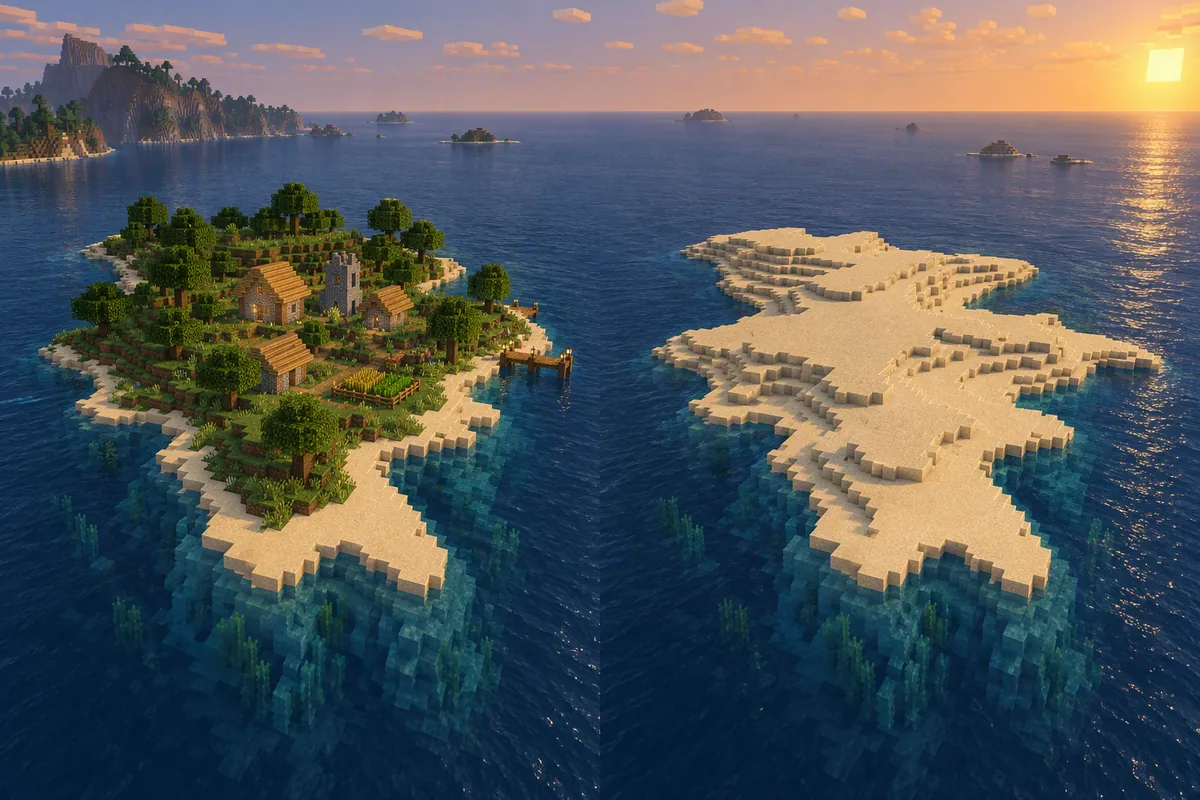
The single most important reason a Bedrock seed needs its own checklist: one code, two realities. The left side is what a Java tester sees, the right side is what a Bedrock tester sees, and the only way to know which one you are about to load is to demand a version and a coordinate before you spend an hour generating the world.
Why a Bedrock seed needs a different checklist than a Java one
Most seed content on the web is produced by scanning Java worlds, because that is where the tooling is. The consequence is that a huge amount of “Minecraft seeds” content is quietly Java-only, and a Bedrock player copying a code out of it gets a world that has nothing to do with the description.
But there is a second problem, and it is the one this page is about. Even when a record is honest enough to write “Bedrock” in the edition column, that single word does very little work. It does not tell you which Bedrock version was loaded. It does not tell you whether anyone wrote down a coordinate or just a sentence. And it does not tell you whether the code was checked on your edition or merely claimed for it.
The clearest demonstration of why that matters is the one code in our records that has both sides written down. Seed 2016000 is listed twice on purpose. On Java 1.20–1.21 it puts you on a plains biome at 0, 63, 0 with a village at -24, 64, 12 and a stronghold eleven blocks under the village well. On Bedrock 1.20.5 the same number puts you in open ocean at 0, 62, 0 with no trees and no village. One code, two realities, and a tester who ran both for three days straight to establish it.
So the checklist below is not about what to do once you are in the world. It is about what to demand from the record before you spend an hour generating one. The in-game side of that — what to do in the first ten minutes after you spawn — is further down this page, and the two are meant to be used in that order.
The ten Bedrock rows in our record, and what each one is missing
These are every row in our seed table with Bedrock in the edition column. The tag column is the tester’s own conclusion, not a score — we do not rank seeds, and nothing on this page is a rating.
Two islands; one tree on the small one plus a ruined portal; cave with a mineshaft on the large one; shipwreck with planks and a treasure map
One treeRuined portalNo version recorded
-665393669
Bedrock only
None recorded
More trees; ocean ruins generated on land with a stone axe and a treasure map; iron ore and two overlapping chests below; badlands with a ruined portal nearby
Land ruinsIron below spawnNo version recorded
-1276503895
Regional Bedrock variant + Bedrock
None recorded
Barren island, few trees and sugar cane; diamond exposed to air with a lava pool; ruined portal on a nearby island; glacier; ocean monument; shipwreck in an underwater canyon; several small islands within 500 blocks
Diamond at spawnNot JavaNo version recorded
39720048960
Java + Bedrock
1.18–1.21.50
/tp -576 ~ 80 — multi-biome island: ice peaks, dark forest, jungle, bamboo, stone shore, lush cave
Teleport command with tildeSix biomes
2589021139
Java + Bedrock
1.18+
Large jungle island, cocoa beans and bamboo, nearby shipwreck and ocean ruins
Description only
32
Java + Bedrock
1.18+
Small grass island, a few trees and sheep, cave system with a spawner
Description only
354089350
Java + Bedrock
1.18+
Resource-rich island, dense trees and animals, cave with redstone, diamonds and a lava lake
Description only
-1103547699
Java + Bedrock
1.18+
Extra-large island, mineshaft, gold, shipwreck, ocean ruins, lava pool
Description only
6390326396262027557
Java + Bedrock
1.18+
Mountain island, rich starting resources, ancient city with a warden below
Description only
Read the third and fourth columns together, because that is where the record is weakest. Four of the ten are Bedrock-only rows. The other six are labelled “Java + Bedrock”, which sounds reassuring and means less than it appears to.
The six checks, in the order we run them
None of these takes more than a minute, and any one of them can end the plan. They are ordered by how cheap they are to run, not by how often they fail — although check three fails far more often than the rest.
Check
The question to ask of the record
What it turns up in our ten rows
1. Edition label
Does it name Bedrock alone, or Bedrock alongside Java?
Four rows are Bedrock-only. Six are “Java + Bedrock”, which means the code was claimed for both editions rather than checked on both.
2. Version
Is there a Bedrock version number, or just the word “Bedrock”?
Seven rows carry a version. Three carry none at all — -706198004, -665393669 and -1276503895.
3. Coordinates
Can you type it into /tp, or is it a sentence?
One row is teleport-ready. One more has a command with a tilde standing in for the height. Eight are prose with no numbers in them.
4. Per-edition split
For a dual-edition row, is the feature list split by edition?
Only 2016000 is split — it occupies two rows on purpose, one per edition. The other six dual-edition rows give a single list for both.
5. Regional variant
Was it recorded on standard Bedrock, or on a regional Bedrock variant?
One row, -1276503895, is a regional-variant record. The tester noted explicitly that it does not work on Java, which is the only edition note of its kind in the table.
6. Ever measured?
Has this seed been held to a standard and passed, or just published?
No Bedrock seed has. All four seeds turned down after mapping in our records are Java 1.18 and above.
Check two is the one people skip, and check three is the one that actually bites. Together they explain why a Bedrock player can read ten seed records and still have nothing to type into the game.
Check two: “Bedrock” is a version range, not a version
The word “Bedrock” in an edition column tells you which family of generators produced the world. It does not tell you which release was loaded, and the difference is not academic — in our own table, one dual-edition row records a Bedrock range of 1.18–1.21.50 against a Java range of 1.18–1.21.2 for the very same code, 39720048960. The two editions do not move in lockstep, and their version numbers are not interchangeable.
Three of our ten Bedrock rows carry no version number whatsoever. Two of them — -706198004 and -665393669 — are among the most detailed island descriptions in the whole table, with tester quotes attached to both. The descriptions are trustworthy. The version they were loaded on is simply not part of the record, and we are not going to invent one.
The practical rule: a versionless Bedrock row is a description of a world someone saw, not a promise about the world you will get. Load it expecting to re-check the shoreline yourself. The full side-by-side of what one code produces on each edition — and why the version number is the whole argument — is on the Java vs Bedrock comparison page.
Check three: one coordinate out of ten
This is the number that made us write this page, and it is worth stating plainly: of the ten Bedrock rows in our record, one carries coordinates in a form you can paste into the game. That is seed 2016000 on Bedrock 1.20.5 — spawn 0, 62, 0, shipwreck 0, 58, 120, mushroom island -300, 64, 0, ocean monument 0, 40, -400. Four structures, four positions, one edition, one version.
A second row, 39720048960, carries /tp -576 ~ 80. That is usable, but note the tilde: the height was never recorded, so the command lands you at the surface above the island rather than at a known altitude. The remaining eight rows are prose. “Large jungle island, cocoa beans and bamboo, nearby shipwreck and ocean ruins” is a true description of a world, and it is also completely unusable if you want to teleport anywhere.
There is an irony here that is worth sitting with. The best-documented Bedrock seed in our record — the only one with four pinned coordinates — is also the one whose spawn is open ocean with no trees on it. Documentation quality and playability are independent variables, and most seed lists only optimise the first one.
If you want the completeness audit across the whole table rather than just the Bedrock rows, the complete coordinate table marks which rows are teleport-ready and which were written as descriptions only, and explains the three-axis, two-axis and tilde formats.
The asymmetry nobody publishes: no Bedrock seed has ever been rejected here
Four seeds in our records were turned down after mapping, each with the line it failed on: distance, no dual ocean monument, a crossroads too far out, a bastion too far out. All four are Java 1.18 and above.
None of that is a comment on Bedrock world quality. It is a comment on where the standard was built. The server-grade criteria — four structures inside a 256-block radius, more than one ocean monument, a bastion within reach, warm ocean access — were written and applied by testers working on Java, and every seed they ran through them was a Java seed. The Bedrock side of the table has never been measured against anything.
We think that is worth saying out loud rather than papering over, because it changes what a Bedrock player can reasonably conclude from our own pages. When you load -665393669 and it plays well, that is a real result from a real play session. It is not a seed that cleared a standard, because no Bedrock seed has. The four checks in the order they get applied, and the three seeds that cleared them, are on the server-grade island seeds page, and the four that failed are on the rejected island seeds page.
Four Bedrock seeds, mapped out
Land Ruins Island — -665393669
Bedrock onlyLand ruinsIron below spawnNo version recorded
LayoutSmaller island, more trees than the size suggests
The findOcean ruins generated on land instead of underwater
ChestStone axe and a treasure map
Below itIron ore and two overlapping chests
NearbyBadlands biome with a ruined portal
This is the one to load if you want an island start that does not punish you immediately. The tester’s note on it is the shortest argument on this page: more trees is better than a bigger island. Wood is the binding constraint on any island, not space.
The ocean ruins are the unusual part. Generating on land instead of underwater is rare, and it means the chest is walkable rather than a dive. The tester’s conclusion was that the ruins carry the start — the supplies are thorough enough that food stops being a concern entirely. On most island seeds, food is what ends the run in the first few days.
Recorded as Bedrock with no version number. Everything above is from the play session; the version is not part of the record, so treat it as a description rather than a guarantee.
One Tree Island — -706198004
Bedrock onlyOne treeRuined portalShipwreck further outNo version recorded
LayoutTwo islands, one large and one small
Small islandExactly one tree, plus a ruined portal
Large islandSmall coastal cave with a mineshaft
Further outShipwreck with planks and a treasure map
Nearest villageA long way off
One tree. That is the entire wood supply on the small island, and next to it a ruined portal. The tester worked it in a specific order and wrote the order down: the ruined portal chest first, then mining along the sandbar on the smaller side of the large island, which turned up a cave, then the shipwreck further out. That order is the order you should work in when you have one tree and no guarantee of a second.
The constraint the tester recorded is the honest one: you cannot sleep on the ocean, and supplies are difficult to restock. The suggested way out is to get obsidian and go to the Nether rather than trying to make the island self-sufficient.
This seed carries no coordinate in the record at all — only the description above. If you want a seed with numbers attached, use 2016000 below and accept the ocean spawn.
Bedrock Ocean Spawn — 2016000
Bedrock 1.20.5Teleport-ready coordinatesMushroom islandOcean spawn, no trees
Ocean monument0, 40, -400 — gold blocks and sponges
Load this one for the coordinates, not the spawn. It is the only Bedrock row in our record with four pinned positions and a version number, which makes it the most useful seed here for anyone who wants to verify something rather than explore something.
It is also the clearest example of why the edition label has to come first. On Java the same number gives you a plains spawn with a village and a stronghold eleven blocks under the well — a run one tester finished in 27 minutes. On Bedrock it gives you open water. The mushroom island 300 blocks west is the nearest land the record names, and it is reachable with /tp -300 64 0 once cheats are on.
The height value is what makes this one teleport-ready. The other Bedrock rows with numbers — 39720048960 below — use a tilde, which lands you at the surface rather than at a known altitude.
Multi Biome Island — 39720048960
Java + BedrockBedrock 1.18–1.21.50Teleport command with tildeSix biomes
Teleport/tp -576 ~ 80
Biomes on one islandIce peaks, dark forest, jungle, bamboo, stone shore, lush cave
Java range1.18–1.21.2
Bedrock range1.18–1.21.50
This is the seed that proves check two. The two version ranges on the same row do not end at the same place, and the Bedrock one runs higher. If you are on a Bedrock release above 1.21.2, this row is the only one in our table that even acknowledges that possibility.
It is also the only dual-edition row with any coordinate at all. The other five “Java + Bedrock” rows share one feature list between two editions, which is fine as a description and useless as a coordinate.
Use /tp -576 ~ 80 with cheats enabled. The tilde replaces a height that was never written down, so you arrive at the surface above the island rather than inside it.
What to do in the first ten minutes once it loads
The six checks above are what you do before generating a world. This is what you do after, and it is the part every theme page on this site keeps because it is the part that decides whether the seed survives the first night. The order is the one in our testing notes.
Count the trees before you touch anything. One tree means one plank budget and one sapling you cannot afford to lose. Chop most of it, keep one standing. “To get rich, first chop trees” is the rule these notes are built on, and on Bedrock island seeds it is the whole opening.
Check the ruined portal chest before you mine. Both brutal seeds above have one. On -706198004 the tester checked it first and found useful items, and if the frame has enough obsidian you may never need to mine for any.
Walk the shoreline, not inland. The cave on -706198004 was found by mining along a sandbar; the shipwreck was found further out. On island seeds the structures sit in the water more often than on the land.
Settle food on day one or accept that the run is a leaving run. On -665393669 the ruined chests ended the question. On -706198004 it never got settled, which is why the recorded advice there is to go to the Nether instead.
Note the coordinate of anything you intend to come back to. Eight of our ten Bedrock records are prose precisely because nobody wrote a number down while they were playing. Do not add to that count.
If there is no wood, no wreck and no portal in sight, leave. The record’s own line for that case is blunt: you cannot survive at this spawn, you can only brave the ocean and explore. Paddling toward land is not giving up.
Step four is the fork. Food settled means the island is a base; food unsettled means the island is a launch point, and everything after day ten is measured in Nether blocks rather than overworld blocks anyway.
After the portal, and what changes on a shared world
Once a portal pair exists, the checks stop mattering in the same way. Distance collapses — the clearest number in our records is a quad ocean monument over three thousand blocks from spawn in the overworld and about 388 blocks of Nether travel by the tester’s own note — and at that exchange rate every description-only seed on this page becomes a short trip rather than a project.
What does not collapse is the edition question. Every player on a shared world has to be on the same edition and the same game version, because a version difference produces exactly the mismatch you get between Java and Bedrock: same code, different terrain, and a complaint that the seed does not work.
And if you are choosing a seed for a shared world rather than a solo run, be aware of what our records can and cannot tell you. The four-check server standard was written on Java, and no Bedrock seed has been run through it. A Bedrock world that plays well is a real play result, not a cleared standard.
A good seed is better with people on it. If you want to host one and run these islands together, Java or Bedrock, Shockbyte is a low-cost host that sets up in minutes. Use code LAUNCH for 25% off your first month. If you sign up through that link, I may receive a commission at no extra cost to you. It does not change what you pay.
Frequently asked questions
How do I know whether a Minecraft Bedrock seed was really tested on Bedrock?
Check three things in the record: does the edition column name Bedrock alone or alongside Java, does it carry a Bedrock version number rather than just the word Bedrock, and does it carry coordinates or only a description. Of the ten Bedrock rows in our own table, only one — 2016000 on Bedrock 1.20.5 — passes all three.
Does a Bedrock seed need a version number, or is “Bedrock” on its own enough?
Not enough. Three of the ten Bedrock rows in our records carry no version number at all, and one dual-edition row shows why it matters: 39720048960 records a Bedrock range of 1.18–1.21.50 against a Java range of 1.18–1.21.2, so the two editions are not on the same release schedule.
How many of your Bedrock seeds come with coordinates I can teleport to?
One of ten: seed 2016000 on Bedrock 1.20.5, with spawn 0, 62, 0, shipwreck 0, 58, 120, mushroom island -300, 64, 0 and ocean monument 0, 40, -400. A second has a teleport command with a tilde in place of the height. The other eight were recorded as descriptions with no numbers.
Has any Bedrock seed been rejected in your testing?
No. All four seeds turned down after mapping in our records are Java 1.18 and above, because the server-grade standard was built and applied on Java. That means the Bedrock side of the record has never been measured against it — which is a gap in our testing, not a claim that Bedrock seeds are better.
Can I use these Bedrock seeds on a realm or a multiplayer server?
Yes. Set the code as the world seed when you create the realm or server, and make sure every player is on the same game version, because a version difference produces the same mismatch you get between editions. Our server-grade standard was written for Java, so treat a Bedrock world as unverified against it.
Why do some seeds in your table say “Java + Bedrock” but only list one set of features?
Because one feature list was written for both editions. Only 2016000 is split into two rows in our records, one per edition. The other six dual-edition rows give a single description, which tells you the code was claimed for both editions rather than checked on both.
Why does the picture on this page show two different worlds for what looks like the same island?
Because that is what one code, 2016000, actually does. On Java 1.20–1.21 the same number puts you in a plains biome at 0, 63, 0 with a village and a stronghold beneath it; on Bedrock 1.20.5 it puts you in open ocean at 0, 62, 0 with no trees and no village. The two halves of the picture are not two seeds, they are the same number loaded twice on two different editions, which is the entire reason this page exists as a checklist rather than a list.
If only the Java side of a record was tested, can the Bedrock side still be trusted?
No, not without reloading. The record on this page holds ten Bedrock rows; only one was re-checked on the actual Bedrock release. The other nine were loaded on Java first and then claimed for Bedrock, which is the pattern this checklist was written to expose. The honest rule is the same one the short answer states: the word Bedrock on its own, with no version number and no coordinate, is not the same thing as a Bedrock test.
Does the same-code, two-worlds picture mean every Bedrock seed in your table has a Java twin?
No. 2016000 is the only seed we have actually loaded on both editions; the other nine Bedrock rows either have no Java row at all or were written for Bedrock only. The picture shows the most extreme case we have found, not the average case, and treating it as the average is exactly the kind of read the rest of this page argues against.
Do any of your Bedrock records say what is inside the village?
No. Not one of the ten Bedrock rows names anything inside a village. The only village interior written anywhere in our records belongs to the Java row for 2016000 — 12 houses, 2 blacksmith forges, 1 church and 2 farms at -24, 64, 12 — and the Bedrock row for that same code explicitly records no village at all. Across the forty-nine records behind this site, the words blacksmith, church and library appear zero times in any record field.
Which Bedrock row in your table carries the most separate numbers?
2016000 on Bedrock 1.20.5, with four: spawn at 0, 62, 0, shipwreck at 0, 58, 120, mushroom island at -300, 64, 0 and ocean monument at 0, 40, -400. No other Bedrock row carries more than one. 39720048960 has the single teleport command /tp -576 ~ 80, and five of the ten are tagged “Description only”, which means the row carries no coordinate at all.
Can I type the teleport command on 39720048960 straight into Bedrock?
Not as it is written. The record gives /tp -576 ~ 80, with a tilde standing in for the height, so you have to stand where you want to land and read your own Y coordinate first. It is still the second-best-documented Bedrock row in the table, and its version range runs from 1.18 to 1.21.50.