Open one of these and you are already on the mountain
100000061447117197 on Bedrock drops you on a mountainous island with three tall peaks, two taiga villages and mushroom fields offshore. -2965711870629693628 puts you on jagged peaks above the cloud layer, looking down into a meadow valley with a village in it. 69427194527559476 starts you on the rim of a stony peaks ring with a forest and bamboo jungle valley inside.
| Seed | Edition and version | Where you start | What this mountain is good for |
|---|---|---|---|
100000061447117197 | Bedrock, 1.21.120 and later | Spawn, on the island itself. Three peaks, valleys between them. | A peak-to-peak settlement: valley floor for the base, two villages already trading, a harbour on the northern slope and an outpost in the mushroom fields. |
-2965711870629693628 | Bedrock, 1.21.80 and later | Spawn, on the ridge above the cloud layer. | A caldera town. The ring closes around a meadow valley, so you get walls for free and one entrance to control. |
69427194527559476 | Bedrock, 1.21.90 and later | Spawn, on the edge of the ring. | A stepped cliff city: terraces cut into the stony slope, bamboo from the valley for scaffolding, bays in the south for a dock. |
- All three are spawn seeds. The world puts you on the mountain, so the only coordinate that matters is the one you are standing on. Turn on Show Coordinates in Bedrock settings and you have the numbers for a sign or a map marker. Spawn = summit side
- All three are still in the game's starter list, which is rewritten with each update and is the nearest thing to a guarantee that a Bedrock seed still looks the way it is described. Current
- One Java option with a real teleport:
39720048960, island at/tp -576 ~ 80— where 80 is the Z coordinate and not a height, since the height slot holds the tilde — filed for 1.18 to 1.21.2. Java - No summit height is printed here, because none is published for these four. Measure it in game rather than trusting a list. Measured, not quoted
Three peaks, two villages, mushroom fields — 100000061447117197 Bedrock 2 villages Spawn on island Best all-round
Jagged peaks above the clouds, village in the bowl — -2965711870629693628 Bedrock Enclosed valley Summit spawn
Stony ring, jungle inside, bays south — 69427194527559476 Bedrock Bamboo valley Cliff terraces
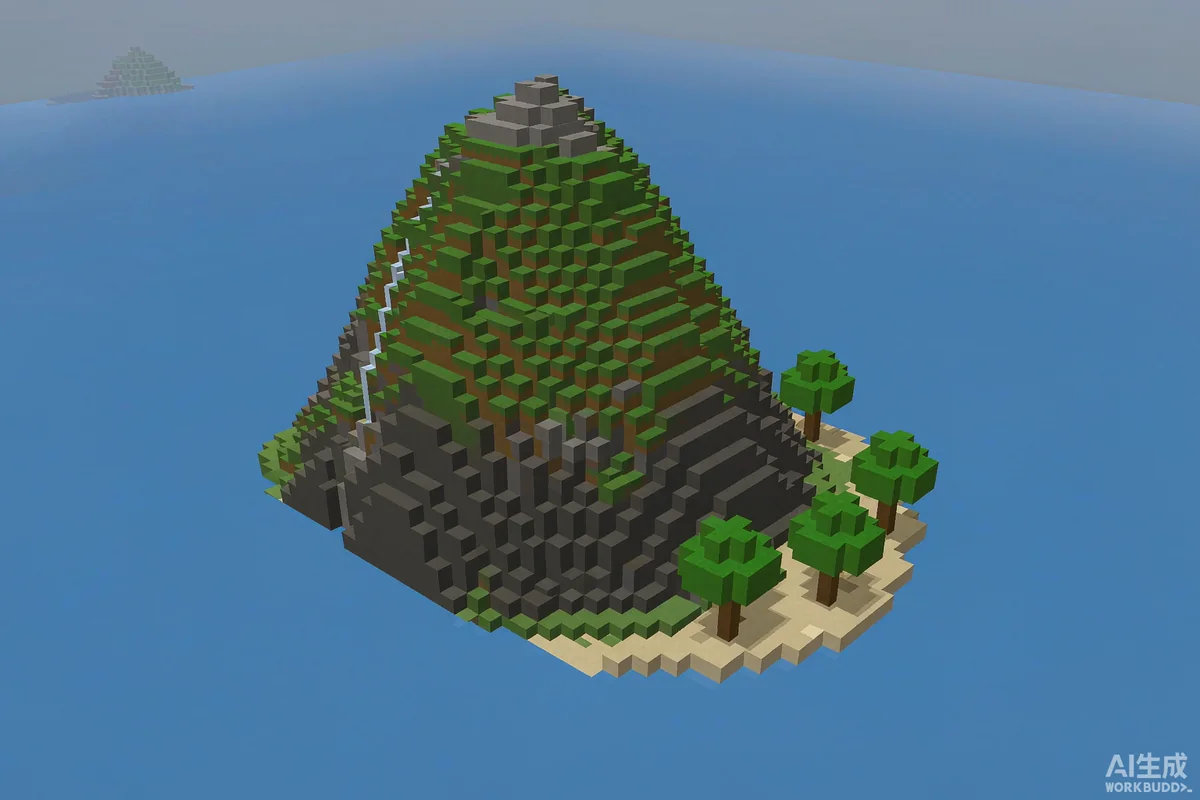
Seed one: three peaks, two villages, one island
100000061447117197 is the one to open if you want a mountain world you can live in rather than visit. The island is large and mountainous, with old growth pine taiga and taiga in the deep valleys between three tall peaks. The north and east slopes run almost straight into the sea, and the coastline is stony shore and bays rather than beach.
What makes it a build seed rather than a viewpoint is the pair of villages: one in the middle of the central valley, another on the steep northern slopes with some of its houses standing out over the water. That second village is the interesting one, because it is already a hillside settlement. You are not clearing a forest to put a town on a slope; you are extending one that the world built for you.
What to put where
| Ground | Build | Why here |
|---|---|---|
| Central valley floor, next to the village | Main base, farms, storage | Flat, sheltered by peaks on three sides, villagers already trading next door. |
| Between two summits | Bridge or viaduct | The gap between peaks is the shortest span and the place a path wants to go anyway. |
| Northern slope, under the hillside village | Harbour and dock | Houses already overhang the water; a dock below them connects the two levels. |
| Offshore mushroom fields | Outpost, mooshroom pen | Separate landmass, no spawn pressure from the main island, easy to wall. |
| Temperate southern half | Timber and farmland | Forest, plains and grove instead of taiga, so wood and crops are cheaper here. |
If you only build one thing on this seed, build the bridge. Three peaks with valleys between them invite a settlement that spans rather than climbs, and the moment you can walk between two summits without touching the valley, the whole island becomes one site instead of four.
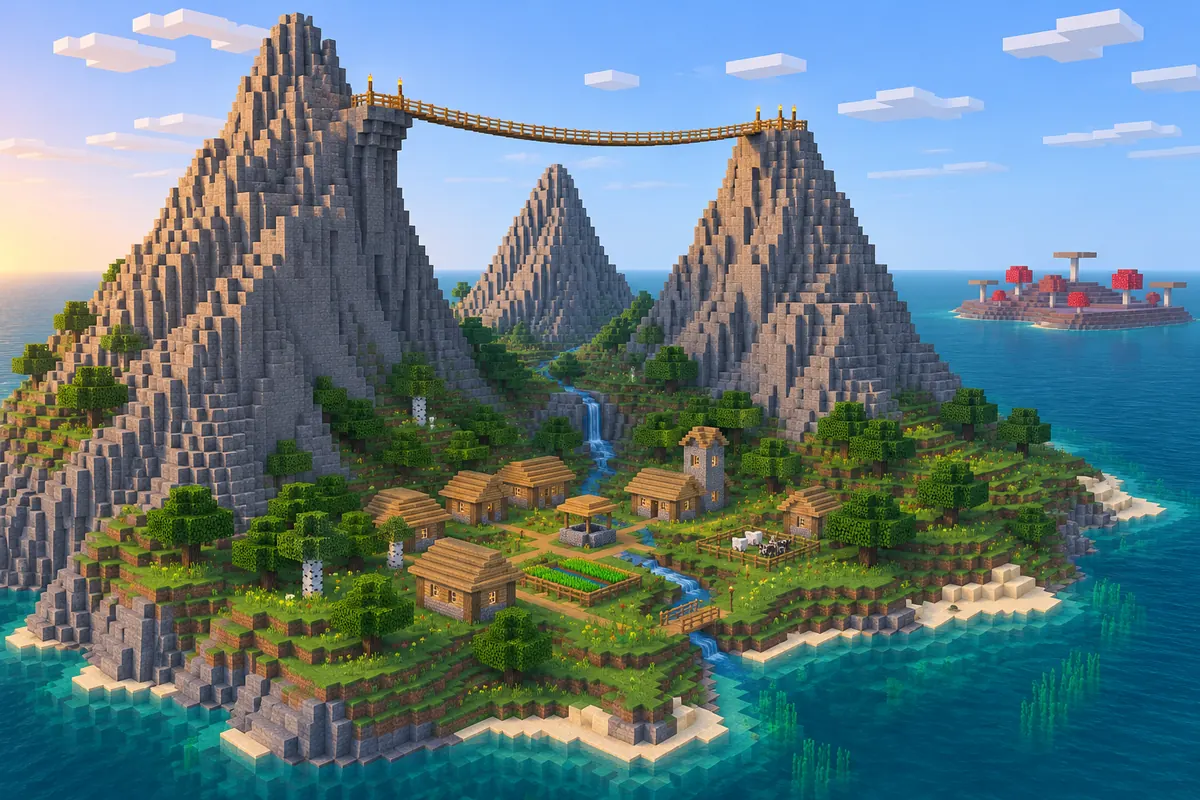
Seed two: a ring of peaks with a valley locked inside
-2965711870629693628 spawns you on jagged peaks above the cloud layer, with the view down into an enclosed meadow valley that has a village in it. More peaks run around that ring, and the high grassland valleys eventually drop into river canyons where the taiga and forest start. South of the spawn area is a very large flower forest with sunflower plains and stony shores.
This is the seed for a town with a wall you did not have to build. The ring does the work: one or two gaps to gate, a flat meadow floor inside, a village already occupying part of it, and peaks high enough that anything coming from outside has to come through a gap you chose.
What to put where
| Ground | Build | Why here |
|---|---|---|
| The ring itself | Rim road, gatehouses at the gaps | Continuous high ground is a wall with a walkway on top. Two gates beat twenty doors. |
| Meadow valley floor | Houses, farms, the town well | Flat, enclosed, and already partly settled by the village inside it. |
| Highest jagged point | Lookout or beacon platform | Above the cloud layer, so it reads as a landmark from outside the ring. |
| Southern flower forest | Dye farm, apiary, garden | Flowers in bulk, and a softer palette than the stone you are surrounded by. |
One caution about the altitude, and it is practical rather than statistical: a base above the cloud layer has no water unless you carry it, and no trees at all. Put the bed and the chests in the valley, keep the summit for the thing you only visit. The after day ten page covers the same trade-off on an island where the resources are further away than they look.
Seed three: stony ring, jungle in the middle
69427194527559476 starts you on the edge of a massive stony peaks ring with a deep forest and bamboo jungle valley inside it. The stony peaks run out in several directions and reach high altitudes, forming a long ridge. Beyond the ring there are river-less jungle biomes with more stony peaks, savanna in the north, and ocean bays with stony shores in the south.
This is the builder's seed of the three, because the ring is a slope you can cut into and the valley gives you bamboo. Terraced building on a stony peaks face is the least forgiving kind of hillside work — every level needs a retaining wall and a stair — and bamboo makes the scaffolding cheap while you are doing it.
What to put where
| Ground | Build | Why here |
|---|---|---|
| Stony peaks face, lower third | Terraced houses, one level per tier | The slope is already stepped; building with the steps costs less fill than building against them. |
| Ridge line | Wall, watchtower, mine entrance | A ridge is a natural boundary and the fastest way to enclose the valley below. |
| Forest and bamboo valley | Workshop, scaffolding yard, tree farm | Bamboo grows faster than any tree and the valley keeps it out of sight. |
| Southern ocean bays | Dock, boathouse, fishing post | Stony shore gives a hard edge to build a pier from, and the bays break the swell. |
No village is described on this one, so the trade route is the project rather than the convenience. If you want villagers here, you are moving them, and that decides your first week more than the mountain does. The village seed page covers what a village actually gives you before you commit to hauling one.
The Java option, with a coordinate you can paste
The three seeds above are Bedrock. The curated starter list is a Bedrock feature, so nothing on it will give a Java player the same spawn. The Java entry that belongs on this page is 39720048960: an island filed with the command /tp -576 ~ 80, with ice peaks among its biomes along with dark forest, jungle, bamboo, stone shore and a lush cave.
| Seed | Edition | Coordinate | Terrain filed with it |
|---|---|---|---|
39720048960 | Java and Bedrock, 1.18 to 1.21.2 | /tp -576 ~ 80 — X and Z, height left to the game | Ice peaks, dark forest, jungle, bamboo, stone shore, lush cave |
Two things to know before you use that command. The tilde in the middle means keep the height you are at, so you arrive at whatever altitude the surface is rather than at a fixed one; and 80 is a Z coordinate, not a height, which is the single most common misreading of a teleport line. The version range is 1.18 to 1.21.2, which is the newest build this one has been run on. On anything later, open it, look at the peaks, and decide from what you see rather than from the label.
Why some mountain seeds you have seen no longer work
Because a seed code and a seed description have different lifespans. The starter list is rewritten as the game updates, and when a code leaves it, the write-up goes with it. 6390326396262027557 is the example you are most likely to run into: a lone elevated island with a birch forest on top and a peak, most sides sheer cliff, and a cave system hollowing out almost the whole island. It entered the list in 1.21.90 and was marked removed by 1.21.120, and the note attached to removed entries is blunt — the description and the screenshots apply to the version they were written for, and those seeds look completely different in current versions.
The code still types in. The island it was famous for is not what you get. That is worth knowing before you spend a weekend planning a build around a photograph, and it is why every seed on this page is either still on the current list or carries a version range you can check against your own build. Code survives, terrain does not
The same trap sits in the other direction too. A seed can be perfectly valid and still be a bad mountain seed, because the word mountain in a description is doing aesthetic work rather than telling you a height. Nothing in this page's table has a published summit figure, and no amount of list-reading will produce one. Measure it. Size words have exactly the same problem on island pages.
First day on a mountain spawn
Spawning on high ground is a mixed gift, and the order of work is different from a beach start in one specific way: you can see your resources before you can reach them. Use that. Before you break a single block, walk the rim for a minute and note three things — where the trees are, where the flat ground is, and which direction the water is.
| Step | What you are doing | Why the mountain changes it |
|---|---|---|
| 1 | Walk the rim, pick a descent | From a peak you can choose your route instead of discovering it. Ten minutes here saves an hour of climbing later. |
| 2 | Wood at the treeline, not on the summit | Trees grow below the stone. On these seeds the forest is in the valley or on the lower slope. |
| 3 | Water before food | A peak has none. Fill buckets at the first stream or bay and carry them up on the way back. |
| 4 | Shelter cut into the slope, not built on top | One pickaxe and a hillside beats a stack of planks and an exposed roof. |
| 5 | Food from the valley, not the summit | Villages on the first two seeds give you crops and a trade; the ridge gives you nothing edible. |
If you are opening this with other people, the host matters more than the seed: Shockbyte is a low-cost Minecraft host that is set up in minutes, and code LAUNCH takes 25 percent off the first month. If you sign up through that link I may receive a commission at no extra cost to you, and it does not change what you pay.
Check the seed before you plan the build
Four checks, in order, before you commit a weekend to any mountain seed — including these. They take about two minutes and they replace every claim a list can make about height, view or space.
| # | Check | Pass condition |
|---|---|---|
| 1 | Your build matches the seed's range | The seed is on the current starter list, or you are inside the version range printed with it. |
| 2 | You can see the peak from spawn | If the mountain is not visible on day one, the description was written for a different version. |
| 3 | The flat ground exists | Walk the valley or the bowl. No flat ground means no base, whatever the view is like. |
| 4 | Water and wood are within sight | Both, before you place a chest. A summit with neither is a campsite, not a home. |
If a seed fails check two, stop there and pick another one. That single check catches the removed-list problem, the wrong-version problem and the mislabelled screenshot problem at once, and it costs you one world load.
Frequently asked questions
What is the best Minecraft mountain seed I can open right now?
100000061447117197 on Bedrock: you spawn on a mountainous island with three tall peaks, two taiga villages on the island, and mushroom fields offshore. It entered the game's own starter seed list in 1.21.120 and is still there, which is the closest thing to a guarantee that it generates today. Build in the central valley between the peaks, where the ground is flat, a village is next door and the view is uphill in every direction.
Do these mountain seeds work on Java?
The three on the first table are Bedrock only. The game's curated starter seeds are a Bedrock feature, and every code on that list is filed as Bedrock. For Java, use 39720048960 on a 1.18 to 1.21.2 build, with the island at /tp -576 ~ 80, where 80 is the Z coordinate rather than a height because the height slot holds the tilde, and ice peaks in the mix, and treat anything past 1.21.2 as unverified.
Why do mountain seeds from older lists not look the same now?
Because the starter seed list is rewritten with the game's updates, and a code that leaves the list loses its write-up rather than its number. 6390326396262027557 is the usual example: it was added in 1.21.90 and marked removed by 1.21.120, and the wiki warns that removed entries look completely different in current versions. The code still types in. The island it was famous for does not.
What height are the peaks on these seeds?
There is no published summit figure for any of the four, so this page does not print one. What the records do say is relative: on -2965711870629693628 you spawn on jagged peaks above the cloud layer, and on 69427194527559476 the stony peaks reach high altitudes and form a ridge. Turn on Show Coordinates in Bedrock settings once you are on the summit and you will have the number in ten seconds, measured rather than guessed.
Can I build a base on the summit, or should I stay low?
Low, with one exception. A summit base costs you a water source, a food supply and a long walk for every block of wood, which is why the valley floors on the first and third seeds are the better build sites. The exception is a lookout or a beacon platform: put that on the highest point you can reach, keep it small, and treat it as a second base rather than the one you sleep in.
Which of these has a village for trading?
100000061447117197, and it has two: one in the middle of the central valley and one on the steep northern slopes with some houses standing over the water. -2965711870629693628 has a village inside the enclosed meadow valley below the spawn ridge. The third seed, 69427194527559476, has no village in its description, only forest and bamboo jungle inside the ring.
Do these mountain seeds work on a phone or a console, or only on PC?
Any Bedrock device. A seed is a world code, not a platform file, so the code you type on a phone, a tablet or a console opens the same world on a Windows copy of Bedrock — what changes the terrain is the version you are running, not the device you run it on. That is also why the three-tab table on this page prints a version next to each code: 1.21.120 and later for the first, 1.21.80 for the second, 1.21.90 for the third. Java is the separate case, because the curated starter list those three come from does not exist there.
Does the server host change what the mountain looks like?
No. Terrain comes from the seed and the version, and the host only decides how the world is served — uptime, memory, how many players can stand on the same summit. Two servers running the same code on the same version generate the same three peaks, so pick the host on performance and pick the seed on terrain. What a host can change is which version the world was first generated on, and that is the one thing worth checking before you invite anyone in.