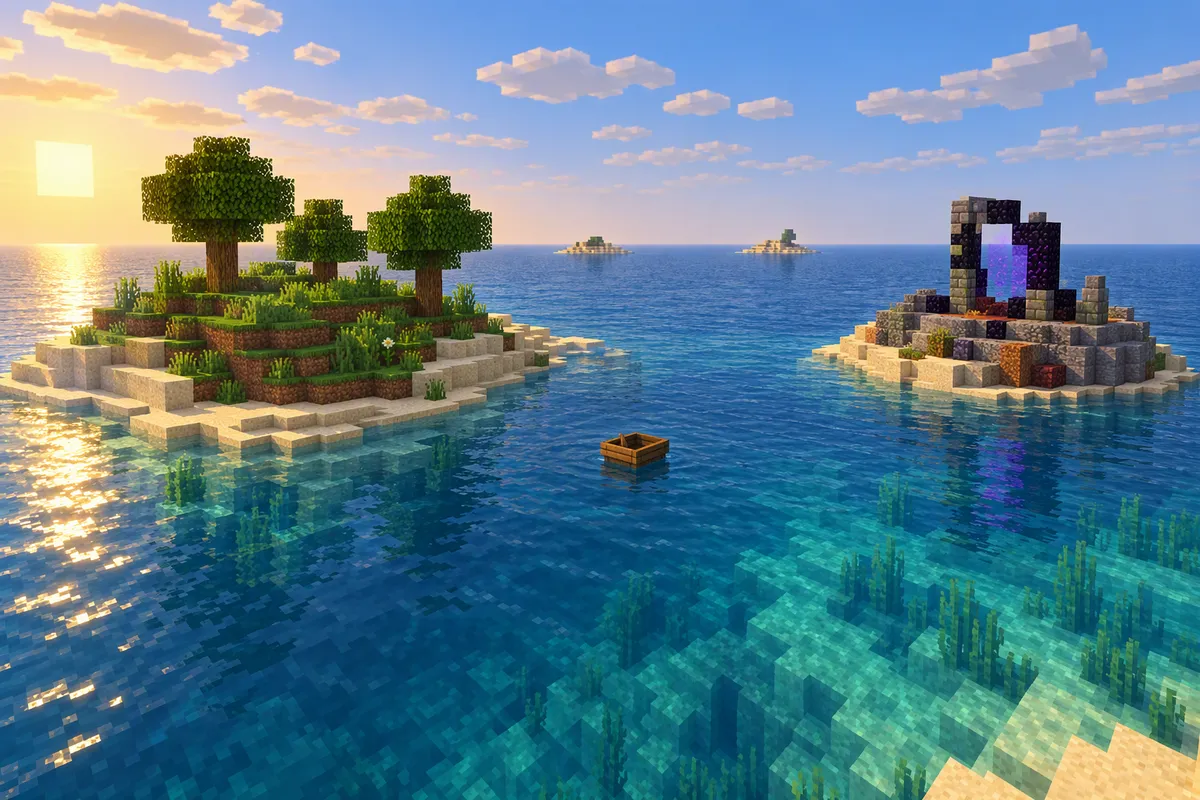
Good Java Seeds: 15 Java Rows in Our Record, and the 3 Seeds With a Neighbouring Island
The short answer
We hold twenty seed rows, and fifteen of them carry a Java version. Run the three checks we run on a Java seed — a recorded landing point, a version range bounded at both ends, and at least one named structure — and exactly one of the fifteen passes all three: 2016000 on Java 1.20–1.21. Now ask the archipelago question, whether another island is within reach, and the record splits in a way no seed list writes down: three rows describe a neighbouring island, and not one of those three is a Java seed. Two are Bedrock rows and one has no edition recorded at all. A Java player gets the neighbour as a coordinate with nothing written about it; a Bedrock player gets the neighbour in words with nothing to navigate by.
The only Java row that clears everything we check:2016000 — Java 1.20–1.21. What it gives you: a spawn you can measure from at 0, 63, 0, five structure coordinates, and the only recorded finish time in the table. What it lacks: any mention of a second island.
The Java row that names a second landmass:4188583766222650532 — Java 1.18+. What it gives you: nine structure coordinates, more than any other row, including a mushroom island at -300, -500. What it lacks: a spawn point, so none of the nine can be measured against where you land.
The second Java row with a pinned neighbour, and the one that was turned down:-9147459640944998301 — Java 1.18+. What it gives you: a spawn at 0, -550 and a mushroom island at 150, 750. What it lacks: a distance short enough to pass — Rejected: over distance
The archipelago row with the only tester-written distance in the table:-1276503895 — Bedrock, recorded as not working on Java. What it gives you: several small islands within 500 blocks of spawn, with the ruined portal on a neighbouring island. What it lacks: any coordinate at all.
The two-island row, and the one tree:-706198004 — Bedrock, no release recorded. What it gives you: a large island and a small one, one tree and a ruined portal on the small, a mine-shaft cave on the large. What it lacks: everything you can type into a teleport command.
The five codes that decide this page — the one Java row that clears every check: 2016000; the two Java rows with a pinned second landmass: 4188583766222650532 and -9147459640944998301; the two rows that describe a neighbour: -1276503895 and -706198004
The shape this page counts: a spawn island, a neighbour across the water carrying something the spawn does not, and no coordinate on either one.
What “good” means on this page, and why there is no score
“Good java seeds” is a phrase that usually arrives attached to a rating — seven out of ten, hardest start, best overall. We do not publish one, and the reason is simple: our testers did not write one down. What they wrote down is a landing point, a version, a list of structures and occasionally a sentence about what the island felt like. Anything graded on this page would be a grade we invented.
So “good” here means usable without guessing. Three specific things, and they are the three that decide whether a Java seed is worth an evening:
You can measure from where you land. A row with a spawn coordinate lets you work out how far anything else is. A row without one leaves every structure floating in space.
The version is bounded at both ends.1.18+ tells you the floor and nothing else. “Good on the release you actually run” needs a ceiling too, or a single numbered release.
Something is named that you can plan around. A village, a stronghold, a shipwreck, a mine shaft, a portal — one fixed thing that turns the first hour into a route instead of a wander.
All three at once, across fifteen Java rows, happens once. That is the finding, and it is a fact about our own spreadsheet rather than about the game: we hold twenty rows written by a handful of testers, not a scan of the seed space.
This page counts neighbouring islands inside the twenty-row coordinate table. The wider question — every seed on this site that names a second island at all, and how many of them tell you how far away it is — is counted on its own page: the archipelago seed count, where 11 of the 48 distinct seed codes name a second landmass and not one of them answers all three questions an archipelago run depends on.
Three rows describe a neighbouring island, and none of them is a Java seed
Our counting rule: a row counts if what the tester wrote names a second landmass in words. “Two islands” counts. A shipwreck does not — that is a structure, not land. A mushroom island coordinate is land, but it is recorded a different way, so it gets its own table below.
Row
Seed
Edition as recorded
What the tester wrote about the neighbour
Is the neighbour load-bearing?
3
-706198004
Bedrock, no release
Two islands: one tree and a ruined portal on the small one, a coastal cave with a mine shaft on the large one
Yes — the cave and the mine shaft are on the other island
6
-1276503895
Bedrock, recorded as not working on Java
Several small islands within 500 blocks of spawn, with the ruined portal on a neighbouring island
Yes — the portal is the obsidian route, and it is not on your island
20
2013
Unknown, flagged as possibly pre-1.13
A small secondary island alongside the main one, recorded as sand only
No — nothing but sand is recorded on it
Three rows out of twenty, and every single one of them fails the Java test. One is a Bedrock row with no release number. One is a Bedrock row the record explicitly says does not work on Java. One has no edition recorded at all and carries a standing warning that it may only generate before 1.13.
Two of the three neighbours are load-bearing, which is the part that matters: the thing that unblocks the start is not on the island you land on. On -1276503895 the ruined portal is on another island, and that portal is the cheapest obsidian route in our whole record — the full argument for checking portal chests before mining anything is on the obsidian route page. On -706198004 the cave and the mine shaft are on the large island while the single tree is on the small one. In both cases a spawn island that looks unplayable is playable once you own a boat.
The third neighbour is scenery. A sand-only island next to a seven-tree island does nothing for you, and it is worth saying so, because “archipelago” on a seed list usually means “more land” without saying whether the extra land has anything on it.
The other way a row records a neighbour: a pinned coordinate with nothing written about it
There is a second way our record says “there is another island”, and it never overlaps with the first one. Three rows carry a coordinate for a mushroom island — a separate landmass, pinned to a position.
Seed
Edition
Second landmass
Landing point recorded?
Distance
Whose number is it?
2016000
Bedrock 1.20.5
Mushroom island at -300, 64, 0
Yes — 0, 62, 0, open ocean
300 blocks on one axis
Ours — subtracting two recorded coordinates. The tester did not write a figure.
4188583766222650532
Java 1.18+
Mushroom island at -300, -500
No
Not measurable
Nobody’s — with no spawn recorded there is nothing to measure from.
-9147459640944998301
Java 1.18+
Mushroom island at 150, 750
Yes — 0, -550
150 blocks on one axis, 1,300 on the other
Both — the tester wrote “slightly over 1,000 blocks” without naming what it measures to; ours is the arithmetic from the two coordinates on the row.
That distance column is the reason for a column about who wrote the number. Two of the three figures on this page are our arithmetic from coordinates the testers recorded, not distances anybody measured in game, and one tester line — “slightly over 1,000 blocks” — is in the record without saying which structure it is measured to. Publishing which is which is the only honest way to publish either. The same rule governs every figure on the coordinate table.
No row does both, and that is the whole problem
Six of our twenty rows mention a second landmass. Three describe it in words and carry no coordinates. Three pin it to a coordinate and describe nothing about it. No row does both, and the split falls along the edition line:
How the neighbour is recorded
Rows
Editions
What you can do with it
Described in words, no coordinates
3
Two Bedrock, one unknown
Read what is over there. You cannot teleport to it, and the row cannot tell you how far it is.
Pinned to a coordinate, no description
3
Two Java, one Bedrock
Measure the trip, if the row also has a spawn. Nothing on the row says what is on the island.
Both
0
—
—
So the honest answer to “where are the good Java archipelago seeds” is that we do not have one, and we are not going to synthesise one from the two halves. What we can tell you is which half you are holding: if you play Java, the neighbour you get is a number you can measure and nothing else; if you play Bedrock, the neighbour you get is a sentence you can read and nothing else.
The reason is boring and worth saying out loud. The testers who filled the Java rows were surveying farm structures — witch huts, ocean monuments, Nether fortresses and bastions — for a server standard, which is documented on the server seeds page. The testers who filled the Bedrock rows were describing what they could see from the beach. Neither group was counting islands. That is a gap in our note-taking, not a property of world generation.
All fifteen Java rows, one check at a time
Every row in the record carrying a Java version, with the three fields that decide whether it is usable. Four of the fifteen were rejected against the server standard; they are marked and the reason each one failed is on the rejected seeds page.
Seed
Version as recorded
Landing point?
Bounded version?
Second landmass?
Verdict in the record
2016000
1.20–1.21
Yes — 0, 63, 0
Yes
No
Clears all three checks
-1463564255
1.15
No
Yes — a single release
No
Unplayable at spawn, per the tester
39720048960
1.18–1.21.2
No — a teleport command with a tilde
Yes
No
Bounded range, no landing point to measure from
-8350249385580253962
1.18+
Yes — -150, 250
No — floor only
No
Server candidate, quad witch hut row
3387664876512721018
1.18+
No
No — floor only
No
Server candidate
4188583766222650532
1.18+
No
No — floor only
Yes — mushroom island
Nine structures, nothing to measure them from
-9147459640944998301
1.18+
Yes — 0, -550
No — floor only
Yes — mushroom island
Rejected: over distance
-4217104969789286797
1.18+
No
No — floor only
No
Rejected: no dual monument
-1056083236240939372
1.18+
Yes — -625, 150
No — floor only
No
Rejected: crossroads too far
6900926224957998486
1.18+
Yes — 200, 350
No — floor only
No
Rejected: bastion too far
2589021139
1.18+
No
No — floor only
No
Five newest rows carry no numbers at all
32
1.18+
No
No — floor only
No
Prose only
354089350
1.18+
No
No — floor only
No
Prose only
-1103547699
1.18+
No
No — floor only
No
Prose only
6390326396262027557
1.18+
No
No — floor only
No
Prose only
Read down the columns and the shape of our own record is hard to miss.
Five of fifteen record a landing point. The other ten hand you structure positions you cannot relate to anything, because nobody wrote down where you start. This is the same gap that the Java checklist is built around, and it is why most “how far is it” questions about these rows have no answer.
Three of fifteen have a bounded version. Twelve stop at 1.18+. That is a floor, not a version, and it is the single most common failure on the Java side of the table.
Five of fifteen carry no numbers at all — the five newest rows, all logged on both editions at once with a prose description shared between them. They are the least usable rows in the table and the most recently written, which is backwards from what you would expect.
Two of fifteen name a second landmass, and one of those two was rejected for distance. Put bluntly: on the Java side of our record, an archipelago is a coordinate with nothing written on it.
What we will not claim
The gap this page is built on is a gap in our own record, and we would rather publish it than fill the column.
We are not claiming Java seeds with neighbouring islands are rare. We hold twenty rows. The correct sentence is that three rows describe a neighbour and none of them is Java, not that Java worlds lack islands.
We are not giving the three archipelago rows a version. Two are logged as “Bedrock” with no release, and one has no edition at all. Do not read “Bedrock” as “runs on current Bedrock”; that is what the Bedrock checklist is for.
We are not measuring distances the testers never measured. Two of the three figures in the distance table are our subtraction of two recorded coordinates, and every one of them is labelled as ours.
We are not scoring anything. There is no rating on this page and no difficulty out of ten. “Clears all three checks” is a statement about which fields a row fills in, not a grade.
We are not saying the four rejected seeds are bad seeds. They failed a server standard built around quad witch huts and bastion distance. Solo, three of them are perfectly playable islands.
The standard: four checks before you call a Java seed good
The sequence we run on a Java row, written so a row fails it fast. The last column is how our own fifteen rows do.
#
Check
What a pass looks like
Our fifteen Java rows
1
Is there a landing point?
A spawn coordinate, so every other position is measurable
5 of 15
2
Is the version bounded at both ends?
A release, or a range with a ceiling — not just 1.18+
3 of 15
3
Is at least one structure named?
Something fixed to route through: a village, a portal, a wreck
15 of 15
4
Does it say anything about a neighbour?
A second landmass, described or pinned — ideally both
2 of 15, and one of those is rejected
Check four is the one nobody runs, and it is the one this page exists for. Every seed list in the world will tell you what is on your island. Almost none will tell you what is on the next one, which is where the ruined portal, the cave and the planks usually are.
The rows that decide the question
Every seed on this page worth loading, with the tags the testers recorded rather than a rating.
Speedrun God Seed — 2016000
Clears all three checksSpawn 0, 63, 0Five structure coordinatesOnly recorded finish timeNo second landmass named
EditionJava 1.20–1.21
ChallengeNot rated by the tester
What you getA spawn at 0, 63, 0, a village at -24, 64, 12, a stronghold at -21, 42, 18, diamonds at -32, 11, 25, a desert temple and a jungle temple
The only row in our record that has a landing point, a bounded version range and named structures at the same time. It is also the only seed we hold with a recorded completion time, and the one where the same number produces a completely different world on the other edition — the full side-by-side is on Java vs Bedrock.
What it does not give you is an archipelago. Nothing on the row mentions a second island on Java; the mushroom island attached to this code belongs to the Bedrock world.
Dual Monument and Mushroom Island — 4188583766222650532
Nine structure coordinatesMushroom island at -300, -500Dual monumentNo spawn recordedVersion floor only
EditionJava 1.18+
ChallengeNot recorded
What you getA witch hut, an ocean monument, a pillager outpost, warm ocean, a mushroom island at -300, -500, two Nether fortresses, a bastion and a dual monument at 3850, -4150
The most detailed row in the table and the clearest example of the gap that makes detail useless: nine coordinates, not one of which can be measured against a landing point, because the landing point was never written down.
It is also the best illustration of check four. There is a second landmass, pinned to a position, and the row does not say one word about what is on it.
Multi-Biome Island — 39720048960
Bounded range 1.18–1.21.2Teleport commandNo landing pointNo second landmass
EditionJava 1.18–1.21.2, Bedrock 1.18–1.21.50
ChallengeNot recorded
What you getA multi-biome island reachable with /tp -576 ~ 80, recorded with ice peaks, dark forest, jungle, bamboo, stone shore and a lush cave
One of only three Java rows with a version bounded at both ends, and the only one whose coordinate is a command rather than a position — the tilde stands in for a height nobody recorded.
Worth noting for anyone running both editions: the Bedrock range on this row runs higher than the Java range. Two numbers, one seed, two ceilings.
Hell Difficulty Island — -1463564255
Single named releaseTwo shipwreck coordinatesUnplayable at spawnNo landing point
EditionJava 1.15
ChallengeThe tester’s own words: “This is truly hell difficulty. A true wasteland.”
What you getAlmost nothing on the island itself, one small vertical mine shaft, and two shipwrecks at 120, 54, -202 and 393, 56, 25
The only row in our record where a tester concluded the spawn cannot be lived in. The verdict is blunt: you cannot survive at this spawn, you can only brave the ocean and explore.
It is also the clearest version warning in the table — a single release from before the terrain overhaul, never re-loaded on anything modern. We have not re-tested it and we are not going to guess. The wider argument about old codes is on the old codes page.
Ancient City Island — 6390326396262027557
Mountain islandRich starting resourcesNo coordinatesVersion floor only
EditionJava + Bedrock, 1.18+
ChallengeNot recorded
What you getA mountain island with rich initial resources and an ancient city underneath it, warden included
One of the five newest rows, and one of the five Java rows carrying no numbers at all. What it has instead is prose worth reading: an ancient city under a survival island is a mid-game objective sitting directly below your first shelter.
Everything else about it is unverified, including whether both editions generate it the same way. Nothing on the row records a position, a spawn, or a ceiling on that version.
What to do in the first ten minutes when there is another island in sight
The order below is the one our testers wrote down while playing, rearranged for the shape this page is about: a spawn island, and land you can see that is not yours yet. It assumes you have wood on your island. If you do not, the one-tree page covers that case first.
Chop trees first, and leave one sapling standing. “To get rich, first chop trees.” Wood is the ceiling on everything else, and a boat is wood. On an island with a neighbour in sight, the boat is not a convenience, it is the whole plan.
Build the boat before you build anything else. Every archipelago row in our record puts something load-bearing on the other island — a ruined portal, a cave, a mine shaft. None of those is reachable by swimming with a full inventory, and none of those rows tells you how far it is.
Check the ruined portal chest before you mine any obsidian. On -1276503895 the portal is on the neighbouring island, which means the boat comes first and the mining may never happen. Counting what a chest already gives you is the entire argument on the obsidian route page.
Scan the coast for a shipwreck before you cross. Shipwrecks supply planks, iron and treasure maps, and on the two-island row the wreck is what made a one-tree island survivable. It is usually closer than the other island.
Only then cross, and set a bed before you explore. The record’s own constraint is blunt: you cannot sleep on the ocean, and supplies are difficult to restock. Crossing for the day and swimming back at dusk is how a good archipelago seed becomes a lost one.
If the neighbour is sand and nothing else, leave it and go further. One of our three archipelago rows records a second island as sand only. Not every extra island is worth the trip; the check is what is on it, not that it exists.
If you are picking one of these for a shared world
An archipelago is the best shape for a group and the worst shape for a decision. Four players on one island are fine; four players spread across three islands need a rule about who crosses, and our record gives you nothing to plan that with. Two of our three archipelago rows carry no coordinates at all, so “the second island” is a direction rather than a destination.
The version question gets sharper with more people on it. Of the fifteen Java rows, twelve stop at 1.18+ and only three name a ceiling. Four players joining on four different updates will not see the same island, and somebody will insist the seed is wrong. Settle the edition and the release before anyone loads it.
A good seed is better with people on it. If you want to host one and run these islands together, Java or Bedrock, Shockbyte is a low-cost host that sets up in minutes. Use code LAUNCH for 25% off your first month. If you sign up through that link, I may receive a commission at no extra cost to you. It does not change what you pay.
Frequently asked questions
Do you have a Java seed with a second island?
Two of our fifteen Java rows put a second landmass in the world, and both do it with a coordinate rather than a description: 4188583766222650532 has a mushroom island at -300, -500, and -9147459640944998301 has one at 150, 750. The second of those was rejected for distance. The three rows that actually describe a neighbouring island in words are all non-Java.
How far is the neighbouring island on -1276503895?
The tester wrote that there are multiple small islands within 500 blocks of spawn, and that the ruined portal sits on a neighbouring island. Five hundred blocks is the tester’s own figure. The row carries no coordinates at all, so no distance on it can be checked against a position.
Why do only five of your Java rows record a spawn point?
Because most of them were written to survey structures rather than to navigate from a landing spot. Five of the fifteen Java rows carry a Spawn coordinate. The other ten give structure positions with nothing to measure them from, so any distance claim about those ten would be invented.
What makes a Java seed good in your records?
Three things at once: a recorded landing point, a version range bounded at both ends rather than an open 1.18+ floor, and at least one named structure you can plan a route around. One of our fifteen Java rows has all three, and it is 2016000 on Java 1.20 to 1.21.
Is 2016000 a good Java seed?
It is the only row in our record that clears every check we run. It is the only Java row with a bounded version range and a spawn coordinate at the same time, it carries five structure coordinates, and it is the one seed in the table with a recorded completion time. It is also the seed where the same number produces a completely different world on Bedrock.
Can I load the Bedrock archipelago seed -706198004 on Java?
We have no Java result for it. The row is logged as Bedrock with no release number and no coordinates, and nothing in the record says it was ever loaded on Java. Treat a Bedrock-only row as a Bedrock row; the checks for whether it runs on the release you have are on the Bedrock checklist.
How many of your Java rows have a version bounded at both ends?
Three of the fifteen. 2016000 is on Java 1.20–1.21, -1463564255 is on a single release, 1.15, and 39720048960 is on 1.18–1.21.2. The other twelve stop at 1.18+, which is a floor with no ceiling, so they tell you the earliest release the row might have been made on and nothing about the version you are running.
Why were four of the fifteen Java rows rejected?
They failed a server standard, not a difficulty test. -9147459640944998301 was turned down over distance, -4217104969789286797 for having no second ocean monument, -1056083236240939372 because the crossroads was too far out, and 6900926224957998486 because the bastion was too far out. Three of the four are playable solo islands; they were measured against a standard built for a shared world.
Does any row both describe the neighbouring island and give its coordinates?
No. Zero of the twenty rows in the record do both. Six of the twenty mention a second landmass at all, and they split cleanly: three describe it in words and carry no coordinate, three pin it to a coordinate and write nothing about what is on it. That is why the neighbour question has no complete answer anywhere in our table