Best Java Seed for the Nether: The Obsidian Route Nobody Records
The short answer
Twenty island seeds are in our records. Four of them record any way at all to get obsidian, and one of those four is a Java seed — 2016000 on Java 1.20–1.21, where the village blacksmith chests held three obsidian. Three is not a portal; a frame needs ten. Every ruined portal in the table sits on a Bedrock row: zero of the fifteen Java rows has one, and three of the ten Bedrock rows do. That is the honest answer to “best Java seed for the Nether”, and it is a gap in what we tested rather than a fact about the game.
The five codes that matter for this problem, and what each one actually gives you:
The only Java seed with obsidian on it:2016000 — Java 1.20–1.21, village at -24, 64, 12, blacksmith chests with 3 obsidian inside. Partial, but it is the one Java row we can put a version on.
The only full portal built without leaving the island:-1276503895 — diamond exposed to open air with a lava pool beside it. Recorded on Bedrock, and the note says it does not work on Java.
Ruined portal on the island itself:-706198004 — Bedrock, one tree, and the tester’s own line: “I checked the ruined portal chest and found useful items.”
Ruined portal one biome over:-665393669 — Bedrock, badlands with a portal, plus ocean ruins that generated on land and held a stone axe.
The Java row with no route at all:-1463564255 — Java 1.15, two shipwrecks at 120, 54, -202 and 393, 56, 25, and nothing anywhere in the record that becomes obsidian.
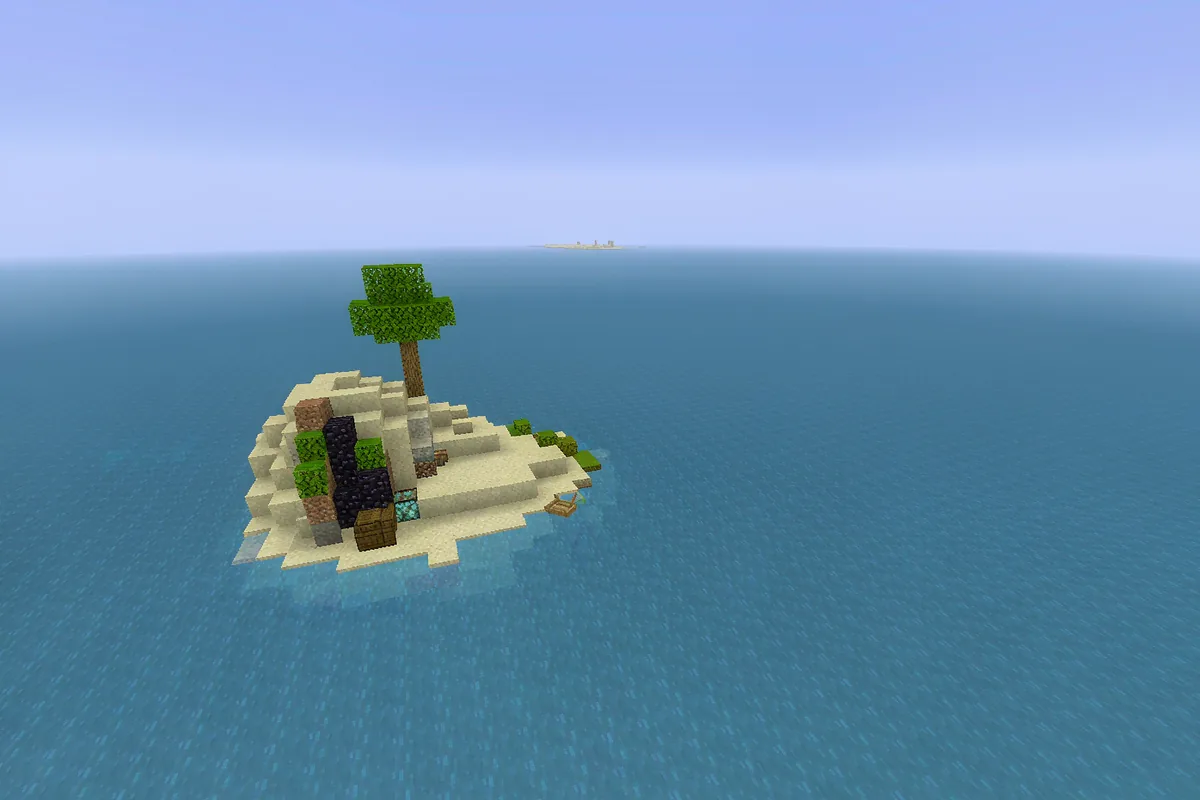
The one Java code in our records with obsidian recorded on it — seed 2016000, three blocks, Java 1.20–1.21
Obsidian is the one thing on an island you cannot replace by chopping a tree. Here it is exposed in the cliff rather than mined, which is the difference between a route and a trip to the Nether: the four rows in our record that mention obsidian at all all describe it as found, never as mined, and three of the four are a ruined portal frame you finish rather than a block you dig for.
Obsidian is the gate, and it is the one thing nobody writes down
Guides treat the Nether portal as a milestone you reach once the island is working. On an island it runs the other way round: the portal is what you build so that the island can work, because an island cannot restock itself. One tester put it plainly while playing -706198004: “You cannot sleep on the ocean. Supplies are difficult to restock. Perhaps getting obsidian and going to the Nether is the better choice.”
That makes obsidian the gate on the whole run. You cannot cut it without a diamond pickaxe, you cannot light a portal without ten blocks of it, and you cannot reach the End without the Nether. What happens after day ten is measured in Nether blocks rather than overworld blocks for exactly this reason.
And yet it is the least recorded field in seed lists. Ours included. Every row in our table has a description of the island, most have coordinates to something, and almost none says where the obsidian came from — which means a list can hand you eight structure coordinates and still leave you standing on a beach with no way through the gate.
The four rows in our record that say anything about obsidian
Out of twenty seeds, these are the only rows where the record contains a route to obsidian. The tag column is the tester’s own conclusion, not a score — we do not rank seeds, and nothing on this page is a rating.
Seed code
Edition
What the record says about obsidian
Route class
Tag
2016000
Java + Bedrock — Java 1.20–1.21
Village blacksmith chests held iron chestplate, 3 obsidian, 2 bread, 1 saddle
Looted, partial
Partial obsidian in chestBounded version rangeThree is not a frame
-706198004
Bedrock
Ruined portal on the small island; tester looted the chest first and found useful items
Frame, on the island
Ruined portalOne treeNo version recorded
-665393669
Bedrock
Badlands nearby with a ruined portal; ocean ruins generated on land and held a stone axe
Frame, off the island
Ruined portalLand ocean ruinsNo version recorded
-1276503895
Bedrock
Ruined portal on a neighbouring island; diamond vein exposed to open air with a lava pool beside it
Frame nearby, plus full pipeline on the island
Full portal on the islandDoes not work on JavaNo version recorded
Two things stand out in that table, and neither is flattering to us. All four rows are missing something: three carry no version number at all, and the one that does carries three obsidian rather than ten. And the single most valuable row in it — the only place where a portal was built end to end on the island — is on an edition that the same row says does not run the Java seed you asked about.
Zero of fifteen Java rows has a ruined portal. Three of ten Bedrock rows do.
This is the number that decides the answer to the target question, so it is worth putting on its own. We counted the twenty rows twice, once per edition — 2016000 appears as two rows because it was recorded on both — and this is what the count gives.
Edition
Rows
With a ruined portal
With any obsidian route
With no route recorded
Java
15
0
1
14
Bedrock
10
3
3
7
None recorded
1
0
0
1
Read that as a statement about our own testing, because that is what it is. We are not claiming Java worlds generate fewer ruined portals, and we are not claiming Bedrock islands are easier to leave. We are saying that in twenty records of island seeds, the cheapest obsidian route available — the one where the game has already placed the blocks for you — appears three times, and every one of those three times it was written down on a Bedrock world.
The Java side of the same table is not empty by accident either. It is where the mapping work happened: the Java rows are the ones carrying eight and nine structure coordinates, the Nether fortress positions, the bastion positions. The Bedrock rows are the ones carrying the portal. Two different kinds of note-taking, made by two different testers, and the gap between them is the whole of this page.
Seven Java rows map the Nether and none of them records the door
Here is the clearest version of the problem. Seven Java rows in our table carry the coordinates of Nether structures — every one of them records a bastion, and four also record a Nether fortress. Not one of those seven says how the portal was built.
The four rejected rows at the bottom make the point sharper. Each one was turned down on a named line — distance, no dual monument, a crossroads too far, a bastion too far — and every one of those is a judgement about the Nether that assumes you already got in. The rejection criteria and the door are two separate things, and only the first was written down. The four that cleared the same standard are on the server-grade page, and the four that did not are on the rejected page.
Three ways past the wall, ranked by what each one costs
These are not equivalent routes. They are ranked by how much of the island you have to spend to walk them, and the ranking is the reason the order rule below exists.
Class
What it costs you
What our record actually supports
Seeds
A. Frame first — complete a ruined portal
Nothing, if enough of the frame survived. You are filling gaps, not cutting blocks.
Three rows, all Bedrock. None records how many blocks survived, so the route is recorded as available, not as sufficient.
-706198004 / -665393669 / -1276503895
B. Pipeline — diamond to pickaxe to lava to obsidian
A diamond pickaxe, which means diamonds first, which means iron before that.
One row, and it is the strongest single find in the record: every input to the portal was on one island. The row is Bedrock and the note says it does not work on Java.
-1276503895
C. Looted partial
A chest you would open anyway.
One row, three blocks out of ten. Useful as the last few blocks of a frame you are already building, never as the plan.
2016000
D. No route recorded
Everything, or a boat.
Sixteen of the twenty rows. On those the honest move is to leave rather than to dig.
The rest of the table
Class A and class B are the two worth caring about, and the record holds an asymmetry between them that no seed list mentions: the cheap route is only written down on Bedrock, and the expensive route is only written down on a seed that will not run on Java. If you are a Java player, our record hands you neither. It hands you three obsidian in a chest and a stronghold under a well.
The order rule: chest, then count, then mine
This is the part of the record that is easy to read past, because it looks like a preference and it is actually a sequence. The tester on -706198004 wrote the order down while playing, and the order was: portal chest first, then mining along the sandbar, then the shipwreck further out.
That order is not politeness. Run it backwards and here is what happens: you spend the day getting iron, then diamonds, then a pickaxe good enough to cut obsidian, then you cut your ten blocks — and then you walk past a ruined portal that already had most of a frame standing on it. Every block you mined was free on the island the whole time. On an island with one tree, that costs you more than obsidian, because the thing you cannot restock on an island is daylight.
Step
What you do
What it costs
What it tells you
1. Loot the chest
Open the ruined portal chest before you touch anything else.
Nothing.
Whether the run has free supplies. This is the only part of a ruined portal the record guarantees — the tester on -706198004 found useful items in it.
2. Count the frame
Walk the frame and count the obsidian blocks that are still standing.
Nothing.
Whether you are completing a portal or building one. Ten is the number a frame needs; the difference is whether you are filling gaps or cutting blocks.
3. Then, and only then, mine
Start the iron to diamond to pickaxe chain.
The whole early game.
Whether this is an island run or a leaving run. If steps one and two came up empty, a boat is cheaper than a tunnel.
4. Write the number down
Record the count and the coordinates before you move on.
One line.
Whether anyone can check your result later. Sixteen of our twenty rows have no obsidian route precisely because nobody wrote one down while they were playing.
Step three is the fork, and it is the same fork that appears on the Java checklist: a seed you can measure is worth more than a seed that sounds good. If your island has no portal, no diamond and no lava pool, the record’s own advice is to go and find obsidian elsewhere rather than try to make a barren island self-sufficient.
The five seeds, and what each one is for
Speedrun God Seed — 2016000
Java + BedrockJava 1.20–1.21Partial obsidian in chestBounded version rangeThree is not a frame
This is the answer for a Java player, and the answer is deliberately modest: it is the only Java row in twenty with any obsidian recorded on it, and the amount recorded is three. Three out of ten is not a portal. What makes the row worth loading anyway is everything around it — a village with two forges at a pinned coordinate, a stronghold eleven blocks under the well, and the only bounded version range on a Java island row in the whole table.
It is also the clearest illustration of the edition trap in our records: the same code on Bedrock was recorded as open ocean at 0, 62, 0 with no trees at all. Same number, two different worlds. That split is the whole subject of the Java vs Bedrock page.
Treat the three obsidian as the last three blocks of a frame, not as the frame.
Diamond-to-Portal Island — -1276503895
BedrockFull portal on the islandRuined portal nearbyDoes not work on JavaNo version recorded
IslandBarren, a few trees and some sugar cane
UndergroundA diamond vein exposed to open air inside a mineshaft, with a lava pool beside it
Around itGlacier, ocean monument, shipwreck in an underwater canyon, several small islands within 500 blocks, ruined portal on a neighbouring island
Tester conclusionThe underground diamond-to-portal pipeline makes the barren spawn viable
This is the strongest single find in the entire record, and it belongs to exactly one seed. Read it as a pipeline rather than a lucky break: the exposed diamond becomes a pickaxe, the pickaxe cuts obsidian, the lava pool beside the vein is where the obsidian comes from, and the portal goes up on the island you spawned on. No shipwreck needed, no mainland trip, no boat.
The reason it cannot be your Java answer is on the row itself. It was recorded on Bedrock, the note says explicitly that it does not work on Java, and it carries no version number. We have not loaded it on Java and we are not going to claim what would happen if you did.
One of two entries in our records where every input to a Nether portal was found on a single island. The other is the same seed.
One Tree Island — -706198004
BedrockRuined portalOne treeNo version recorded
Small islandExactly one tree, plus a ruined portal
Large islandSmall coastal cave with a mineshaft
Further outShipwreck holding planks and a treasure map
Tester noteI checked the ruined portal chest and found useful items
ConstraintYou cannot sleep on the ocean. Supplies are difficult to restock.
One tree. That is the entire wood supply on the small island, and next to it a ruined portal. The tester worked it in a specific order and wrote the order down — portal chest, then mining the sandbar, then the shipwreck — and that order is the one you should use when you have one tree and no guarantee of a second.
The constraint recorded on this row is the honest one, and it is the reason the portal matters more than the tree here: an island that cannot restock itself is not a base, it is a launch point. The suggested way out in the tester’s own words is to get obsidian and go to the Nether rather than try to make it self-sufficient.
One of three rows in the table with a ruined portal. None of the three records how much of the frame survived.
Land Ruins Island — -665393669
BedrockRuined portalLand ocean ruinsNo version recorded
IslandSmaller than the others but with more trees
Ocean ruinsGenerated on land instead of underwater, which is rare — chest held a stone axe and a treasure map
Below the ruinsIron ore and two overlapping chests
NearbyBadlands biome with a ruined portal
Tester conclusionMore trees is better than a bigger island
This is the row to load if you want the frame route without the one-tree punishment. The portal is not on the spawn island — it is in badlands nearby — so step two of the order rule still applies: count what survived before you commit to mining anything.
The rarity here is the ocean ruins. They generated on land rather than underwater, the chest held a stone axe, and directly below the tester found iron ore and two overlapping chests. A stone axe on day one removes the wood problem on an island that still has trees to spare, and the tester’s conclusion was that food stopped being a concern at all.
The only row where a tool, a food start and a portal all appear in the same record.
Hell Difficulty Island — -1463564255
Java 1.15Two shipwrecksNo obsidian route recordedPre-overhaul versionNot re-checked on 1.18+
IslandBarren, with a small mineshaft at one corner
Shipwreck 1120, 54, -202
Shipwreck 2393, 56, 25
ObsidianNothing in the record that becomes any
Tester noteThis is truly hell difficulty, a true wasteland
Load this one to see the leaving case rather than the portal case. Two shipwrecks are the whole early-game plan — wrecks are how island runs get wood, food and a treasure map when the island offers nothing — and after that the record has no route at all.
It is also the row that shows why the version field matters on this page specifically. It was recorded on 1.15, before the overworld generation overhaul, and it has not been re-checked since. If you want a Java seed you can trust on a later release, use 2016000 above.
Fourteen of the fifteen Java rows in our table look like this one: no obsidian route recorded anywhere on the row.
What to do in the first ten minutes once it loads
The order below is the order in our testing notes, and it is built around one idea: do the free things before the expensive ones. On an island that rule is not a preference, because you cannot restock the daylight you spend.
Count the trees, then chop most of them and keep one standing. One tree means one plank budget and one sapling you cannot afford to lose. To get rich, first chop trees — that is the rule these notes are built on.
Loot any ruined portal chest before you touch the frame, and before you mine anything. The chest is free and it is the only part of a ruined portal the record guarantees. On -706198004 the tester found useful items in it.
Count the obsidian still standing in the frame. Ten is what a frame needs. If most of it survived you are completing a portal; if none of it did, you are building one, and that is a different plan with a different price.
Only then start the iron to diamond to pickaxe chain. This is the route that costs the most and it is the one people start first. Starting it first is how you mine ten blocks you already had.
Walk the shoreline rather than inland. Both wrecks on -1463564255 are in the water, at 120, 54, -202 and 393, 56, 25. On island seeds the structures sit in the ocean more often than on the land.
Write down the count, the coordinates and the version. Three of our four obsidian rows carry no version at all, and sixteen of twenty carry no route. Do not add to either count.
Step four is the fork. If the island has produced a portal by the end of day one, the island is a launch point and everything after day ten opens up. If it has not, the recorded advice is to go and get obsidian rather than try to make a barren island feed itself.
After the portal, and what changes on a shared world
Once a portal pair exists, distance stops being the constraint it was. That is what makes a distant structure an errand rather than a project, and it is why the seven Java rows above bother to record fortress and bastion positions at all — those coordinates only matter once you are through the gate.
What does not collapse is the edition question, and on this page it is the live one. Three of the ten Bedrock rows in our table have a ruined portal and zero of the fifteen Java rows do. If you are choosing a seed for a shared world, every player has to be on the same edition and the same release, because a version difference produces the same mismatch you get between Java and Bedrock: same code, different terrain, and a complaint that the seed does not work. With three of the four obsidian rows carrying no version number at all, that is not a theoretical risk.
And if you want the full coordinate set for any of these codes rather than the obsidian story alone, the coordinate table carries all twenty rows with every number that was recorded, including the ones where nothing was.
A good seed is better with people on it. If you want to host one and run these islands together, Java or Bedrock, Shockbyte is a low-cost host that sets up in minutes. Use code LAUNCH for 25% off your first month. If you sign up through that link, I may receive a commission at no extra cost to you. It does not change what you pay.
Frequently asked questions
What is the best Java seed for reaching the Nether from an island?
In our records there is exactly one Java seed with any obsidian recorded on it: 2016000 on Java 1.20–1.21, where the village blacksmith chests at -24, 64, 12 held three obsidian. Three blocks is not a portal, which needs ten, so no Java row in our table hands you a finished route. What that seed does give you is a bounded version range, a stronghold recorded eleven blocks under the village well, and a completed 27-minute run.
Does a ruined portal count as an obsidian source?
Yes, if enough of the frame survived, because you are completing a shape rather than cutting blocks. Three of the twenty rows in our table record a ruined portal, and every one of them is a Bedrock row. None of the three records how many obsidian blocks were still standing, which is the number that actually decides whether the route works — so we can tell you the portal is there and we cannot tell you it is enough.
Why do none of your Java seeds have a ruined portal?
Because none of the fifteen Java rows in our table records one. That is a gap in what we tested, not a claim about the game: we are not saying Java worlds lack ruined portals, we are saying our own record does not contain one on a Java row, and we will not fill that gap by guessing. The three portal rows we do have carry no version number either.
How much obsidian do I actually need for a Nether portal?
Ten blocks for the smallest frame that will light. That number is why the looted route never closes the gap on its own: the largest amount of obsidian recorded anywhere in our twenty rows is three, in the blacksmith chests of 2016000 on Java, and three out of ten is a contribution to a frame you are already building rather than a plan. You also cannot cut obsidian without a diamond pickaxe, so the mining route has its own price before it gives you anything.
Can I use the diamond-to-lava pipeline on Java?
We have not verified it on Java, so we will not tell you it works there. The one record of that pipeline is -1276503895, where a diamond vein sat exposed to open air beside a lava pool and the whole portal was built on the spawn island. That row was recorded on Bedrock, and the note on it says the code does not work on Java.
What should I do first if my island has a ruined portal?
Loot the chest, then count the intact blocks in the frame, then decide whether to mine. In that order, because the order is what saves you the work: the chest costs nothing and is the only part the record guarantees, the frame count tells you whether you are completing a portal or building one, and mining is the route that needs a diamond pickaxe before it gives you anything. On -706198004 the tester wrote that exact order down while playing.
How far do I have to travel to reach the ruined portal on these seeds?
Only one of the three rows that record a ruined portal gives a number at all: seed -1276503895, where the portal sits on a neighbouring island with several small islands recorded within 500 blocks. Seeds -706198004 and -665393669 place theirs in words only — further out, and in badlands nearby. Across the twenty rows in the table, three use any distance word in prose, and all three of them use the same word, near. The structures have coordinates; the distance does not.
How many of these five seeds are recorded on Java at all?
Two. Seed 2016000 was recorded on Java 1.20–1.21 and on Bedrock 1.20.5, and seed -1463564255 on Java 1.15 and nothing later. The other three were recorded on Bedrock only, and none of the three carries a version number. That is the real size of the question this page exists to answer: when you ask for the best Java seed for obsidian, the record hands you two candidates to argue about, not five.
Which of these five has nothing in the record that becomes obsidian?
Only seed -1463564255. The row's own line on it is that nothing in the record becomes any obsidian at all. The other four each record obsidian in some form: three blocks in blacksmith chests on 2016000, an exposed diamond vein beside a lava pool on -1276503895, and a ruined portal on both -706198004 and -665393669. We list the empty row on purpose, because a row with nothing in it is the only honest way to show how thin the obsidian coverage is.