Best Seed for Minecraft Java: 15 Java Rows, and Only One Says How Hard It Is
The short answer
We hold twenty island seed rows and fifteen of them run on Java. One of those fifteen carries a difficulty label in its name. Zero of twenty carries a difficulty number. Four rows carry a word that looks like a grade and is not one: Challenge, Survival, resource-rich, and one row that holds rich initial resources and an ancient city with a warden at the same time and never decides which one wins. The one label we have sits on the only Java 1.15 row in the record, which we have not re-loaded on 1.18 or later.
The only row with an explicit difficulty label:-1463564255 — Java 1.15 only. Name says "Hell Difficulty Island". Description: a barren island with a small mine shaft and two shipwrecks. The label was written on 2021-03-07, the row has not been re-checked on a current release, and we will not tell you the label still holds. Difficulty: HellNever re-testedJava 1.15 only
The Java row with six coordinates and no difficulty word:2016000 — Java 1.20–1.21. Spawn 0, 63, 0, village -24, 64, 12, stronghold -21, 42, 18, diamonds -32, 11, 25, desert temple -320, 64, 180, jungle temple 450, 63, -270. Six answers to "where", zero to "how hard". Six coordinatesDifficulty field blank
The row with the deepest record and the quietest difficulty:4188583766222650532 — Java 1.18+. Nine structure coordinates including a dual monument at 3850, -4150 and a mushroom island at -300, -500. The description is nine lines of numbers and not one word about challenge. Nine coordinatesDifficulty field blank
The row that says "Challenge" in the name and reads like the opposite:2589021139 — Java and Bedrock 1.18+. Name says "Jungle Challenge Island", description says large jungle with cocoa beans, bamboo, a nearby shipwreck and ocean ruins. The grade-shaped word is in the title, the description is full of good news. "Challenge" in name onlyResource-positive description
The row with two signals and no grade:6390326396262027557 — Java and Bedrock 1.18+. Name says "Ancient City Island", description says "rich initial resources" and an underground ancient city with a warden. The row carries an ease signal and a danger signal in the same sentence and never says which one wins. Two signals, no gradeWarden under the surface
The five codes that decide this page — the only difficulty label: -1463564255; the deepest row: 4188583766222650532; the most coordinates: 2016000; the look-alike: 2589021139; the two-signal row: 6390326396262027557
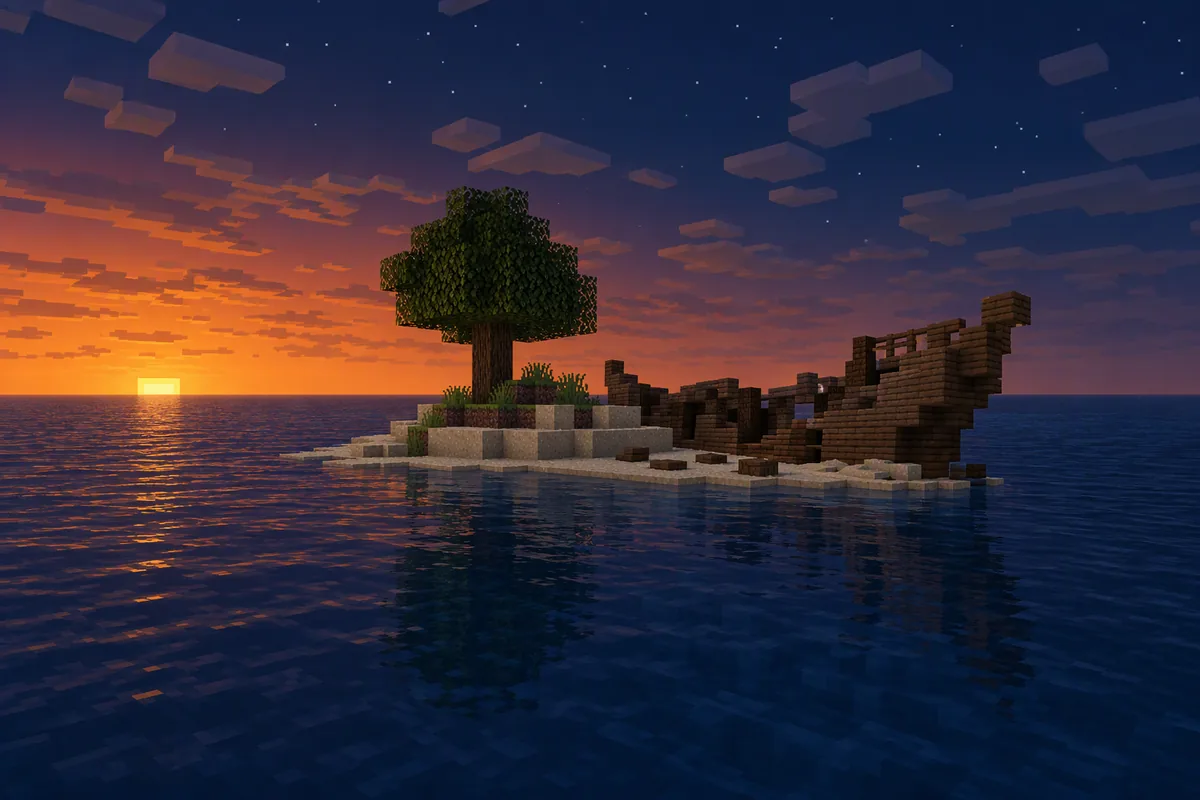
The record tells you what the island looks like and never how hard it is, so the picture has to stop at the moment the difficulty is about to be decided: a small island in the last light, one tree, a half-broken shipwreck on the sand, and dark water all the way to the horizon, with no village light to walk toward and no village name on the row to tell you what you would have found.
Why a list of the best Java seeds needs a difficulty column we do not have
Every list of the best Minecraft Java seeds you will find online is doing the same two things. It hands you a code, and it tells you the code is good. The second half is where the numbers usually come from, and they are usually invented. A difficulty score, a star rating, a rank from one to ten — none of it can be checked against anything we can load.
This page does not do that. There is no score here and no ordering from best to worst. The numbers on this page all count rows in our own record, which is twenty rows long, and every one of those rows is something somebody wrote down after loading a world. That makes the numbers small and checkable, and it makes them the only kind of number we are willing to publish.
So when this page says a seed is one of the best Java seeds we have, what it means is narrower than it sounds. It means the row tells you more than the others do. -1463564255 is the best-graded row in the table, because it is the only one that says how hard the island is. That is a statement about a single field, and it is also the entire difficulty record we have.
The full coverage: does each of the twenty rows state a difficulty?
Counting rule we are publishing up front, because the whole page turns on it. A difficulty label is a word or phrase that assigns a level or grade to the whole island, like the "Hell Difficulty" in row 5's name. Adjectives that describe the surface are not a difficulty label: "barren", "resource-rich" and "extra-large" describe what the ground is made of, not how hard the island is. The count below uses the strict definition. We will give the looser count at the end of the section.
#
Seed
Edition
Name as recorded
Difficulty label in the row?
1
2016000
Java 1.20–1.21 + Bedrock 1.20.5
Speedrun God Seed
No — name implies speed, not difficulty
2
2016000
Bedrock 1.20.5
Bedrock Ocean Spawn (same code as #1)
No
3
-706198004
Bedrock
One Tree Island
No — scarcity by count, not a grade
4
-665393669
Bedrock
Land Ruins Island
No — "more trees" is comparative, not graded
5
-1463564255
Java 1.15
Hell Difficulty Island
Yes — the only one in twenty
6
-1276503895
Bedrock only (not Java)
Diamond-to-Portal Island
No — "barren" is a surface adjective under the strict rule
7
-8350249385580253962
Java 1.18+
Quad Witch Hut Island A
No
8
3387664876512721018
Java 1.18+
Quad Witch Hut Island B
No
9
4188583766222650532
Java 1.18+
Dual Monument + Mushroom Island
No
10
-9147459640944998301
Java 1.18+
Rejected: Over-distance
No — rejection is a verdict, not a grade
11
-4217104969789286797
Java 1.18+
Rejected: No Dual Monument
No
12
-1056083236240939372
Java 1.18+
Rejected: Crossroads Too Far
No
13
6900926224957998486
Java 1.18+
Rejected: Bastion Too Far
No
14
39720048960
Java 1.18–1.21.2 + Bedrock 1.18–1.21.50
Multi-Biome Island
No
15
2589021139
Java + Bedrock 1.18+
Jungle Challenge Island
No — "Challenge" is a name, the description is positive
16
32
Java + Bedrock 1.18+
Plains Survival Island
No — "Survival" is the game mode, not a grade
17
354089350
Java + Bedrock 1.18+
Mixed Biome Island (resource-rich)
No — "resource-rich" is a positive descriptor
18
-1103547699
Java + Bedrock 1.18+
Kingdom Island (extra-large)
No — "extra-large" is a size, not a grade
19
6390326396262027557
Java + Bedrock 1.18+
Ancient City Island (rich initial resources + warden)
No — two signals in one row, no grade
20
2013
Unknown edition, possibly pre-1.13
Classic Island (7 trees, no animals)
No — "no passive mobs" is an absence, not a grade
One row in twenty carries a difficulty label. Zero of twenty carries a difficulty number. If you also count "barren" on row 6 as a difficulty adjective (it describes how empty the island is, which is closer to a grade than a surface word), the count goes from 1 to 2 — and the second row is not a Java row, so on the Java side the count stays at 1 out of 15. If you also count "resource-rich" and "rich initial resources" as ease labels, the count goes from 1 to 4, but only 1 of those 4 is actually a difficulty word, and the other 3 say the island is easier than average. We are telling you which way we counted because the whole point of a number like this is that you can redo it.
Four rows carry a word that looks like a difficulty and is not one
Three of the nineteen blank rows carry an adjective that reads like a grade at a glance. None of them is a grade. Naming them lets you see why the headline is 1, not 4.
Row
Seed
The grade-shaped word
What the row actually says
Why it is not a difficulty
15
2589021139
"Challenge" (in the name "Jungle Challenge Island")
Large jungle island, cocoa beans, bamboo, nearby shipwreck and ocean ruins
Name has the word, description has only good news. The label is in the title, the evidence is in the text.
16
32
"Survival" (in the name "Plains Survival Island")
Small grass island, a few trees, sheep, an underground cave with a spawner
"Survival" is the game mode, not a grade. Every row in the table is a survival row.
17
354089350
"resource-rich" (in the description)
Resource-rich island, dense trees, animals, cave with redstone, diamonds, lava lake
Counts as an ease word, not a difficulty. The row says the island is full, not how hard it is.
19
6390326396262027557
"rich initial resources" (ease) and "ancient city with warden" (danger) in the same sentence
Mountain island, rich initial resources, underground ancient city with a warden
The row carries an ease signal and a danger signal at the same time and never says which one wins. A row with two opposite signals is its own kind of blank.
Row 19 is the only one in the table that holds both an ease word and a danger word in the same description. Most rows pick one tone; this one holds both and the record does not resolve them. That is a second, quieter way a row can be missing a difficulty label — not because nobody said anything, but because the row says two things and stops.
Two questions, zero overlap: where you land and how hard it is
Six rows in the record carry a spawn coordinate — that is, a number that says where you actually stand when the world starts. One row carries a difficulty label. None of the six rows with a spawn coordinate is the row with the difficulty label. The overlap between the two sets is zero.
Six tells you where, one tells you how hard, and the two rows are different. Of the six rows that have a spawn coordinate, two are on the rejected list (rows 12 and 13), and the other four are split between Java 1.20+ (row 1) and Java 1.18+ (rows 7, 10). The one row with a difficulty label is on a code whose version is Java 1.15. The two fields were filled in by different passes over different worlds on different releases.
This is the same zero-overlap pattern the food field page and the archipelago page found when they counted two fields on the same table: a record that records where a thing is rarely records how hard it is, and a record that records how hard it is rarely records where. The shape is consistent across fields, which is itself a finding about how the record was made.
The four rejected rows never say how hard the island is either
Rows 10, 11, 12 and 13 were rejected after mapping, and the rejection reason on each is a distance or structure judgement, not a difficulty grade. None of the four names a difficulty. The overlap between the four rejected rows and the one row with a difficulty label is zero.
Row
Seed
Rejection reason as written
Difficulty word in the row?
10
-9147459640944998301
Over-distance — structures sit too far from spawn for server use
None
11
-4217104969789286797
No dual monument — the record explicitly notes the absence
None
12
-1056083236240939372
Crossroads too far
None
13
6900926224957998486
Bastion too far
None
What this means in practice: a list of "hardest Java seeds" cannot be built from our four rejected rows, because the rejections were decisions about distance and structure layout, not about challenge. The four rejected seeds were not rejected because they were hard. They were rejected because their structures were too far apart to feed a server. A row can be unplayable on a server and trivially easy to solo. The record does not say which one any of them is.
The one label we have sits on the one row we cannot verify on a modern Java release
Row 5 is the entire difficulty record, and it is the row most exposed to the version-trap problem. The label was written on 2021-03-07, the row is recorded on Java 1.15, and our wider record treats Java 1.18 as the floor for seeds we stand behind. We have not re-loaded -1463564255 on 1.18 or later, and we do not know whether the barren island it describes still generates.
Field
What the row says
What that means for the label
Difficulty label
Hell Difficulty (in the row's name)
Written 2021-03-07. Not re-verified.
Java version
1.15 only
Our record's floor for kept seeds is 1.18+. This row sits below it.
Coordinates
Two shipwrecks: 120, 54, -202 and 393, 56, 25
Coordinates, not a grade. The two numbers say where the wrecks are, not how hard the island is.
Other notes
Barren island, a small mine shaft
"Barren" is a surface word under the rule on this page. "Mine shaft" is a structure, not a difficulty signal.
So the entire difficulty record for the best Java seeds is one label, on one row, on a version we do not cover. We are publishing it because it is the field we have, and because pretending the field is fuller than it is would be worse than admitting it is one row long. The honest reading of this row is not "Hell Difficulty Island" — the honest reading is "this is the only difficulty label we have, and it is older than the rest of the table".
What we will not claim
We are not saying row 5 is still Hell Difficulty on a current Java release. The label was written on Java 1.15 and the code has not been re-loaded on 1.18 or later. We are publishing the label because the field is the field, not because the field is still accurate.
We are not saying the other nineteen rows are easy. A row without a difficulty label is a row the record never graded. It is not a verdict, and we are not going to fill in one.
We are not saying "barren", "resource-rich" or "extra-large" are difficulty scores. Those are surface adjectives and they describe what the ground is made of, not how hard the island is. Count them and the numbers change, but they would still be counts of words, not grades.
We are not saying the four rejected seeds are the four hardest. The rejection reasons on rows 10–13 are distance and structure judgements, not difficulty judgements. A row can be too spread out to be a server and still be easy to solo.
There is no difficulty score on this page and there will not be one. We do not convert a row's name into a number, and we do not infer a number from the structures on the row. A score would be made up.
Five checks to run on a Java seed row before you load it
Five checks, in the order we would run them. Every one of them is a question you can answer from the row itself, in about a minute, without loading anything. The point is to spot the rows that look graded before you treat them as graded.
Check
The question
What it catches
How our record scores
1
Does the row carry a difficulty label in the name or description?
Rows that look graded because of a word like Hell, Brutal or Hard
1 of 20 passes — only -1463564255
2
Does the row carry a difficulty number, score or star rating?
The kind of number that almost every list online invents
0 of 20 passes
3
Is the grade-shaped word actually backed by the description?
Names like "Jungle Challenge" that read as hard but read as the opposite in the text
1 of 20 turns on this — row 15 carries "Challenge" and the description is positive
4
Does the row carry a spawn point?
Rows that have no coordinate to stand on, so any distance or difficulty is unreproducible
6 of 20 pass — none of them is the row with the difficulty label
5
Is the row recorded on a version you are loading?
Labels on old rows that may not describe the world you actually generate
1 of 1 difficulty-labelled row sits on Java 1.15, our record's floor is 1.18+
Check 3 is the one nobody runs on lists, and it is the one that decides whether the "Challenge" in row 15's name is real. Check 5 is the one that matters most for Java, because the only difficulty label we hold is on a code whose version is older than the rest of the record.
The five rows, in full
Hell Difficulty Island — -1463564255
Edition and version: Java 1.15 only. Difficulty label: "Hell Difficulty" in the row's name — the only one in twenty. Coordinates: two shipwrecks at 120, 54, -202 and 393, 56, 25; no spawn point. Why it is here: it is the entire difficulty record. The label is the field, and the field is one row long. We have not re-loaded this code on 1.18 or later. Difficulty: HellNever re-testedJava 1.15 only
Speedrun God Seed — 2016000
Edition and version: Java 1.20–1.21 (and Bedrock 1.20.5 on a separate row). Difficulty label: none — the name says "Speedrun", which is a pace, not a grade. Coordinates: six on the Java row — spawn 0, 63, 0, village -24, 64, 12, stronghold -21, 42, 18, diamonds -32, 11, 25, desert temple -320, 64, 180, jungle temple 450, 63, -270. Why it is here: it answers "where" six times and "how hard" zero times, and that is the cleanest illustration of the field gap. Six coordinatesDifficulty field blank
Dual Monument and Mushroom Island — 4188583766222650532
Edition and version: Java 1.18+. Difficulty label: none. Coordinates: nine — witch hut 350, 350, ocean monument 350, -250, pillager -350, 0, warm ocean 0, -250, mushroom island -300, -500, nether fortress 0, -150 and -100, 200, bastion 150, 0, dual monument 3850, -4150. Why it is here: it is the deepest row in the record and the description is nine lines of numbers and not one word about challenge. Nine coordinatesDifficulty field blank
Jungle Challenge Island — 2589021139
Edition and version: Java and Bedrock, 1.18+. Difficulty label: none — the name has "Challenge" but the description is positive (cocoa beans, bamboo, a nearby shipwreck and ocean ruins). Coordinates: none of any kind. Why it is here: it is the row that says "Challenge" in the title and reads like the opposite in the text. The grade-shaped word is in the name, the evidence is in the description, and the two do not agree. "Challenge" in name onlyResource-positive description
Ancient City Island — 6390326396262027557
Edition and version: Java and Bedrock, 1.18+. Difficulty label: none — the description carries both "rich initial resources" (ease) and "ancient city with warden" (danger) in the same sentence and never says which one wins. Coordinates: none. Why it is here: it is the only row in the record that holds an ease signal and a danger signal at the same time. A row with two opposite signals is its own kind of blank. Two signals, no gradeWarden under the surface
First ten minutes on a Java island, difficulty first
If the record does not say how hard the island is, your first ten minutes are the only difficulty reading you will get. Here is the order we would run it in.
Read the biome on the debug screen and write it down. Five of our fifteen Java rows never name a biome, so for those five the first field is yours to fill in. The biome is the closest thing the game has to a built-in difficulty signal, and it is also the one our record leaves blank most often.
Count the trees before you touch them. The full count of trees across the record is on the one-tree page; the short version is that tree count decides the day more than island size does. Wood is the first ceiling.
Look for animals and for grass to break, in that order. Three of twenty rows mention animals; one of those three records their absence along with three wheat seeds from grass. That single row is the whole of our food record — the count is on the food page.
Walk the shoreline once in one direction and count the biome changes. One change means a single-biome island. Six means you are standing on 39720048960 or something very like it. The biome walk is the closest you will get to a difficulty grade without a number.
Find the first night shelter before the sun is halfway down. Eight of our twenty rows end in a decision to leave. None of them records how long the attempt took. The when-to-quit page splits those eight into three different kinds of quit.
Before the first dawn, decide whether this seed is the one you wanted. A row that you can survive is not the same thing as a row that you want to survive. The record cannot tell you which one you have. The first night is the closest the record will come to a difficulty score.
Running these islands with other people
Everything on this page is a single-player audit of a twenty-row record, and it stays true on a shared world with one addition: a difficulty label that one player writes is rarely the difficulty the next one plays, which is exactly why the field is one row long in the first place. The honest thing to do on a server is to publish the row, not the verdict.
If you want to run these islands with other people rather than alone, Java or Bedrock, Shockbyte is a low-cost host that sets up in minutes — use code LAUNCH for 25% off your first month. If you sign up through that link, I may receive a commission at no extra cost to you. It does not change what you pay.
Frequently asked questions
How many of your Java rows say how hard the island is?
One. Out of fifteen Java rows in the record, only -1463564255 carries a difficulty label in its name (Hell Difficulty Island), and it is recorded on Java 1.15 only. The other fourteen Java rows name no difficulty grade. Zero of twenty rows carries a difficulty number.
Does the Hell Difficulty label mean row 5 is the hardest seed in your table?
Not in a way that we can verify on a current Java release. The label is part of the row's name as written on 2021-03-07, and the row is recorded on Java 1.15. We have not re-loaded this code on Java 1.18 or later, so we do not know whether the terrain it describes still generates, and we will not tell you the label is still accurate.
Do the seeds you rejected for being too far also carry a difficulty label?
No. The four rejected rows are 10, 11, 12 and 13, and the rejection reason on each is a distance or structure judgement (over-distance, no dual monument, crossroads too far, bastion too far). None of the four names a difficulty. The overlap between the four rejected rows and the one row with a difficulty label is zero.
Why do none of your rows have a difficulty score?
Because a difficulty score is a number someone has to put on a row, and we have not. The record we publish is a list of what somebody wrote down after loading a world: coordinates, structure names, biome names, edition and version. Difficulty was not a field they filled in. The page above counts what the record says and what it leaves out.
Should I avoid a Java seed row that has no difficulty label?
No. The fifteen Java rows split 1 with a label, 14 without, and the four kept rows that are also Java — 2016000, 4188583766222650532, -8350249385580253962 and 39720048960 — are the most coordinate-rich rows we hold. None of the four carries a difficulty word. The label is rare because the field was rare, not because the seeds are easy or hard.
Do you rank these seeds by difficulty?
No. There is no score, no tier list and no ordering on this page. The record we publish is a count of what each row says, and nineteen of twenty rows say nothing about difficulty. We are not going to invent a number for them, and we are not going to convert a single name into one either.