Open one of these and you are already in a village
1000367306308321 on Bedrock drops you in a coastal village with five weaponsmith houses and warm ocean ruins fused into the house foundations. -7148389242537051542 puts you on a plains peninsula with four weaponsmith houses, a ruined portal, and a second village somewhere in the area. 1143653337750952406 starts you among plains valleys and meadow plateaus, with many villages spread across them.
| Seed | Edition and version | Where you start | What is already built |
|---|---|---|---|
1000367306308321 | Bedrock, 1.21.90 and later | Spawn, inside the village. Coastal, warm ocean ruins in the foundations. | Five weaponsmith houses, a pillager outpost out of aggro range, jungle and savanna nearby, desert to the east. |
-7148389242537051542 | Bedrock, 1.21.80 and later | Spawn, on the peninsula. Coastal village, lagoons and rivers around it. | Four weaponsmith houses, a ruined portal, a second village in the same area, a jungle nearby. |
1143653337750952406 | Bedrock, 1.21.120 and later | Spawn, in the valley. Plains and meadow plateaus. | Many villages across the valleys, windswept hills to the east, dark forest and pale gardens to the south. |
- All three are spawn seeds. The world puts you inside the village, so you do not need a coordinate to find it. Turn on Show Coordinates in Bedrock settings and you have the numbers for a map marker. Spawn = village
- All three are still in the game's starter list, which is rewritten with each update and is the nearest thing to a guarantee that a Bedrock seed still looks the way it is described. Current
- One Java option with a real village coordinate:
2016000, village at-24, 64, 12— about 27 blocks from spawn at0, 63, 0— filed for Java 1.20 to 1.21. Java - No building scores are printed here, because none are published for these seeds. What each one gives you is terrain and structures, not a rating. No scores
Five weaponsmith houses, warm ocean ruins in the foundations — 1000367306308321 Bedrock 5 weaponsmiths Spawn in village Best all-round
Four weaponsmith houses, peninsula, ruined portal, second village — -7148389242537051542 Bedrock 4 weaponsmiths Ruined portal Two villages
Multi-village valley, meadow plateaus above — 1143653337750952406 Bedrock Multiple villages Plateau overlook
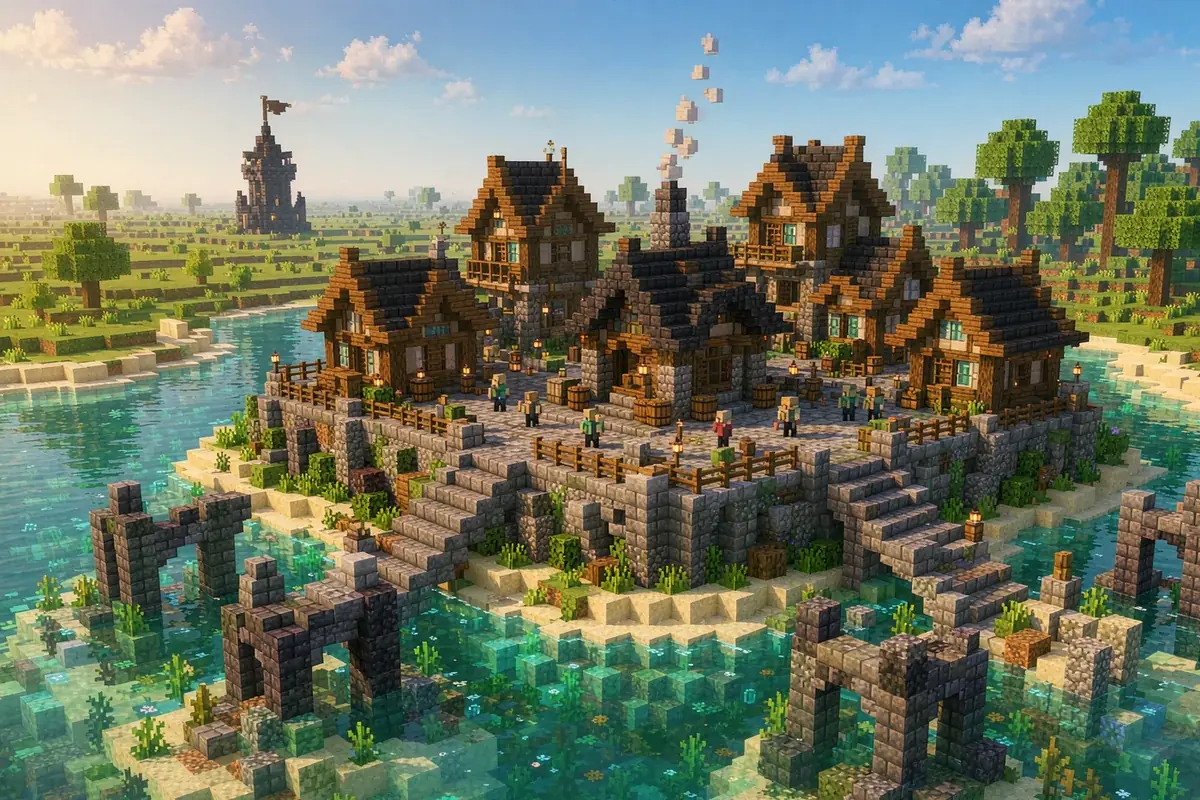
Seed one: five weaponsmith houses and warm ocean ruins under the houses
1000367306308321 is the one to open if you want a village that is already a building site. You spawn inside a coastal village where most of the houses sit on ocean platforms, and the most striking feature is that warm ocean ruins are integrated into the village centre. That is not decoration; it is a foundation someone else laid. The village has five weaponsmith houses, and a pillager outpost sits far enough away that it does not trigger raids on the village.
What makes this a building seed rather than a survival seed is the amount of structure already on the ground. Five weaponsmith houses mean five chests that can hold iron, and the warm ocean ruins give you stone brick you would otherwise have to mine. The surrounding biomes — jungle and savanna next to the village, desert to the east — mean you have three wood types and sand within a short walk.
What to put where
| Ground | Build | Why here |
|---|---|---|
| Village centre, on the warm ocean ruins | Main hall, storage, trade and smithy complex | The ruins are already a stone foundation at water level. Build on top of them and you get a basement for free. |
| Ocean platform houses | Extend outward with docks and bridges | Houses already overhang the water. Connecting them with a boardwalk turns five separate buildings into one waterfront. |
| Between village and pillager outpost | Wall or gatehouse | The outpost is close enough to matter but far enough to plan for. A wall between the village and the outpost turns a threat into a landmark. |
| Jungle edge to the west | Timber yard, bamboo scaffolding | Jungle wood and bamboo grow within sight of the village. Keep the cutting here so the village view stays clean. |
| Desert to the east | Sandstone quarry, glassworks | Sand and sandstone are a building material, not just a biome. A road to the desert and back is cheaper than hauling stone. |
If you only build one thing on this seed, build the boardwalk. Five houses on ocean platforms are five separate rooms with water between them, and the moment you connect them with a walkway, the village becomes one structure instead of five. The village seed page covers what a village gives you before you start extending it.
Seed two: four weaponsmith houses, a peninsula, and a second village
-7148389242537051542 spawns you on a plains peninsula where a coastal village sits with four weaponsmith houses and a ruined portal. The surrounding terrain is broken up by many lagoons and rivers, and the same area also holds some islands, a second village and a jungle. The starter list does not say which direction any of those lie in, so treat them as things to find rather than things to follow.
This is the seed for a town that uses water as a boundary. The peninsula is already a natural building site — three sides of water mean three sides you do not have to wall — and the lagoons give you a moat system that costs nothing to dig. Four weaponsmith houses give you four chests of iron and coal on day one, and the ruined portal gives you a head start on the Nether without mining a single obsidian block.
What to put where
| Ground | Build | Why here |
|---|---|---|
| Peninsula tip, village side | Main base, town square, forge district | Four weaponsmith houses in one village is a trade district already. Group your trading and metalwork here. |
| The second village | Trade post, farm colony | A second village means a second set of villagers. Once you find it, a road or a bridge between the two turns one settlement into two. |
| Lagoon shoreline | Bridge, dock, canal | The lagoons are what makes the peninsula defensible. A bridge over one is a road and a landmark at the same time. |
| Ruined portal site | Nether hub, obsidian farm | The frame is already there. Loot the chest, count the blocks, fill in the gap. |
| Jungle edge | Lookout tower, tree farm | Jungle canopy is high enough to see the whole peninsula from. A platform at canopy height is a watchtower without a foundation. |
The ruined portal on this seed does the same work as the one described on the obsidian route page: it gives you a Nether entrance without the ten blocks of obsidian you would otherwise have to mine or find. Four weaponsmith houses and a portal in one spawn is the best start a builder can ask for.
Seed three: a valley of villages with plateaus above
1143653337750952406 starts you among plains valleys and meadow plateaus, with many villages spread across them. To the east are some large windswept hills; in the south, plateau terrain begins with a dark forest and pale gardens. The layout reads as a bowl: villages on the low ground, meadow plateaus standing above them, and a view from the top that takes in everything you have built.
This is the builder's seed of the three, because it gives you a natural hierarchy of sites. The valley floors are flat, already settled, and big enough for a town. The plateaus above them are raised, defensible, and empty — the place for a keep or a landmark that looks down on the settlement below. And the windswept hills to the east put bare stone at surface level, which is the cheapest masonry you will find anywhere on this seed.
What to put where
| Ground | Build | Why here |
|---|---|---|
| Valley floor, next to a village | Town, farms, market, roads | Flat, already settled, and the villages give you a road network to extend rather than design. |
| Meadow plateau above the valley | Keep, castle, beacon platform | Raised ground overlooking the town is the classic castle site. One staircase connects the two levels. |
| Windswept hills to the east | Stone quarry, masonry yard | Windswept hills are bare stone at the surface, so a quarry there costs no digging and no scaffolding. A road east is a stone pipeline. |
| Dark forest and pale gardens to the south | Garden district, eerie build | Pale gardens are a mood, not a material. Use them for a district that is visually different from the plains town. |
| Between villages in the valley | Central square, well, road hub | Many villages mean many centres. A square between two of them becomes the town heart. |
No specific village count is printed here, because the starter list says many rather than a number, and this page does not turn a description into a count. Walk the valley on day one and count them yourself; that is the number you can plan with. The blacksmith page covers what a forge chest can actually hold before you plan a trade district around one.
The Java option, with a village you can teleport to
The three seeds above are Bedrock. The curated starter list is a Bedrock feature, so nothing on it will give a Java player the same spawn. The Java entry that belongs on this page is 2016000: a seed filed for Java 1.20 to 1.21 that puts you at 0, 63, 0 on plains, with a village at -24, 64, 12 — about 27 blocks away. That village has twelve houses, two blacksmith forges, one church and two farms, which is the only village interior count in our entire record of forty-nine seeds.
| Seed | Edition | Spawn | Village | What is inside |
|---|---|---|---|---|
2016000 | Java, 1.20 to 1.21 | 0, 63, 0 (plains) | -24, 64, 12 (27 blocks away) | 12 houses, 2 blacksmith forges, 1 church, 2 farms |
Two things to know before you use this seed. First, the village is twenty-seven blocks from spawn, not at spawn: you will see it from where you land, but you have to walk to it. Second, a stronghold is recorded eleven blocks under the village well, which makes this seed as good for a speedrun as it is for a build, if you decide to change direction. On Bedrock 1.20.5 the same code gives you open ocean instead — the village is a Java feature, not a Bedrock one, and the Java vs Bedrock page covers why one number makes two worlds.
Why building seeds from old lists may not look the same now
Because the starter list is rewritten as the game updates, and a code that leaves the list keeps its number but loses the terrain it was described for. The mountain seed 6390326396262027557 is the example you are most likely to run into: a mountain island added in 1.21.90 and marked removed by 1.21.120. The wiki note attached to removed entries is blunt — the description and the screenshots apply to the version they were written for, and those seeds look completely different in current versions.
The same trap applies to building seeds. A village that was at spawn in 1.20 may have moved, merged with terrain, or lost structures in 1.21. The code still types in. The village it was famous for may not be where the old description says. That is why every seed on this page is either still on the current starter list or carries a version range you can check against your own build. Code survives, village does not
The same caution sits in the archive. Our own record of forty-nine seeds contains exactly one village interior description — the twelve houses and two blacksmith forges on 2016000 — and the other forty-eight records either name a village without saying what is in it, or do not name a village at all. If you are planning a build around a village, the question is not whether one exists but whether it is still there and what it contains. The Bedrock checklist covers the six checks to run before you commit.
First day on a village spawn
Spawning inside a village is a different start from spawning on an empty island, and the order of work changes in one specific way: you already have shelter, so the first question is not where to sleep but what to keep. Use the first ten minutes to decide what stays and what gets rebuilt.
| Step | What you are doing | Why a village changes it |
|---|---|---|
| 1 | Walk the village, count the forges | Each weaponsmith house has a chest that may hold iron, coal or obsidian. Five of them is five chances at iron on day one. |
| 2 | Loot the village chests before you touch a tree | The chests cost nothing and are the only part the village guarantees. Wood is a walk; iron is a lottery. |
| 3 | Pick a house to keep, clear the rest for materials | You need a bed and a door on night one. One house gives you both; the others give you planks, stairs and fences. |
| 4 | Map the terrain beyond the village | The village is your base; the biomes around it are your supply line. Note where the wood, sand and stone are before you build. |
| 5 | Plan the extension, not the replacement | A village already has roads, houses and a well. The cheapest build is the one that extends the road network rather than starting a new one. |
If you are opening this with other people, the host matters more than the seed: Shockbyte is a low-cost Minecraft host that is set up in minutes, and code LAUNCH takes 25 percent off the first month. If you sign up through that link I may receive a commission at no extra cost to you, and it does not change what you pay.
Check the seed before you plan the build
Four checks, in order, before you commit a weekend to any building seed — including these. They take about two minutes and they replace every claim a list can make about villages, terrain or materials.
| # | Check | Pass condition |
|---|---|---|
| 1 | Your build matches the seed's range | The seed is on the current starter list, or you are inside the version range printed with it. |
| 2 | You can see the village from spawn | If the village is not visible on day one, the description was written for a different version. |
| 3 | The flat ground exists | Walk the area around the village. No flat ground means no room to extend, whatever the view is like. |
| 4 | Wood and water are within sight | Both, before you place a chest. A village without either nearby is a campsite, not a town. |
If a seed fails check two, stop there and pick another one. That single check catches the removed-list problem, the wrong-version problem and the mislabelled screenshot problem at once, and it costs you one world load.
Frequently asked questions
What is the best Minecraft building seed with a village at spawn?
1000367306308321 on Bedrock: you spawn inside a coastal village with five weaponsmith houses, warm ocean ruins integrated into the house foundations, and a pillager outpost far enough away that it does not threaten the village. It entered the game's starter seed list in 1.21.90 and is still there, which is the closest thing to a guarantee it generates today. Build outward from the village edge where the warm ocean ruins give you a foundation that is already underwater.
Do these building seeds work on Java Edition?
The three on the first table are Bedrock only, because the game's curated starter seeds are a Bedrock feature. For Java, use 2016000 on version 1.20 to 1.21, which puts you at 0, 63, 0 on plains with a village twenty-seven blocks away at -24, 64, 12. That village has twelve houses, two blacksmith forges, one church and two farms already counted in the record, and a stronghold recorded eleven blocks under the village well.
What does a building seed actually give you that a random seed does not?
Existing structures you can extend rather than replace, and flat ground next to them. A village gives you houses you can move into on day one, weaponsmith houses whose chests may hold iron and obsidian, and roads that are already a path network. The three seeds on this page each have villages at spawn, and the difference between them is what kind of terrain the village sits in: one is coastal, one is a peninsula, and one is a valley.
How many of your records describe what is inside a village?
One out of forty-nine. The only record that counts the buildings inside a village is 2016000 on Java, which lists twelve houses, two blacksmith forges, one church and two farms. The other forty-eight records either name a village without describing it, or do not name a village at all. That is why this page draws its building seeds from the game's current starter list rather than from our archive: the archive tells you a village exists, but not what is in it.
Can I use these seeds to build a castle?
Yes, but pick by terrain rather than by village. A castle needs a raised site with a flat approach and a wall route, and villages are on flat ground. The second seed, -7148389242537051542, has lagoons and rivers that give you a natural moat line, and the third, 1143653337750952406, has meadow plateaus standing above the valley villages where you can put a keep that looks down on the settlement below.
Are these seeds still in the game or have they been removed?
All three are on the game's current starter seed list as of November 2026. The list is rewritten with each update, and codes that leave it keep their number but lose the terrain they were described for. The mountain seed 6390326396262027557 is the cautionary example: added in 1.21.90, removed by 1.21.120, and the wiki warns that removed entries look completely different in current versions. Every seed on this page is verified against the current list, not against an archived screenshot.