The short answer
This site publishes 49 seed records — twenty rows in the coordinate table and twenty-nine archive cards from 2011 to 2019. Zero of the forty-nine use the word savanna, in either spelling, and zero of the forty-nine say savanna village. Acacia, the tree a savanna is made of, appears zero times anywhere on this site, across all thirty-two published pages. Zero of the forty-nine name a village type for any biome, so there is no record here we can honestly label a savanna village seed. What we do have is one row carrying the word plains, in its name column and nowhere else, and a spawn point elsewhere that the site prose calls plains while the village beside it goes unlabelled. Both of those are below, with the field they sit on named out loud.
- The only row in the table with a dry open-ground biome word in its name:
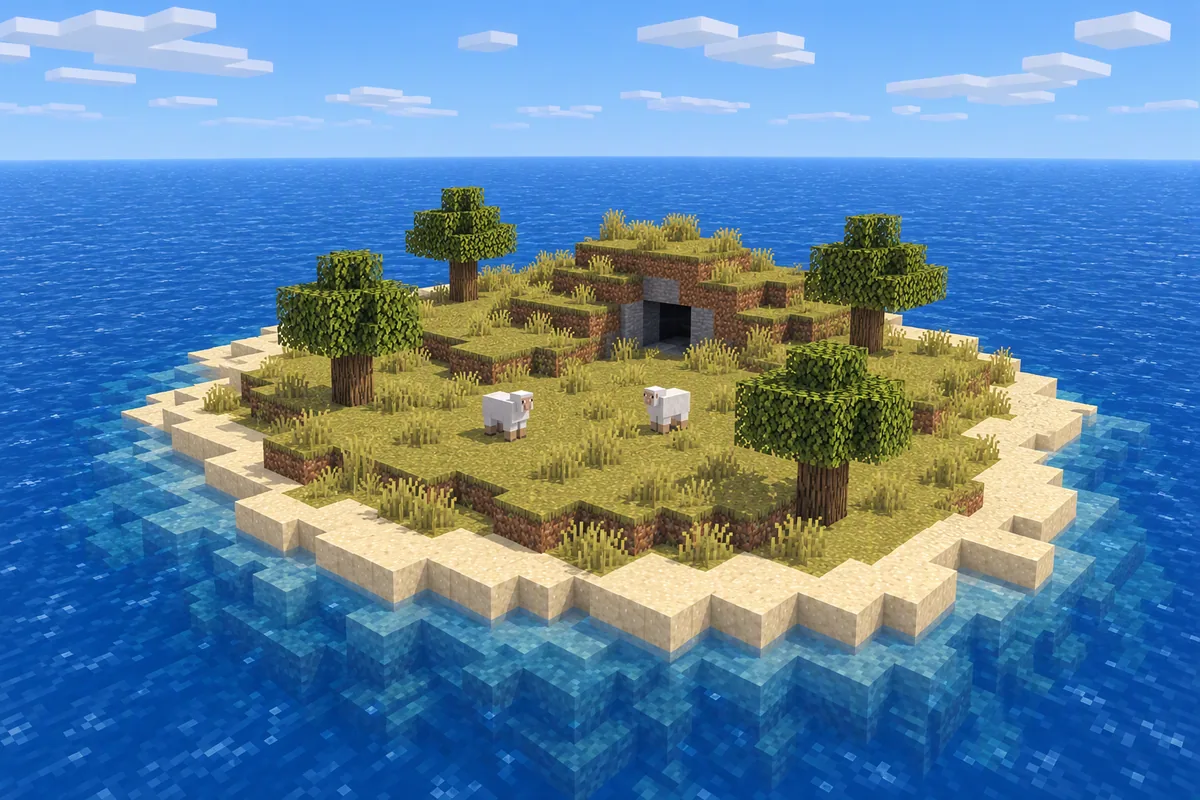
32 — row sixteen, Java and Bedrock 1.18+. Recorded as a small grass island, a few trees, sheep, and an underground cave system with a spawner. Its description names no biome at all. Name says plains Sheep recorded Spawner cave Biome not named in description No coordinate
- The only row in the table with a village on it:
2016000 — Java 1.20–1.21, village at -24, 64, 12, spawn recorded at 0, 63, 0 as plains with oak and birch within ten blocks. The word describes where you land, not the village twenty-seven blocks away. Village at spawn Stronghold under well Speedrun-capable Village type unrecorded
- The best-covered biome word in the whole set, for contrast:
2589021139 — row fifteen, Java and Bedrock 1.18+, a large jungle island with cocoa beans and bamboo, a shipwreck and ocean ruins nearby. Jungle is the one biome word our records actually carry, on eight of the forty-nine. Jungle island Shipwreck Ocean ruins No coordinate
- The two records that name a village, and say nothing about its kind:
2016000 on Java 1.20–1.21 and an archive card posted 26 July 2013. Two out of forty-nine name a village; zero out of forty-nine give it a biome. Savanna not named Village type unrecorded
The three codes worth copying, one each — 32; 2016000; 2589021139
How we counted, before you read any number on this page
Every figure below counts records, not worlds. That distinction decides the whole page, so here is the rule in full, before any of the counts.
What a record is. Forty-nine of them. Twenty rows in the coordinate table, each one a seed somebody wrote down after loading it, with a seed code, an edition, a version and whatever structures they found. Twenty-nine archive cards from 2011 to 2019, each one a seed code plus the terrain the person who found it described. Forty-nine records, and no invented entries among them.
What counts as saying savanna. The word itself, in either spelling, in either source, in any position on the record — a biome line, a terrain description, a note, a name. Zero records qualify. We did not count related words as savanna, and the related words are listed separately below so you can see exactly how far the dry-ground vocabulary goes.
What counts as a savanna village. Strictly this: the record has to name a village and attach savanna to it, or state outright that the village is a savanna village. Zero of the forty-nine do, and they fail on both halves of that sentence — zero name savanna at all, and zero name any village type.
Which column a word sits in. This is the part that changes the answer for plains. A row has a name, an edition, a version, a coordinate line and a description. A biome word in the name is a label the finder chose; a biome word in the description is an observation about the terrain. We keep the two apart, because the only plains in the table sits in a name and has no observation behind it.
The count: zero savanna, zero savanna villages, zero acacia
Two sources, one result each, listed in full. There is no third place these words could be hiding.
| Word |
Rows out of 20 |
Cards out of 29 |
What that means |
| savanna |
0 |
0 |
Zero of forty-nine. Not one record in either source uses the word. |
| savanna village |
0 |
0 |
The search term itself appears nowhere in the record. |
| savannah (alternate spelling) |
0 |
0 |
Zero in both spellings, so this is not a spelling artefact. |
| acacia |
0 |
0 |
Zero — and zero across every page this site has published, not just the records. |
| plains |
1 |
0 |
One row, and it is in the name column of row sixteen. Zero descriptions. |
| plains village |
0 |
0 |
Zero as a record. Two records name a village and neither says plains. |
| jungle, for contrast |
3 |
5 |
Eight records. The best-covered biome word in the whole set. |
| desert, for contrast |
1 |
1 |
Two records, and one of them is the row that names a village. |
| taiga, for contrast |
0 |
1 |
One record, an archive card from 2012. |
| swamp, for contrast |
0 |
0 |
Zero, the same as savanna. |
| Names a village at all |
1 |
1 |
2016000 and the archive card posted 26 July 2013 |
| Names a village type |
0 |
0 |
Zero of forty-nine, for every biome, not just this one. |
The bottom two rows are where the search term dies. A savanna village needs two things written on the same record, a village and a biome, and our set has two of the first and zero of the second. There is no overlap to report, because one side of the overlap is empty.
One correction worth making on our own numbers while we are here. The count table on our taiga page lists plains as zero rows out of twenty, and this table lists it as one. Both are true about different columns: that row was counting biome words written in the description text, and this one includes the name column, where row sixteen reads Plains Survival Island. We are flagging the difference rather than quietly keeping whichever number flatters the page, because the whole point of counting the same field twice is that the field has to stay the same.
The eight mentions of savanna on this site: all eight are sentences about absence
Before this page, the word savanna appeared eight times across the thirty-two pages this site had published, on three of them. That number is eight and the number of savanna records is zero, and the gap between them is the entire point.
| Where |
Times |
What those mentions actually are |
/taiga-village-minecraft/ |
4 |
One count-table row reading “plains / savanna / swamp — 0 / 0”, one table row listing the biome words our records do not use, and two FAQ answers that repeat the same list. |
/jungle-village-minecraft/ |
3 |
The definition of what would count as a village type (“plains village, desert village, jungle village, taiga village, savanna village”), plus two sentences saying no record uses any of those words. |
/swamp-village-minecraft/ |
1 |
One FAQ answer: “neither says plains, desert, jungle, taiga, savanna or swamp”. |
Every one of the eight is a sentence about the word being missing. None of them is a savanna record, and none of them is even a sentence about a place. Repeating an absence on a fourth page adds words to a site and adds nothing to a dataset: the only honest way to raise this count from zero is to load a seed that has savanna on it and write the word down.
The same test applied to acacia is cleaner still, because it is zero in both directions. Zero in the records, zero in the prose, zero across thirty-two pages. If a single card had ever mentioned an acacia tree, that tree alone would have been enough to put savanna within reach of this page, and it never happened.
Plains: the one row, the one spawn, and the label we refuse to add
Plains is the paired word people search alongside savanna, and our set treats it almost the same way — one appearance, in a column that does not mean what it looks like it means. Two separate places carry it, and neither is a village type.
| Where the word sits |
What was written |
What no one wrote |
Row sixteen, name column — 32
Java and Bedrock 1.18+ |
The row is titled Plains Survival Island. Its description reads: small grass island, a few trees, sheep, and an underground cave system with a spawner. |
A biome in the description. The word is in the title the finder chose and not in anything they observed. There is also no coordinate on the row. |
Row one, spawn description — 2016000
Java 1.20–1.21 |
Spawn at 0, 63, 0, described as plains with oak and birch within ten blocks. Village at -24, 64, 12, described as twelve houses, two blacksmith forges, one church and two farms. |
Any word on the village itself. Plains describes the ground you land on; the village twenty-seven blocks away is given a layout and not a type. |
| Site prose, for completeness |
Across the thirty-two pages published before this one, the word plains appears forty-five times on sixteen of them, mostly restating those two facts. |
A third record. Forty-five mentions, two sources, and no new field behind them. |
The trap is the middle row, and it is worth naming out loud. Row one does put the word plains on the record. It puts it on the spawn, at 0, 63, 0, in a phrase about oak and birch being within ten blocks. That is a fact about where you land. It is not a statement that the village is a plains village, and we are not going to quietly upgrade it into one — the same way we do not call the taiga card a taiga village spawn when the taiga is above the player’s head rather than under their feet.
One place on this site has been looser than the rest, and it should be named too. The FAQ on our archive page answers a question about finishing the game by saying the fastest recorded run started at “a plains village”. That is our own sentence and not a record: the record behind it says plains about the spawn and says nothing about the village. Both statements exist on the site today, and the count on this page follows the record rather than the sentence.
What we will not claim
- We do not have a savanna village seed. Zero records say savanna, zero say savanna village, and zero name a village type. We are not going to relabel a grass island to fill the slot.
- We do not have a plains village seed either. One row carries the word plains in its name only, and one spawn is described as plains. Neither is a village type, and a paired search term does not get a different standard.
- We are not saying the forty-nine records have no savanna anywhere in them. A record that never mentions a biome has said nothing about that biome. Silence is not a negative result, and we will not read one into it.
- We are not estimating how often savanna appears beside an island spawn. We have not scanned for it. A rate taken from records gathered for a different question would be a guess dressed as a finding.
- We are not upgrading a spawn biome into a village type. The plains on row one belongs to the spawn point, and the village twenty-seven blocks away was never given a word of its own.
- We are not ranking these seeds. No score, no tier, no ordering. Zero savanna, one plains name, two villages, zero village types — those are counts, and a count is not a grade.
Five checks before you call a code a savanna village seed
Five checks, in the order we run them on a record before repeating anything off it. Each one is answerable from the record itself, in about a minute, without loading a world. The point is to separate a code that puts you in a savanna village from a code that has dry ground somewhere on it.
| Check |
The question |
What it catches |
How our record scores |
| 1 |
Does the record name the biome rather than the shape of the ground? |
Grass islands and dry hills sold as savanna |
0 of 49 pass — no record says savanna in either spelling |
| 2 |
Does the record name a village? |
Open ground with no settlement anywhere near it |
2 of 49 pass — 2016000 and the 2013 card |
| 3 |
Does the record attach the biome to the village, rather than to the terrain around it? |
A dry biome near a village sold as a dry village |
0 of 49 pass — zero name a village type |
| 4 |
Is the word in a description, or only in the name someone gave the seed? |
A title doing the work of an observation |
1 of 49 carries a biome word at all, and it is in the name — 32 |
| 5 |
Can you get to it — a coordinate, a teleport command, or a spawn point? |
Records you cannot act on without re-exploring the whole map |
1 of the 2 village records gives coordinates — 2016000; 32 has none |
Check 3 is the one that fails everywhere, and it fails on a field rather than on a world — nobody who wrote these records down was filling in a village type, so the column is empty in all forty-nine rows and not merely in the ones we looked at. Check 4 is the one that separates seed 32 from a real observation: Plains Survival Island is a name, and the description under it says grass, trees, sheep and a spawner cave, which is a shape and an inventory rather than a biome. Check 5 is the one that decides whether a record is usable at all, and it is why the one row with a village on it is also the one row worth copying.
The five records, in full
Plains Survival Island — 32
Edition and version: row sixteen of the coordinate table, Java and Bedrock, 1.18+. Terrain as written: a small grass island with a few trees, sheep, and an underground cave system containing a spawner. Biome in the description: none named. Coordinate: none recorded — the row carries no location you can travel to. Village: none named. Why it is here: it is the only row in the whole table where a dry open-ground biome word appears at all, and it is also the cleanest example of the name-versus-description gap on this page — the title says plains and the observation says grass, trees, sheep and a spawner. Two characters long, which makes it the shortest code in the set and the easiest to mistype from memory. Name says plains Sheep recorded Spawner cave Biome not named in description No coordinate
Speedrun God Seed — 2016000
Edition and version: row one of the coordinate table, Java 1.20–1.21. Spawn: 0, 63, 0, recorded as plains with oak and birch within ten blocks. Village: -24, 64, 12, recorded as twelve houses, two blacksmith forges, one church and two farms. Also on the row: stronghold at -21, 42, 18, eleven blocks beneath the village well; diamonds at -32, 11, 25; desert temple at -320, 64, 180; jungle temple at 450, 63, -270. Village type: unrecorded. Why it is here: it is the only row in forty-nine that names a village, and it is the row that makes the plains trap visible — the biome word belongs to the spawn, and the village was given a layout and not a label. On Bedrock 1.20.5 the same code is a separate row and puts you in open ocean at 0, 62, 0 with no trees and no village. Village at spawn Stronghold under well Speedrun-capable Both editions listed Village type unrecorded Savanna not named
Jungle Challenge Island — 2589021139
Edition and version: row fifteen of the coordinate table, Java and Bedrock, 1.18+. Terrain as written: a large jungle island with cocoa beans and bamboo, a shipwreck and ocean ruins nearby. Coordinate: none recorded. Village: none named. Why it is here: jungle is the one biome word our records actually carry, on eight of the forty-nine, and this row is the strongest of them — which is the clearest illustration of how uneven the coverage is. The same set that records jungle eight times records savanna zero times, and nothing in the way the records were written explains the difference. Jungle island Shipwreck Ocean ruins No coordinate No village
One Tree Island — -706198004
Edition and version: Bedrock. Terrain as written: two islands — a small one with a single tree, and a large one with a ruined portal and a cave — plus a shipwreck holding planks and a treasure map. Coordinate: none recorded. Biome: none named. Why it is here: it is the record people reach for when they want to know whether a bare island is survivable, and it is the one that shows what a Biome-less record looks like in practice — the finder wrote down what they could use, not what the ground was called. One tree Ruined portal Shipwreck with planks Bedrock only Biome not named
Classic Island — 2013
Edition and version: unknown, and the row notes it may only work on versions before 1.13. Terrain as written: an ocean island with seven trees, no passive mobs, three wheat seeds from grass, a beach and grass block mix, a small satellite island of sand only, and an underground mine shaft. Biome: none named. Village: none named. Why it is here: it is the most fully described island in the set and it still names no biome, which is the pattern in miniature — these records were written by people counting trees and animals, not by people filling in a biome column. Seven trees No passive mobs Wheat from grass Version long past Biome not named
First day on a grass island when the biome word is missing
Every record on this page is missing the same field, so the first day has to be planned without it. The order below is built from what the records actually say — grass, trees, sheep, spawners, caves — rather than from a biome label none of them carries.
- Count the trees before anything else. The binding constraint on a small island is wood, not space. Seed
32 records a few trees on a small grass island; 2013 records seven and no passive mobs. Wood decides the first night, and neither row names a biome to distract you from that.
- Take the sheep last, and take them alive.
32 is the only row in the table that records sheep on an island. Three wool is a bed, and a bed is a reset point — worth more on day one than the same sheep as food.
- Do not plan a village around a spawn you have not seen. Zero of the forty-nine records name a village type, so no dry-ground record here tells you what you would be walking into. If you are on
2016000 the village is at -24, 64, 12 and you can walk to it; everywhere else, assume you are alone.
- A spawner cave is a farm, not a threat, if you light it first.
32 records an underground cave system with a spawner and gives no coordinate for it. Clear the dark before you go looking, or the first trip down is the last one.
- Write the biome word down when you get there. Forty-nine records, zero savanna, zero acacia. If you load a dry island and it turns out to be savanna, the single most useful thing you can add to this record is the word itself — that is the only way this count ever moves.
- Check the edition and version before you blame the code.
2016000 is two different worlds on two editions, and 2013 may not generate at all past 1.13. If the terrain is not where the row says, that is the generator talking, not a broken seed.
- Two characters is not a safe code.
32 is the shortest seed in the set. Copy it rather than retyping it, and confirm the edition before you load it.
Running a dry open spawn with other people
Open ground splits a group differently from forest, and the reason is in the records. Seed 32 puts sheep and a spawner cave on a small island with no coordinate recorded, which means everybody lands in the same place and then has to agree who eats and who keeps the wool before night falls — the group that settles it on the first day does not spend the second day arguing about it. Seed 2013 is the harder shape for a crowd: seven trees, no passive mobs, three wheat seeds, and a sand-only satellite island, so food is the bottleneck from the first minute.
If you want to run one of these with other people on Java or Bedrock, Shockbyte is a low-cost host that sets up in minutes — use code LAUNCH for 25% off your first month. If you sign up through that link, I may receive a commission at no extra cost to you. It does not change what you pay.
Frequently asked questions
Do you have a savanna village seed?
No. Zero of the forty-nine records we publish use the word savanna in either spelling, and zero name a village type for any biome. Only two of the forty-nine name a village at all, and neither says savanna, plains, desert, jungle, taiga or swamp.
How many of your records say savanna at all?
Zero out of forty-nine. Neither of the two sources contains the word: zero of the twenty rows in the coordinate table and zero of the twenty-nine archive cards. The alternate spelling savannah also returns zero, and acacia, the tree a savanna is made of, appears zero times anywhere on this site.
Is a plains village the same thing as a savanna village?
No, and we do not have either one. Plains and savanna are different biomes, and zero of the forty-nine records name a village type for any biome, so there is no plains village seed here either. The word plains appears once in the twenty-row table, in the name column of 32, and our prose describes the spawn of 2016000 as plains while never attaching that word to the village.
Why does jungle appear in eight of your records and savanna in none?
We can report the count but not the cause. Five of the twenty-nine archive cards and three of the twenty rows mention jungle; taiga appears on one card and on no rows; savanna, swamp and spruce appear in neither source. These records were written down by people hunting islands, and biome was never a field they filled in, so the set was never built to measure how often any biome turns up.
What is the closest thing you have to a savanna island?
Seed 32, row sixteen of the coordinate table, on Java and Bedrock 1.18+. It is recorded as a small grass island with a few trees, sheep, and an underground cave system with a spawner. It is the only row in the table whose name carries a dry open-ground biome word, and its description names no biome at all, so it is close on ground type and silent on the word.
How many of your records name a village type?
Zero out of forty-nine. A record counts only if it attaches a biome word to the village itself. Two of the forty-nine name a village at all — 2016000 on Java 1.20–1.21 with a village at -24, 64, 12, and an archive card posted 26 July 2013 — and neither gives it a type.