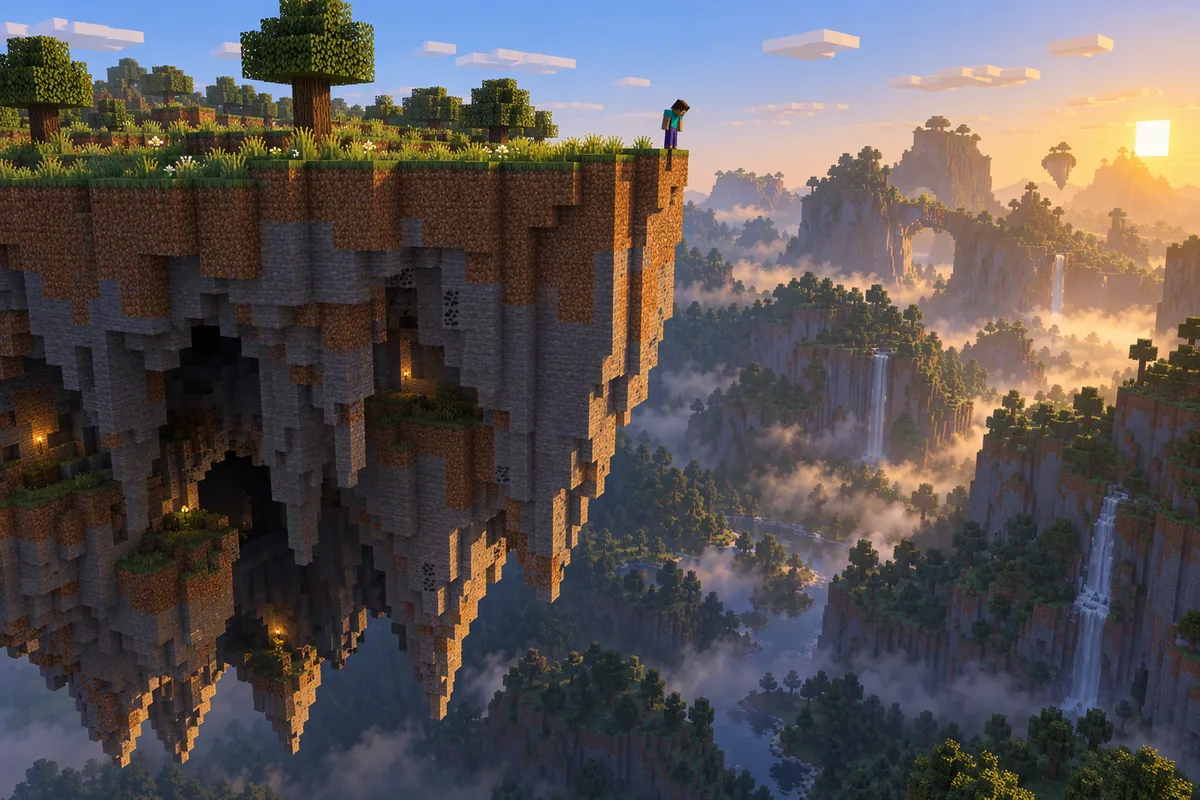
Floating Island Minecraft Seeds: 3 Real Codes From 2011 and What We Will Not Claim
The short answer
Three codes in our records describe genuinely floating terrain, and all three were posted in March 2011 on Beta 1.3–1.7: -1784338777788894343, -442650539972332399 and -9028489474908844496. None of the three has been re-checked on any release from 1.18 onward, and none of the three carries a coordinate. We are not going to tell you they work on a modern version, because nothing in our records says they do.
The seven high-ground codes worth knowing, in the order we would look at them:
The whole range hanging — -1784338777788894343. An extensive mountain range described as almost completely suspended, not a ridge with a few loose chunks. Beta 1.3–1.7, posted 1 March 2011.
Floating rock with caves under it — -442650539972332399. Tall mountain ranges, huge caves, oddly shaped floating islands and overhangs. Beta 1.3–1.7, posted 7 March 2011.
Rock bridges already built — -9028489474908844496. Massive floating mountains and pathways between them, so you can walk the gap instead of bridging it. Beta 1.3–1.7, posted 18 March 2011.
A lake under the cliffs — 5682930821. Huge underground lake below tall overhanging cliffs. The only high-ground record here that names water beneath the build site.
Cold spawn, heavy timber — 1474776471. Icy overhangs inside a large pine forest, at (x=-165, z=510). Pine gives more wood per tree than most, which matters when night is coming.
Lava at the overhang — 177907495. A long overhang with a lava flow already in it, at (x=-100, z=30). Free light and fuel, one careless step from losing your inventory.
The short one — 729. Two-tier mountain range at (x=-200, z=-200). Easy to remember, staircase terrain you can build into.
If you only load one, load the suspended range — seed -1784338777788894343, Beta 1.3–1.7, no coordinate recorded
Getting up is the easy half. Three of the records on this page describe floating terrain, and none of them carry a coordinate, so the drop you are looking at is the one thing here you can actually count on.
Floating islands in 2011 were not a biome
The line in our own record for -442650539972332399 says it plainly, and it is the reason this page exists: floating islands in 2011 were not a biome. They were a bug people hunted for.
That distinction is doing more work than it looks like it is. When a modern player searches for a floating island seed, they are usually imagining a generated feature they can count on — something the world generator produces on purpose, in a known biome, under known rules. That is not what these codes are. What a player in March 2011 found was terrain the generator produced by accident, and finding one was the achievement. The seed was worth posting precisely because the shape was not supposed to exist.
Which means the honest framing for all three codes below is this: they are records of an unusual world that somebody saw and wrote down, not guarantees about the world you will get. That is a weaker promise than a modern seed list makes, and it is the only promise our records can actually support.
The nine high-ground records, sorted by what the terrain actually is
Our records carry nine codes filed under high ground — overhangs and floating rock. Read as one group they all sound like the same thing, and read individually they split into three clearly different classes. The tags are our own reading of the recorded terrain wording, not a score. We do not rank seeds, and nothing on this page is a rating.
Seed code
Terrain as recorded
Version
Coordinates
Tag
-1784338777788894343
Extensive mountain range almost completely suspended
Magnificent overhanging cliffs and steep mountains
Beta 1.3–1.7
around (x=100)
OverhangApproximate coordinate
1474776471
Icy overhangs surrounded by a large pine forest
Beta 1.3–1.7
(x=-165, z=510)
OverhangPine forest
177907495
Long overhang complete with lava flow
Beta 1.3–1.7
(x=-100, z=30)
OverhangLava at spawn
729
Two-tier mountain range
Beta 1.3–1.7
(x=-200, z=-200)
MountainShort code
5515274009531393841
Vast mountainous landscape, plenty of trees and water
Beta 1.3–1.7
None
MountainPoster called it undramatic
The version column is the same on all nine, and that uniformity is exactly the problem. Not one of these records has been revisited on a later release.
Three classes, and only one of them is floating
Sorting the nine by what the terrain wording actually claims gives you a much smaller set than the heading suggests.
Class
What the record claims
Count
With coordinates
Floating
A mass with open air beneath it — “almost completely suspended”, “floating islands”, “floating mountains”
3
0 of 3
Overhang
Rock still attached to the terrain, with air below part of it — “overhanging cliffs”, “icy overhangs”, “long overhang”
4
3 of 4 (one approximate)
Tall mountain
Height without suspension — “two-tier mountain range”, “vast mountainous landscape”
2
1 of 2
So the floating set is three codes out of nine, not nine out of nine. Most pages that collect this kind of terrain put all three classes under one heading, which is how a player ends up loading a steep mountain and wondering where the floating rock went.
The gap nobody mentions: the floating three have no coordinates at all
This is the part that surprised us when the nine rows were laid out side by side. Four of the nine records carry numbers you can type into the game. None of the three floating ones does.
The four that do are 1474776471 at (x=-165, z=510), 177907495 at (x=-100, z=30), 729 at (x=-200, z=-200), and 1541961902 at roughly (x=100) — roughly being the operative word, since that one was written as “around” rather than as a fixed position. Every one of those four is an overhang or a mountain. The three records describing suspended terrain give you a shape and a name and nothing else.
There is a reason for that, and it is not carelessness. A player in 2011 who found floating rock cared about the shape, because the shape was the find. A player who found overhanging cliffs was more likely to be describing a place to build, and a place to build is a place you write a number for. The most interesting three entries in this set are also the three you cannot teleport to, and that is not a coincidence — it is what the records were for.
If you want numbers rather than descriptions, the complete coordinate table marks which rows are teleport-ready and which were written as prose, and explains the three-axis, two-axis and tilde formats. None of the three floating codes on this page appears in it with coordinates, for the reason above.
Three finds, eighteen days apart
The posting dates on the three floating codes are 1 March 2011, 7 March 2011 and 18 March 2011. Three separate players — the records carry their handles — posted three separate floating-terrain worlds inside eighteen days of each other, on the same version range.
Our reading of that is narrow and we want to keep it narrow: it tells you the terrain was findable in that window on that version, by people who were actively looking for it. It does not tell you how rare it was, and we have not scanned anything to find out. We are not going to attach a probability to a number we did not measure.
What it does tell you is useful in a different way. A cluster like that is what a bug-era feature looks like in a record set — a burst of finds while people are hunting, then nothing. If floating rock were a stable generated feature, you would expect these finds to be spread across years and versions instead of packed into three weeks of one Beta range.
What we will not claim about modern versions
Every code on this page was recorded on Beta 1.3–1.7. Not one of the nine has been re-checked on any release from 1.18 onward, and there is no modern verification of any of them anywhere in our records.
That is worth stating as its own section because it is the question a floating island search is really asking. The answer we can defend is: unknown. We do not have a test result on a modern release for any of these three codes, so we will not write that they work on a current version, and we will not write that they do not. Both would be inventions.
The practical rule: treat a Beta 1.3–1.7 record as a description of a world somebody saw in 2011, not as a promise about the world your launcher will build. If you load one of these three and get flat terrain, that is not a broken code and it is not a broken game — the terrain generator is not the same generator that produced the record. The same version problem in its more common form, where one code gives two different worlds on two editions, is laid out on the Java vs Bedrock comparison page.
How to judge a floating terrain record before you load it
Five checks, in the order they are cheap to run. Any one of them can end the plan, and check two is the one that actually ends it.
Check
The question to ask of the record
What it turns up in our nine
1. Version
Does it name a release, and has that release been re-checked since?
All nine say Beta 1.3–1.7. None has been re-checked on 1.18 or later.
2. Coordinates
Can you type it into /tp, or is it a sentence?
Four of nine carry coordinates. Zero of the three floating ones do.
3. Suspension wording
Does it say suspended or floating, or does it only say steep and high?
Three say floating, four say overhang, two say mountain. The wording is the only evidence you have.
4. Water below
Does the record name anything underneath the mass?
One does — a huge underground lake under the cliffs. The other eight say nothing about what is below.
5. Roof value
Does the mass give you cover on the first night?
Every overhang record does, and that is the one reliable survival advantage in the whole set.
Checks two and four are the pair that decide it. A floating mass with no coordinate and no recorded water underneath is a shape to look at, not a spawn to build a run on, and that description fits all three floating codes on this page.
Five of them, mapped out
The Suspended Range — -1784338777788894343
FloatingWhole range hangingNo coordinate recordedNo modern re-check
TerrainExtensive mountain range almost completely suspended
VersionBeta 1.3–1.7
Posted1 March 2011
CoordinatesNone recorded
The record’s own phrasing is what separates this one from the rest: not a ridge with a few floating chunks hanging off it, but the whole range. That is the strongest suspension claim of the three, and it is also the least useful one to act on, because there is no coordinate anywhere in it.
What you can do with it is load it and look. What you cannot do is plan a route to it in advance, and you should not expect the shape to survive onto a release that was built fifteen years after the post.
Posted 1 March 2011, the earliest of the three floating records. The finder’s handle is part of the record; the position of the terrain is not.
Bug Era Terrain — -442650539972332399
FloatingOverhangHuge cavesNo coordinate recordedNo modern re-check
This is the code whose record carries the line this page is built around: floating islands in 2011 were not a biome, they were a bug people hunted for. It is also the only one of the three that names caves underneath the floating shapes, which matters more than it sounds — caves below suspended rock means there is something under the drop.
The word “oddly shaped” is doing real work too. This was not a clean floating slab; it was malformed terrain, which is exactly what a generator accident looks like and exactly what a designed feature does not.
One of three floating records posted in March 2011. No coordinate was written down, and none has been added since.
Rock Bridge Pathways — -9028489474908844496
FloatingNatural rock bridgesNo coordinate recordedNo modern re-check
TerrainMassive floating mountains and pathways
VersionBeta 1.3–1.7
Posted18 March 2011
Found bynrm19
Pathways. The record describes rock bridges already strung between the floating masses, which is the one feature on this page that changes how you would actually move across the terrain. Everywhere else on a floating seed, the gap is yours to bridge. Here the record says the gap was already bridged by the world.
That is also the most fragile claim of the three, because it is a claim about connectivity rather than about a single shape. If the generator changed, the masses might still be there and the bridges might not be.
The last of the three March 2011 floating records. Recorded on Beta 1.3–1.7 and never revisited.
Icy Overhangs — 1474776471
OverhangPine forestCoordinate recordedBeta-era only
TerrainIcy overhangs surrounded by a large pine forest
Coordinates(x=-165, z=510)
VersionBeta 1.3–1.7
Posted3 June 2011
This is the one to load if you want a number that goes into the game. It is not floating rock — it is attached cliff with air below part of it — but it is the single high-ground record here that combines a coordinate, a roof and a wood supply in one line.
The pine is the part worth noticing. Cold spawn, heavy timber, and pine gives more wood per tree than most, which matters when night is coming and you have one night to get a wall up. An overhang you can walk into plus a forest you can chop is a night-one plan; a floating mass with no forest named is a screenshot.
One of only four records in this set carrying usable coordinates, and one of two where the timber supply is named.
Lava Overhang — 177907495
OverhangLava at spawnCoordinate recordedBeta-era only
TerrainLong overhang complete with lava flow
Coordinates(x=-100, z=30)
VersionBeta 1.3–1.7
Posted31 August 2011
Lava at spawn is a gift and a trap, and the record says so in those words. Free light and free fuel on the first night, one careless step from losing your inventory before you have a chest to put it in.
The useful reading is that this is the one high-ground record where the hazard is in the description rather than missing from it. Five of the nine records here say nothing at all about what can kill you on the terrain they describe, which is a bigger omission than a missing coordinate.
Posted five months after the March cluster, which makes it the latest of the nine — and still on the same Beta range.
What to do in the first ten minutes on high ground
The five checks above are what you do before generating a world. This is what you do after, and the order is the one our testing notes use. It differs from the island version of this list in one important way: on an island your problem is that everything is far away, and up here your problem is that everything is below you.
Find the down-route before you need one. On floating or overhanging terrain the first ten minutes are not about building, they are about knowing how you get to wood and water and back. Walk the edge and find the slope before it is dark and you are doing it at a run.
Take the rock as your night-one roof. The reason overhangs are filed under high ground at all is that half of surviving a spawn is having a roof, and an overhang is a roof the world already built. Build into it, do not build on top of it.
Count trees from above, then commit to the descent once. Wood is the binding constraint on any spawn, not space. On 1474776471 the pine forest is the reason the coordinate is worth typing; on the three floating codes the record never names a tree at all, which is a warning rather than a detail.
Treat recorded lava as light and fuel, never as a shortcut.177907495 has a flow inside the overhang. Light it up, do not build around it.
Write down every coordinate you care about while you are standing on it. Four of nine records here carry numbers and five do not, and the five are lost to exactly this omission — somebody saw something worth posting and did not note where it was.
If there is no wood below you and no water under you, leave the terrain. The blunt version from our notes: you cannot survive at this spawn, you can only brave the drop and explore. Walking away from good-looking rock is not giving up.
Step three is the fork. Wood in reach means the high ground is a base; wood out of reach means it is a viewpoint, and everything that happens after the first few days is measured from wherever you end up building instead.
On a shared world, and what changes
Nothing about these nine records makes them good multiplayer picks, and it is worth being direct about why. A shared world needs four players surviving the same first night, and the failure mode of high ground — one person falls, or one person cannot find the way down in the dark — is a failure mode that scales with player count. Our server-grade standard was written for island terrain with four structures inside a short radius, and none of these nine has been measured against it.
What does carry over is the version discipline. Every player on a shared world has to be on the same edition and the same game version, because a version difference produces the same mismatch you get between Java and Bedrock: same code, different terrain, and a complaint that the seed does not work. On a fifteen-year-old record that risk is not a footnote.
A floating shape is more fun with people on it, even if it is a worse base. If you want to host one and load these together, Shockbyte is a low-cost host that sets up in minutes. Use code LAUNCH for 25% off your first month. If you sign up through that link, I may receive a commission at no extra cost to you. It does not change what you pay.
Frequently asked questions
Do these floating island seeds still work on modern Minecraft?
We do not know, and we are not going to claim it. All three were recorded on Beta 1.3–1.7 in March 2011 and none of them has been re-checked on any release from 1.18 onward. There is no modern verification in our records, so the honest answer is unknown rather than yes.
What is the difference between a floating island and an overhang?
A floating mass has open air beneath all of it, while an overhang is rock still attached to the terrain with air below part of it. In our records the wording separates them: -1784338777788894343 is described as an extensive mountain range almost completely suspended, and 1541961902 as magnificent overhanging cliffs and steep mountains. The practical difference is that you can walk off an overhang onto terrain, and off a floating mass into a drop.
Why do none of your floating island seeds have coordinates?
Because the players who posted them in 2011 wrote down the terrain and their own names, not the numbers. Four of the nine high-ground records in our set do carry coordinates — 1474776471, 177907495, 729 and approximately 1541961902 — and all four are the overhang and mountain entries rather than the floating ones.
Is a floating island a good survival spawn?
Usually no, and the reason is gravity rather than mobs. A floating mass gives you a roof on night one but puts your wood, water and animals at the bottom of a drop you have to survive, and the three floating codes in our records say nothing about what is underneath them. An overhang is the better version of the same idea: same roof, no gap to fall into.
How many floating terrain seeds did your records turn up?
Three out of nine high-ground records, all posted in March 2011 within eighteen days of each other, on 1 March, 7 March and 18 March. The other six are overhangs and tall mountains, which is a different thing even though most seed lists group them together. We have not scanned for more, so three is a count of our records, not an estimate of the game.
Where did these 2011 seed records come from?
They were pulled out of player posts dated 2011 whose hosting has since disappeared. The finder name, the posting date, the version and the terrain wording are kept exactly as they were written, and we did not fill in any missing field — which is why three of them carry no coordinate and all nine carry a version we cannot update. The full set of older codes, including the ones filed as island spawns rather than high ground, is on the 2011–2019 seeds page.
Why do most floating island lists mix floating terrain with overhangs and tall mountains?
Because the term "floating island" became a marketing label for "high-ground seeds you can find fast", not a strict terrain class. The nine records here split into three real floating, four overhangs and two tall mountains, and the boundary matters: an overhang is still attached to terrain you can walk to, a floating mass is open sky underneath every face. The shorthand we use is that if you can step off the rock onto another hill without jumping, it is not floating. Most lists do not enforce that boundary, which is why a search for "floating island seeds" returns a mix of overhangs, tall mountains and a few true floats every time.
How is this list different from a top-25 floating island video?
The videos pin coordinates, modern versions and structure counts; this list pins the opposite - the finder, the posting date, the exact Beta 1.3-1.7 wording, and the fact that we have not re-checked any of it on a modern release. That means a top-25 video can promise a working modern spawn and we cannot, and a reader looking for "what to play tonight" gets more from a video than from this page. A reader looking for "what was actually findable in March 2011" gets more from this page than from a video. The two answer different questions, and this page is the second one.