Best Minecraft Seeds Java: 5 Tested on 1.18+, and 19 Old Ones Nobody Re-Tested
The short answer
Of the nineteen seed codes we hold from 2011 to 2019, only seven name an edition at all, only six carry a coordinate you could type into the game, and not one has been loaded on a modern release. If you want a Java seed you can actually play today, use one of the five below — every one of them was recorded on Java 1.18 or later.
Want the only seed with a bounded version range and a finished run:2016000 — Works for Java 1.20–1.21. Village at -24, 64, 12 with a stronghold eleven blocks under the well; one tester finished in 27 minutes.
Want the deepest coordinate set we have:4188583766222650532 — Works for Java 1.18+. Nine structure entries, including a mushroom island at -300, -500 and a second Nether fortress at -100, 200.
Want four farm structures inside one radius:-8350249385580253962 — Works for Java 1.18+. Witch hut at -325, 325, ocean monument at -300, 150, warm ocean at 550, 1100.
Want a bounded range and a teleport command:39720048960 — Works for Java 1.18–1.21.2. Multi-biome island at /tp -576 ~ 80.
Want a small island with animals on it:32 — Works for Java 1.18+. Small grass island, a few trees and sheep, cave system with a spawner underneath.
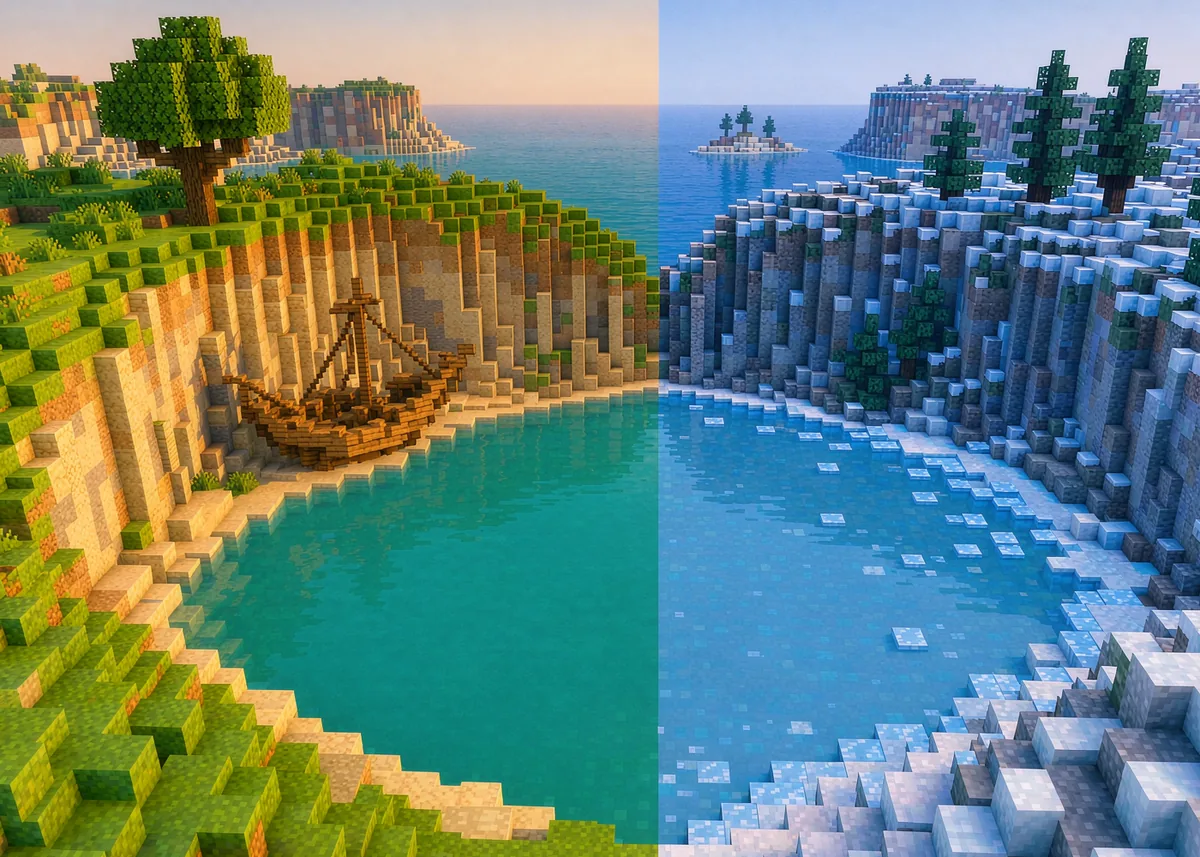
The one Java code in our records with a bounded version range and a completed timed run attached — seed 2016000, Java 1.20–1.21
One bay, two terrain generators from one code. Nineteen codes below date from 2011–2019 and none has been loaded on a modern release: the left half is the promise, the right half is what you may get.
Why “best Java seed” lists quietly mix two different things
Search for the best Minecraft seeds on Java and you get one of two things. Either a list of codes with a version number on top and no evidence underneath, or a list of codes from 2011 that nobody has opened in fifteen years. Both get presented the same way: a number, a sentence, a promise.
They are not the same kind of claim. A seed recorded on Java 1.20–1.21 with six structure coordinates is a description of a world somebody actually walked around in. A seed recorded as “Beta 1.3–1.7” is a description of a world that existed under a terrain generator that has since been replaced. The first one you can plan a run around. The second one you can only load and find out.
We hold both kinds, which is the reason this page exists. On one side is a twenty-row table of seeds we recorded on current releases — fifteen of those rows carry Java. On the other side is a set of nineteen codes from 2011 to 2019 that we recovered from posts whose pages no longer answer. The gap between those two sets is not a matter of quality. It is a matter of whether anyone ever opened the world again, and for the nineteen, nobody did.
So this page does two jobs. It gives you the Java seeds we will vouch for, with the version each one was recorded on and the coordinates that came with it. And it puts the nineteen old codes on the table with exactly as much information as the record actually contains — which, as the counts below show, is much less than a seed list usually admits to.
Five Java seeds we recorded on a current release
These are rows from our tested table, not from the old set. Every one carries a Java version and everything the tester wrote down. The tags are the tester’s own findings — we do not score seeds, and nothing on this page is a rating.
Island teleport /tp -576 ~ 80 — multi-biome: ice peaks, dark forest, jungle, bamboo, stone shore, lush cave
Bounded version rangeTeleport commandMulti-biome
32
Java 1.18+
Small grass island, few trees and sheep, underground cave system with a spawner
Two-digit codeAnimals at spawnDescription only
Two of these five carry a version range with an end on it. The other three say 1.18+, which is a floor with no ceiling — true forever and therefore almost empty of information. That split is not a criticism of those three seeds; it is the single most common defect in every seed list we have looked at, including the ones we wrote ourselves. The full field-by-field version audit is on the Java seed checklist.
The nineteen old codes, and what the record actually says
Below is every code in the 2011–2019 set, with the version exactly as it was written down, whether an edition was named at all, and whatever coordinate came with it. The point of printing it in full is that the empty cells are the story.
Version as recorded
Codes
What that label tells a Java player
Beta 1.3–1.7
10
Java-era version numbering, no edition word anywhere on the row, and a generator that predates the 1.18 overworld overhaul
Java Edition 1.14
3
Names Java and gives a release, but none of the three carries a coordinate and none names the person who found it
Java Edition (no number)
2
Names Java and nothing else — you know the edition, not the release
Pocket Edition / Bedrock
2
Names an edition that is not Java, so these two are simply out of scope for this page
1.2
1
A bare number with no edition attached; Java numbering, but the record never says so
Nothing recorded
1
No version at all — this is the one row that does carry a coordinate, and it is a coordinate with no version to attach it to
Read that table as a Java player and one number matters more than the rest: seven of nineteen. That is how many codes in this set even say which edition they belong to. Twelve give you a bare version number or nothing, and a bare version number is not an edition.
All nineteen, in the order they were posted
Posted
Seed code
Version as recorded
Coordinate
What the note says
Tag
1 Mar 2011
-1784338777788894343
Beta 1.3–1.7
—
Extensive mountain range almost completely suspended
Massive floating mountains and pathways between them
Floating rockNo edition named
30 Mar 2011
5682930821
Beta 1.3–1.7
—
Huge underground lake, tall overhanging cliffs
Underground lakeNo edition named
27 May 2011
1541961902
Beta 1.3–1.7
around x=100
Magnificent overhanging cliffs and steep mountains
OverhangX only, no Z
3 Jun 2011
1474776471
Beta 1.3–1.7
x=-165, z=510
Icy overhangs surrounded by a large pine forest
OverhangPine forest
8 Jul 2011
5515274009531393841
Beta 1.3–1.7
—
Vast mountainous landscape, plenty of trees and water
Trees and waterNo edition named
1 Aug 2011
729
Beta 1.3–1.7
x=-200, z=-200
Two-tier mountain range
Two-tier rangeThree-digit code
23 Aug 2011
1385327417
Beta 1.3–1.7
lagoon x=-170, z=290
Tall mountains, overhangs, and a lagoon — the only true lagoon in the set
LagoonOverhang
31 Aug 2011
177907495
Beta 1.3–1.7
x=-100, z=30
Long overhang complete with lava flow
OverhangLava at spawn
28 Apr 2012
1736813803934715730
1.2
—
Spawn inside a skeleton dungeon, vast taiga biome above it
Spawner at spawnEdition unstated
26 Jul 2013
-7492801512473941435
—
x=-400, z=280
Desert pyramid, NPC village, two surface spider dungeons sharing a wall, jungle with bays
Village and pyramidNo version recorded
12 Nov 2018
102043410 (kicly)
Java Edition
—
Badlands sitting in water
Word seedJava named
28 Nov 2018
-671686628 (foxtime)
Java Edition
—
Mesa, eleven minecart chests by spawn
Word seedChests at spawn
23 May 2019
116585159
Java Edition 1.14
—
Badlands with spawners, mineshafts and shipwrecks
Java namedNo coordinates
24 May 2019
1915631036
Pocket Edition / Bedrock 1.11, 1.12+
—
Badlands with exposed spawner and ravine dungeon
Exposed spawnerNot Java
5 Aug 2019
1927214572 (RIPSKID)
Java Edition 1.14
—
Bamboo forest and jungle biomes meeting ocean
Word seedBamboo
9 Sep 2019
-1881547168 (REDRED)
Java Edition 1.14
—
Pillager outpost at spawn
Word seedOutpost at spawn
5 Oct 2019
1959330209 (BINBAG)
Pocket Edition / Bedrock 1.12.1
—
Bamboo and a panda
Word seedNot Java
The coordinate paradox: the newer the Java label, the less you can navigate
Six of the nineteen carry something you could type into the game. Five are a complete X/Z pair; one, 1541961902, is an X value with the word “around” in front of it and no Z at all. Thirteen carry nothing.
Now cross that against the version column. Of those six coordinate-bearing codes, five were recorded on Beta 1.3–1.7 and one has no version recorded at all. Not one of the six carries a modern Java label. Meanwhile the three newest Java codes in the set — all three of them Java Edition 1.14 — carry no coordinates whatsoever.
That inversion is the most useful thing on this page, and it runs against intuition. You would expect the recent entries to be the detailed ones, because they were written by people with better tools. What the record shows is the opposite: the 2011 entries came with numbers attached, and the 2019 Java entries came with a description and nothing else. The nine high-ground codes that include the three floating ones are broken out separately on the floating island seeds page.
There is a second constraint hidden in those six coordinates. None of them carries a height value. Every one is an X/Z pair, which means every one needs a tilde in the Y slot before the teleport command will run — /tp -170 ~ 290, not /tp -170 64 290. If you paste an old coordinate and the game refuses it, that is usually why.
Five of the nineteen are words, and all five arrived in the same eleven months
Five codes in this set were written down as a word with the number beside it: kicly at 102043410, foxtime at -671686628, RIPSKID at 1927214572, REDRED at -1881547168 and BINBAG at 1959330209. The word is how the finder remembered it; the number is the string you paste.
All five were posted between November 2018 and October 2019 — an eleven-month window in a set that otherwise spans eight years. And the edition split inside that window is lopsided: four of the five were recorded on Java, one on Pocket Edition. So the word-seed habit in this particular record is mostly a Java habit, concentrated in the last year the set covers.
Which is worth knowing for a different reason. If you are reading a seed list and the codes are words, you are almost certainly looking at a recent Java-era list, not a 2011 one, and the version question has not gone away — it has just moved into the number next to the word.
What we will not claim
We did not load any of these nineteen worlds on a modern release, so we are not going to tell you what is still there.
We do not know whether any of the nineteen still generates the described terrain. Ten were recorded on Beta 1.3–1.7, which predates the 1.18 overworld overhaul that changed terrain shape and world height. Three were recorded on Java Edition 1.14, which also predates it.
We do not know which edition twelve of them belong to. Ten say Beta 1.3–1.7, one says a bare 1.2, and one says nothing. None of those twelve names Java or Bedrock anywhere on the row.
We cannot tell you the height of any of the six coordinates. No Y value was written down for any of them.
We have not re-tested a single one. That is the whole point of this page, and it is a gap in our own testing rather than a claim about the game.
What we can say is what the record contains, and that is what the tables above are. If you want seeds where the version question has an answer, use the five at the top of this page, or the full coordinate table where every row carries the release it was recorded on.
Five checks to run on any Java seed before you paste it
These are the same checks we run on our own rows, in the order that costs the least time. The right-hand column is how the nineteen old codes score against them — which is the fastest way to see why we do not publish them as recommendations.
Check
What to look for
Against the nineteen old codes
1. Is an edition named?
A field that says Java, not just a version number
7 of 19 pass. Twelve give a bare number or nothing.
2. Does it name a release you can pick?
A range with two ends, or one named release — not a floor like 1.18+, not an edition with no number
15 of 19 pass. Not one of those 15 is a modern release.
3. Is there a coordinate?
An X/Z pair you can teleport to, not a sentence
6 of 19 pass. One of those six is an X value with no Z.
4. Does the coordinate have a height?
A Y value, or a tilde you can substitute
0 of 19. Every recorded coordinate needs a tilde.
5. Was it ever re-checked?
Any evidence someone reloaded it after the generator changed
0 of 19. This is why they are a record, not a recommendation.
Check one is the one that fails most often on seed lists generally, and it fails quietly: a version number looks like an edition label until you notice that both Java and Bedrock have used 1.18, 1.20 and 1.21 at different times in different numbering systems. If the row does not say which edition, you are guessing. The cross-edition version of this page is the Bedrock checklist, and the side-by-side case of one code producing two worlds is on Java vs Bedrock.
Five codes from the set, mapped out
These are the five entries in the old set that we would load first if we were going to load any of them — chosen for what the record actually gives you to work with, not for how good they sound.
This is the only code in the whole set that the person who found it described as an actual lagoon — sheltered water with steep walls around it and wood on the slopes. Everything else in the 2011–2019 set is coastline, cliffs, flooded badlands, or high ground with water somewhere nearby.
It is also the clearest example of the trap. The description is vivid and the coordinate is precise, and both were written against a generator that no longer exists. Load it as an experiment, not as a plan.
No Y value was recorded, so the teleport needs a tilde: /tp -170 ~ 290.
Pyramid, Village, Two Dungeons — -7492801512473941435
Village and pyramidLinked dungeonsNo version recordedNot re-tested
Posted26 July 2013
Coordinatex=-400, z=280
TerrainDesert pyramid, NPC village, two surface spider dungeons sharing a wall, jungle with bays
Two surface dungeons sharing a wall is rare on its own, and a village and a pyramid inside the same short walk is the kind of spawn that gets called overpowered. The jungle behind it has bays cut into the coastline.
This is the one row in the set with a coordinate and no version at all. So it is simultaneously the navigable one and the least dated one — you know where to go and have no idea which release the note belongs to.
Overhang with Lava — 177907495
Beta 1.3–1.7OverhangLava at spawnNo edition named
Posted31 August 2011
Coordinatex=-100, z=30
TerrainLong overhang complete with lava flow
An overhang is a roof you did not have to build, which is most of what you need on night one. Lava at spawn is free light and free fuel and one careless step from losing everything you are carrying.
Short code, easy to remember, and one of only six entries in the set with a usable coordinate.
Eleven Chests — -671686628
Word seedJava namedChests at spawnNo release number
Posted28 November 2018
Also recorded asfoxtime
VersionJava Edition, no release number given
TerrainMesa, eleven minecart chests by spawn
Eleven minecart chests at spawn is the single most concrete loot claim in the entire set. It is also one of only five entries that names Java explicitly.
What it does not give you is a release. “Java Edition” with no number is an edition answer and a version silence, and there is no coordinate to navigate with either.
Two-Tier Range — 729
Beta 1.3–1.7Three-digit codeTwo-tier rangeNo edition named
Posted1 August 2011
Coordinatex=-200, z=-200
TerrainTwo-tier mountain range
A staircase terrain you can build straight into, and a code short enough to remember without writing it down. In a set where the longest code runs to nineteen digits, three digits is its own kind of convenience.
That same shortness is the reason to be careful with it. Our own tested table contains a two-digit code, seed 32, and a nineteen-digit one, and code length tells you nothing about which edition produced the world.
What to do in the first ten minutes once a Java seed loads
This is the part every theme page on this site keeps, because it is the part that decides whether the seed survives the first night. The order is the one in our testing notes.
Count the trees before you touch anything. One tree means one plank budget and one sapling you cannot afford to lose. Chop most of it and leave one standing. To get rich, first chop trees — on an island that rule is the entire opening.
Check the ruined portal chest before you mine anything. A ruined portal carries obsidian in its frame, so you may never have to mine for any. Chest first, then count the intact blocks, then decide whether to mine — that order is argued out on the obsidian route page.
Walk the shoreline before you walk inland. On island seeds the structures sit in the water more often than on the land, so the wrecks and the ruins are found by circling the coast, not by climbing.
Write down the coordinate of anything you intend to return to. Thirteen of the nineteen old codes are prose precisely because nobody recorded a number while they were playing. Do not add to that count.
Settle food on day one or accept that the run is a leaving run. Village rows settle it for you. Barren rows do not, and on those the recorded advice is to get obsidian and go to the Nether rather than try to make the island self-sufficient.
If there is no wood, no wreck and no portal in sight, leave. Paddling toward land is not giving up. Everything after day ten is measured in Nether blocks rather than overworld blocks anyway.
If you are picking a Java seed for a server instead
Solo and server are different problems, and the record treats them differently. Four Java seeds were measured against our server standard and rejected, each with the line it failed on — distance, no dual ocean monument, a crossroads too far out, a bastion too far out. Those four are listed with their reasons on the rejected seeds page, and the standard itself is on server-grade island seeds.
What does not change on a shared world is the version question — it gets stricter. Every player has to be on the same edition and the same release, because a version difference produces exactly the mismatch you get between Java and Bedrock: same code, different terrain, and somebody complaining that the seed does not work. With three of the five seeds at the top of this page versioned only as 1.18+, pin the release before you invite anyone.
A good seed is better with people on it. If you want to host one and run these islands together, Java or Bedrock, Shockbyte is a low-cost host that sets up in minutes. Use code LAUNCH for 25% off your first month. If you sign up through that link, I may receive a commission at no extra cost to you. It does not change what you pay.
Frequently asked questions
What is the best Minecraft seed for Java?
Seed 2016000 on Java 1.20–1.21, because it is the only code in our records with a bounded version range, structure coordinates and a completed timed run attached — a village at -24, 64, 12 with a stronghold eleven blocks under the well, and one tester finished it in 27 minutes. If you want four farm structures inside one radius instead, -8350249385580253962 on Java 1.18 and above is the row that clears our server standard.
Do old Minecraft seeds still work on newer versions?
We do not know, and we are not going to claim it either way. Every one of the nineteen codes we hold from 2011 to 2019 was typed against the terrain generator of its own era — ten recorded as Beta 1.3–1.7, three as Java Edition 1.14 — and none of them has been loaded on a modern release by us. A seed is a claim about the version it was loaded on, and we did not re-load these.
How can I tell whether a Java seed was tested on a modern version?
Look for four fields: an edition label that says Java, a version number with an end on it rather than an open-ended floor, structure coordinates instead of a sentence, and some evidence somebody re-checked it. In our own record of nineteen old codes, seven name an edition and six carry a coordinate; in the twenty-row table we tested ourselves, fifteen rows carry Java and three carry a bounded version range.
Are word seeds like RIPSKID valid Java seeds?
Yes, and the record pairs each word with the number that goes with it, which is the string to paste. Five of our nineteen old codes were written down this way: kicly at 102043410, foxtime at -671686628, RIPSKID at 1927214572, REDRED at -1881547168 and BINBAG at 1959330209. Four of those five were recorded on Java and one on Pocket Edition, which is why the number matters more than the word.
Why do so few old seed posts include coordinates?
Because most of them were written to describe a world, not to navigate one. Only six of our nineteen old codes carry any coordinate at all, and none of the six carries a height value, so every one needs a tilde for the Y axis before it will teleport. The three most recent Java-labelled codes in the set, all Java Edition 1.14, carry no coordinates whatsoever.
Should I use a 2011 seed on Java 1.21?
Only if you are prepared for the world to be different from the description. Ten of our nineteen old codes were recorded on Beta 1.3–1.7, which predates the 1.18 overworld overhaul that changed terrain shape and world height, so the notes attached to those codes describe a generator that no longer exists. Load one as an experiment, not as a plan.
Do the coordinates on this page include a height, or only X and Z?
The five tested rows carry all three numbers. Seed 2016000 alone lists six: spawn 0, 63, 0, village -24, 64, 12, stronghold -21, 42, 18, diamonds -32, 11, 25, desert temple -320, 64, 180 and jungle temple 450, 63, -270. The one exception is 39720048960, which is written as /tp -576 ~ 80 where the tilde means whatever height you are standing at. The nineteen old codes are the opposite case: six of them carry a coordinate and none carries a height, so every old coordinate needs a tilde added before it will teleport you anywhere.
How deep do these coordinates go? Is any of them underground?
The deepest confirmed value is Y=11, the diamond ore on 2016000. Across every coordinate triple published in this site's body text — 585 of them on 33 pages — not one Y is negative, and 89% sit between 32 and 99, which is the surface band. Since 1.18 the world bottom is -64, so this is a surface record: nothing in it was written from underground, and no seed here tells you what is under the island at a negative height.
Can I use these Java seeds on Bedrock as well?
Three of the five do appear in our Bedrock set: 2016000, which has a Bedrock 1.20.5 row with an ocean spawn at 0, 62, 0, plus 39720048960 and 32. The other two, 4188583766222650532 and -8350249385580253962, appear only on Java rows. The nineteen old codes are out of scope either way — two of them name Pocket Edition or Bedrock and never name Java.