Best Minecraft Java Seeds: 15 Java Rows, and the 5 That Never Say Which Biome You Land In
The short answer
We hold twenty island seed rows and fifteen of them run on Java. Five of those fifteen never name a single biome. Fourteen of the twenty rows name at least one, but one word does half the work: warm ocean appears on seven rows, and those seven split three kept, four rejected. Only one row in the whole record names more than two biomes.
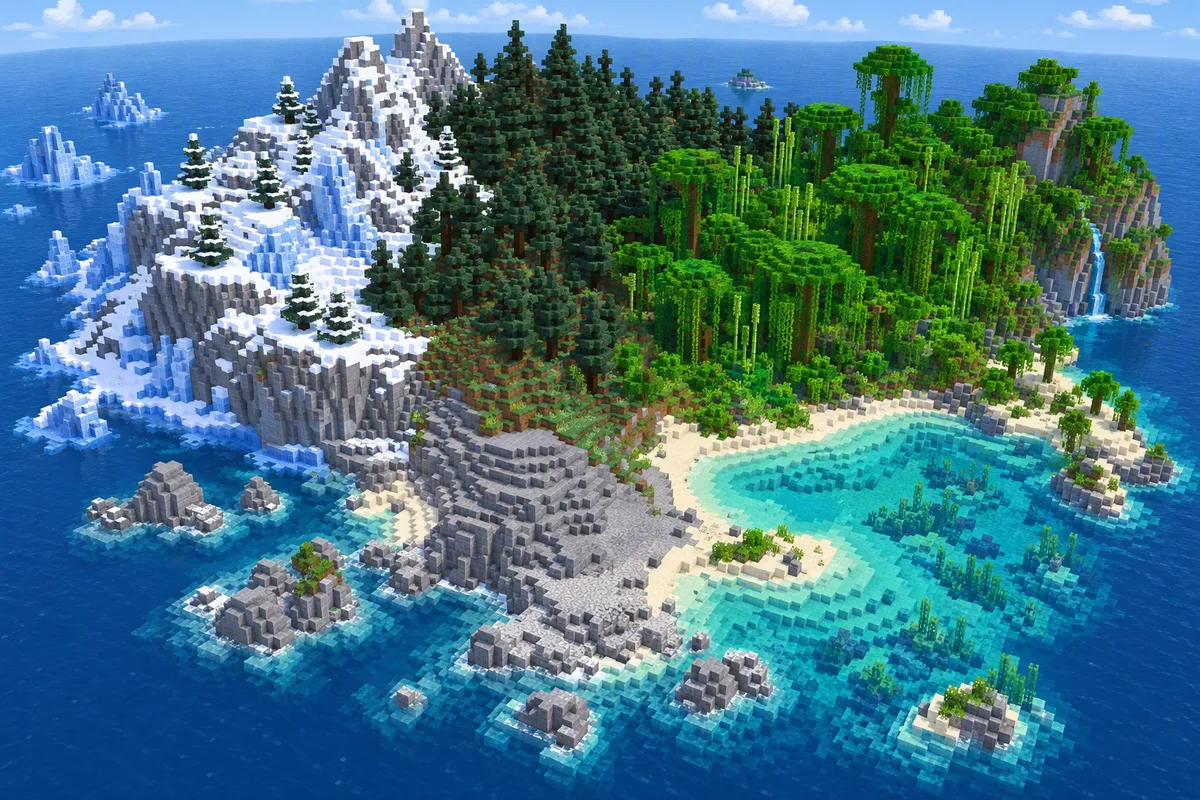
The one row that actually tells you what biome you are standing in, six times over:39720048960 — Java 1.18–1.21.2 and Bedrock 1.18–1.21.50. What it gives you: ice peaks, dark forest, jungle, bamboo, stone shore and lush cave, delivered as a teleport command rather than a structure list. What nobody else in the record does: name more than two. Six biomesTeleport-ready
The row that answers “where” five times and “which biome” zero times:2016000 — Java 1.20–1.21. What it gives you: a spawn, a village, a stronghold, diamonds, a desert temple and a jungle temple, every one with numbers. What the biome field says: nothing. Five structure coordinatesBiome field blank
The biome that predicts nothing:4188583766222650532 (kept) and -9147459640944998301 (rejected) — both Java 1.18+, both record a warm ocean and a mushroom island, both carry eight or nine structure coordinates. One was kept for the record and one was rejected as over-distance. The shared biome word is the only thing they have in common that does not separate them. Warm ocean + mushroom islandSame biome, opposite verdict
The three modern Java rows that say nothing at all:32, 354089350 and -1103547699 — all Java and Bedrock 1.18+, all recorded on the same date in 2025. What they give you: a small grass island with sheep and a cave, a resource-rich island with animals and redstone, an extra-large island with a mineshaft. What none of them gives you: a biome word or a single coordinate. No biomeNo coordinate
The gap in one sentence: nine of twenty rows give you both a coordinate and a biome. Four give you neither. Three of those four are Java rows. 4 of 20 answer neither question
The five codes that decide this page — the six-biome row: 39720048960; the blank rows: 2016000, 32, 354089350, -1103547699
Six biomes on one island is what the fullest row in our record looks like. It is also the only row that manages it — the other nineteen name two biomes at most, and six of them name none.
What “best” means on this page, and what it does not
Every list of the best Minecraft Java seeds you will find is doing the same two things: handing you a code, and telling you it is good. The second half is where the numbers usually come from, and they are usually invented. A difficulty score, a star rating, a rank from one to ten — none of it can be checked against anything.
This page does not do that. There is no score here and no ordering from best to worst. Every number on this page counts rows in our own record, which is twenty rows long, and every one of those rows is something somebody wrote down after loading a world. That makes the numbers small and checkable, and it makes them the only kind of number we are willing to publish.
So when this page says a seed is one of the best Java seeds we have, what it means is narrower than it sounds: it means the row tells you more than the others do. 39720048960 is the best-documented Java row in the table, because it is the only one that says which biome you are standing in six times over. That is a statement about our note-taking, and we would rather publish that than a score.
Four ways a row can be recorded, and one of them is empty of everything
Two separate questions decide whether a seed row is useful to you. The first is where — a coordinate you can walk or teleport to. The second is what — the biome you will actually be standing in. Our record answers them independently, which means a row can answer one, both, or neither. Here is the split, counted row by row.
Nine plus two plus five plus four is twenty, so nothing is double-counted. The bottom row is the one worth staring at, because those four rows are not short entries — they are among the more descriptive rows in the table. -706198004 tells you about two islands, one tree, a ruined portal, a cave and a shipwreck with planks and a treasure map. That is a paragraph of information with no number in it and no biome word in it. You can read it, picture it, and still not know where to go or what biome you are in.
The three Java rows in that bottom group share something else: they were all recorded on the same date in 2025, by the same pass over the same set of islands. The row that came out of that pass with a biome word is 2589021139, which names a jungle. Three of its neighbours from the same day name nothing.
The five Java rows with a blank biome field
Fifteen of our twenty rows run on Java. Five of them name no biome at all. Here they are, with everything each row does record, because the point is not that these rows are thin — two of them are among the fullest rows in the table.
Row
Seed
Edition and version
What the row does record
Biome
1
2016000
Java 1.20–1.21 (also Bedrock 1.20.5)
Spawn, village, stronghold, diamonds, desert temple, jungle temple — six coordinates
None named
5
-1463564255
Java 1.15 only
Barren island, a small mine shaft, two shipwreck coordinates
None named
16
32
Java + Bedrock, 1.18+
Small grass island, a few trees, sheep, an underground cave with a spawner
None named
17
354089350
Java + Bedrock, 1.18+
Resource-rich island, dense trees, animals, a cave with redstone, diamonds and a lava lake
None named
18
-1103547699
Java + Bedrock, 1.18+
Extra-large island, mineshaft, gold, shipwreck, ocean ruins, lava pool
None named
Two details in that table are doing more work than the blank column. The first is row 17, which is titled Mixed Biome Island and does not name a single biome anywhere in the record. A row can be named after the thing it fails to write down.
The second is row 1, and it is the one place where our counting rule is genuinely arguable. 2016000 names a desert temple and a jungle temple. Those are structure names, and we counted structures, not the biome words hiding inside them. Count those two words and the number of blank Java rows falls from five to four. We are telling you which way we counted rather than picking the number that looks better, because the whole point of publishing counts like these is that you can redo them.
One more thing about row 5 that matters more than the missing biome: -1463564255 is recorded on Java 1.15, and the wider record treats 1.18 as the floor for the seeds we actually stand behind. We have not re-loaded this code on 1.18 or later, so we do not know whether the barren island it describes still generates. The argument about old codes sitting next to new ones is on the old codes page.
Warm ocean: the most-recorded biome in our table, and it separates nothing
Thirteen distinct biome names appear across our twenty rows. One of them, warm ocean, appears on seven. That is half the biome record carried by a single word, and the interesting part is what it does when you sort the rows by whether we kept them.
Row
Seed
Verdict
Biomes named
Why the verdict went that way
7
-8350249385580253962
Kept
Warm ocean
Quad witch hut island, seven structure coordinates
8
3387664876512721018
Kept
Warm ocean
Quad witch hut island, six structure coordinates
9
4188583766222650532
Kept
Warm ocean, mushroom island
Dual monument plus a mushroom island, nine coordinates
10
-9147459640944998301
Rejected
Warm ocean, mushroom island
Over-distance — the structures sit too far from spawn for server use
11
-4217104969789286797
Rejected
Warm ocean
No dual monument — the record explicitly notes the absence
12
-1056083236240939372
Rejected
Warm ocean
Crossroads too far
13
6900926224957998486
Rejected
Warm ocean
Bastion too far
Read the middle column. Every one of the four rejected seeds records a warm ocean, and so do all three of the seeds we kept. The biome word is identical across both groups. If you were using “does this seed have a warm ocean” as a filter, you would keep all seven and reject none, and you would be wrong four times out of seven.
What actually separated those rows was distance and structure count, which is why the rejections on this page are the most-measured rows we have — the same pattern the Java checklist found when it counted which rows carry coordinates at all. A biome name is the wrong granularity for the decision. It tells you what the water feels like.
Thirteen names, and the four that never appear on a Java row
Here is the full biome vocabulary of the record, with how many rows each name appears on and whether any of those rows is a Java row. This is the whole list — there is no fourteenth name.
Biome name
Rows
Appears on a Java row?
Which rows
Warm ocean
7
Yes
7, 8, 9, 10, 11, 12, 13
Mushroom island
3
Yes
2 (Bedrock), 9, 10
Jungle
2
Yes
14, 15
Ice peaks
1
Yes
14
Dark forest
1
Yes
14
Bamboo
1
Yes
14
Stone shore
1
Yes
14
Lush cave
1
Yes
14
Mountain
1
Yes
19
Badlands
1
No
4 (Bedrock)
Glacier
1
No
6 (Bedrock)
Beach
1
No
20 (edition not recorded)
Ocean
1
No
20 (edition not recorded)
Nine of the thirteen names appear on a Java row. Four do not, and the reason is not a fact about Minecraft — it is a fact about which rows happen to exist. Badlands sits on a Bedrock-only row, glacier sits on a Bedrock row whose note says it does not generate this world on Java, and beach and ocean sit on the one row in the table with no edition label at all.
That last row is worth flagging separately because it is the strangest entry we hold. 2013 records seven trees, no passive mobs, three wheat seeds from grass, a beach and a small sand-only neighbouring island — and it names no edition and no version. Our note flags it as possibly only generating before release 1.13. We have not re-loaded it on a current version, and we are not going to tell you it works.
The one row with six biomes gets there by a different route
39720048960 is the only row in twenty that records more than two biomes, and the way it is written tells you why the other nineteen never manage it.
Field
What the row says
How many other rows do this
Biomes named
Ice peaks, dark forest, jungle, bamboo, stone shore, lush cave
0 of 20
How the location is given
A teleport command: /tp -576 ~ 80
0 of 20 — every other row uses structure coordinates
Java version range
1.18–1.21.2
3 of 20 — most rows stop at “1.18+”
Bedrock version range
1.18–1.21.50
0 of 20 — the widest bounded range in the record
The reason is structural. Every other row in the table was written by somebody measuring structures: a witch hut here, a monument there, a bastion at some distance. A structure coordinate tells you where a building is, and the biome it sits in is incidental. This row was written by somebody standing in one place and looking around, which is a different kind of note entirely — and it is the only row in the record where the height is written as a tilde rather than a number.
That is also why this row is the only one that can honestly be called the best-documented Java seed we have, and why “best” here still only means “best written down”.
What we will not claim
We are not saying those five Java rows have no biome. We are saying our record does not name one. A world always generates in some biome. Silence in a table is not a negative result, and we are not going to dress it up as one.
We are not saying warm ocean is good or bad for an island. We are saying it appeared on seven of our rows and failed to separate the four we rejected from the three we kept. That is a finding about seven rows, not about the biome.
We have not re-loaded any code on the edition it was not recorded on. Four biome names in the record appear only on rows that are not Java rows, and we have not checked whether those biomes exist on the Java generation of the same code.
We have not re-tested -1463564255 or 2013 on a current release. One is recorded on Java 1.15, the other carries no version at all and is flagged as possibly pre-1.13. Both are published as records, not as recommendations.
There is no difficulty score on this page and there will not be one. The words our testers used — barren, resource-rich, extra-large — are quoted as written. We do not convert them into numbers.
How to judge a Java seed row before you load it
Five checks, in the order we would run them. Every one of them is a question you can answer from the row itself, in about a minute, without loading anything.
Check
The question
What it catches
How our record scores
1
Does the row name a biome at all?
Rows that describe an island without ever saying what it is made of
14 of 20 pass
2
Does it name more than one?
The single-word rows, which are the majority
1 of 20 passes
3
Is the biome word a structure name in disguise?
“Desert temple” and “jungle temple” are buildings, not biomes
1 row turns on this
4
Is there a coordinate you can stand in that biome?
Rows that name a biome and give you no way to reach it
9 of 20 pass
5
Is the biome recorded on the edition you are loading?
Names that only exist on the other half of the table
4 of 13 names are not on a Java row
Check three is the one nobody runs, and it is the one that decides whether check one is even honest. Check five is the one that matters most if you play Java, because four of the thirteen names in this record were written down on worlds that are not Java worlds.
The five rows, in full
Six Biome Island — 39720048960
Edition and version: Java 1.18–1.21.2 and Bedrock 1.18–1.21.50. Biomes: ice peaks, dark forest, jungle, bamboo, stone shore, lush cave. Location: the only teleport command in the record, /tp -576 ~ 80. Why it is here: it is the only row in twenty that names more than two biomes, and the only row with a bounded Bedrock range that runs higher than its Java range. Six biomesTeleport-readyBounded version range
Speedrun God Seed (Java row) — 2016000
Edition and version: Java 1.20–1.21, and Bedrock 1.20.5 on a separate row. Biomes: none named on either row. Location: six coordinates on the Java row — spawn 0, 63, 0, village -24, 64, 12, stronghold -21, 42, 18, diamonds -32, 11, 25, desert temple -320, 64, 180, jungle temple 450, 63, -270. Why it is here: it answers “where” six times and “which biome” zero times, and the two structure names on it are the reason our counting rule has to be stated out loud. Six coordinatesBiome field blank
Dual Monument and Mushroom Island — 4188583766222650532
Edition and version: Java 1.18+. Biomes: warm ocean and mushroom island. Location: nine structure coordinates including a mushroom island at -300, -500. Why it is here: it is the deepest row in the record and it shares its biome pairing with a seed we rejected. Nine coordinatesWarm ocean + mushroom island
Rejected Over-distance — -9147459640944998301
Edition and version: Java 1.18+. Biomes: warm ocean and mushroom island. Location: eight structure coordinates from a spawn at 0, -550. Why it is here: it proves the biome field cannot be used as a filter. Same two biome words as the row above, opposite verdict. Rejected: over-distanceMushroom island at 150, 750
Plains Survival Island — 32
Edition and version: Java and Bedrock, 1.18+. Biomes: none named. Location: no coordinate of any kind. Why it is here: it is one of three modern Java rows recorded on the same date in 2025 that describe an island in detail without writing down what biome it is or where it sits. What it does record: a small grass island, a few trees, sheep, and an underground cave with a spawner. No biomeNo coordinate
First ten minutes on a Java island, biome first
The reason to read the biome before anything else is the count above: five of our fifteen Java rows cannot tell you what it is, so for those five you are the only one who will find out. Here is the order we would run it in.
Stand still and read the biome name. On Java the debug screen shows the biome you are standing in. Write it down before you move. That one word is the field our record leaves blank five times out of fifteen, and it takes two seconds to fill in yourself.
Write down the spawn coordinate as well. Fourteen of our twenty rows have no spawn point recorded, which is why most of them cannot tell you how far anything is. You are fixing the same gap from the inside.
Walk the shoreline once, in one direction, and count the biome changes. One change means a single-biome island. Six means you are standing on 39720048960 or something very like it. Our record only ever managed the second case once.
Count the trees before you touch them. Six of our twenty rows mention trees at all and only two put a number on it — the full count is on the one-tree page. Wood is the first constraint and the worst-recorded field in the table.
Look for animals and for grass to break, in that order. Three of twenty rows mention animals; one of those three records their absence along with three wheat seeds from grass. That single row is the whole of our food record — the food page has the count.
Before dark, decide whether you are staying. Eight of our twenty rows end in a decision to walk away, and none of them records how long the attempt took. The when-to-quit page splits those eight into three different kinds of quit.
Running these islands with other people
Everything on this page is a single-player audit of a twenty-row record, and it stays true on a shared world with one addition: the biome you spawn in is the one thing every player on the server will experience identically, which makes it the fairest thing to agree on before anyone joins.
If you want to run these islands with other people rather than alone, Java or Bedrock, Shockbyte is a low-cost host that sets up in minutes — use code LAUNCH for 25% off your first month. If you sign up through that link, I may receive a commission at no extra cost to you. It does not change what you pay.
Frequently asked questions
Which of your Java seeds name the biome you spawn in?
Ten of the fifteen Java rows in our record name at least one biome. Five name none: 2016000 on the Java row, -1463564255, 32, 354089350 and -1103547699. For those five the honest answer is that we do not know which biome you land in, not that the island has none.
Is warm ocean a good sign for an island seed?
On our own record it is not a sign of anything. Seven of the fifteen Java rows name a warm ocean, and those seven split three kept to four rejected. Every one of the four seeds we rejected carries a warm ocean, and so do three of the seeds we kept.
Which Minecraft seed has the most biomes?
39720048960, the only row in our twenty that records more than two. It lists six: ice peaks, dark forest, jungle, bamboo, stone shore and lush cave. It is also the only row whose biome list arrives by a teleport command rather than by a structure coordinate.
Do any of your rows give both a coordinate and a biome?
Nine of the twenty do. Two rows carry coordinates and name no biome, five name a biome and carry no coordinate at all, and four give neither: -706198004, 32, 354089350 and -1103547699. Three of those four are Java rows.
Are the biomes in your table tested on Java or on Bedrock?
Both, but not evenly, and never across editions. Nine of the thirteen biome names in the record appear on a Java row. Four names — badlands, glacier, beach and ocean — appear only on rows that are not Java rows. We have not re-loaded any of these codes on the other edition to check whether the biome is still there.
Do you rank these seeds from best to worst?
No. There is no score, no tier list and no ordering on this page. Every number here counts rows in our own twenty-row record, not quality in the game. We publish what a row says and what it leaves out, because a record that tells you where things are is not the same thing as a record that tells you whether the island is worth your evening.
Do any of these Java rows carry a Bedrock version number on the same row?
Two of the five do. 39720048960 writes both editions on one row, Java 1.18–1.21.2 next to Bedrock 1.18–1.21.50, and 32 writes “Java and Bedrock, 1.18+” with one shared range. 2016000 keeps its Bedrock number, 1.20.5, on a separate row, and the two remaining rows, 4188583766222650532 and -9147459640944998301, are recorded as Java 1.18+ with nothing said about the other edition.
Which row on this page has the widest version range?
39720048960, and it is the only row where the Bedrock ceiling sits higher than the Java one: Java 1.18–1.21.2 against Bedrock 1.18–1.21.50. Every other row on the page either stops at an open “1.18+” or moves its Bedrock number onto another row, so no other row on this page lets you compare two bounded ranges against each other.
Do all of your seed cards use the same field name for the version?
No. Across the 119 seed cards published on this site the same fact appears under three different field names: Edition on 31 cards, Version on 29, and Edition and version on 20 — the five cards on this page all use the third. The remaining 39 cards carry no version or edition field at all, which is why we print the range exactly as it was written to us instead of collapsing it into one number.