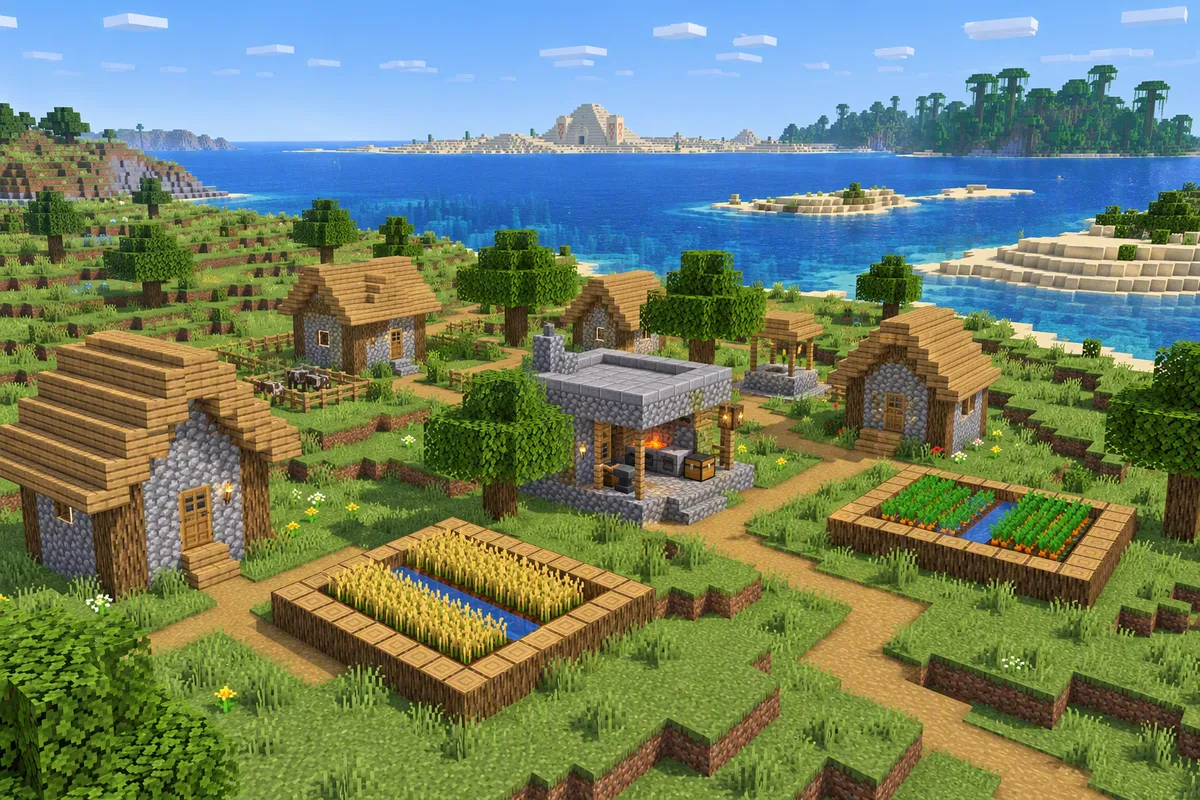
Minecraft Village Seed: 2 Villages in 49 Records, and Neither One Is on an Island
The short answer
This site publishes 49 seed records — twenty rows in the coordinate table and twenty-nine archive cards from 2011 to 2019. Exactly two of the forty-nine name a village. Ten of the forty-nine are island records, and not one of those ten has a village. The table records seven witch huts and seven pillager outposts for every one village. Both village records sit on land, both give a coordinate, and only one of the two records a spawn point — which is the only reason we can tell you how far the village is.
The only village row in the coordinate table:2016000 — Java 1.20–1.21. Village at -24, 64, 12, about 27 blocks from the recorded spawn at 0, 63, 0. The row describes it as 12 houses, 2 blacksmith forges, 1 church and 2 farms. Village at spawnDistance: about 27 blocksNever re-tested
The only village card in the archive:-7492801512473941435 — posted 26 July 2013. Terrain as written: desert pyramid, NPC village, two surface spider dungeons sharing a wall, jungle with bays cut into the coastline. One coordinate for the whole card (x=-400, z=280), no spawn, no edition, no version. Village in the terrain listNo spawn recordedEdition unstated
The code that has the village and loses it:2016000 — Bedrock 1.20.5, the second row of the same code. Ocean spawn at 0, 62, 0, shipwreck at 0, 58, 120, mushroom island at -300, 64, 0, ocean monument at 0, 40, -400. No village on this row. Ocean spawnNo villageSame code, different world
The island set, counted: the ten archive island cards name 0 villages, 0 shipwrecks, 0 strongholds and 0 pillager outposts between them. The only structure in that set is a jungle temple on 64951768. 0 villages in 10 island records1 temple
The structure the table has seven of: a witch hut is recorded on rows 7 through 13 and a pillager outpost on the same seven rows, against a single village. Witch hut × 7Pillager outpost × 7Village × 1
The two village records, and the code that drops its village on the other edition — 2016000; -7492801512473941435; the island card with the only structure — 64951768
A village like the one our record describes, with the ocean behind it and a desert pyramid on the far shore. The picture is the easy part. The hard part is that out of forty-nine written-down seed records we hold, only two of them ever mention a village at all.
How we counted, before you read any number on this page
Every figure below counts records, not worlds. That distinction decides the whole page, so here is the rule we used, in full, before any of the arithmetic.
What a record is. Forty-nine of them. Twenty rows in our coordinate table, each one a seed somebody wrote down after loading it, with a seed code, an edition, a version and whatever structures they found. Twenty-nine archive cards from 2011 to 2019, each one a seed code plus the terrain the person who found it described. Forty-nine records, and no invented entries among them.
What counts as a village. A record counts as naming a village if the word village appears on that record as a structure the person actually found — either as a named structure with a coordinate, or in the terrain description of that card. A record that uses the word village only in a sentence about something else does not count. This is a strict reading, and it is the reading that produces the number 2.
What counts as an island record. The archive page sorts its cards into groups and the first group is titled real island spawns, ten cards long. Those ten are the island records on this page. The coordinate table is a table of island seeds, and the one row in it that names a village is also the one row whose recorded spawn is a plains spawn rather than an island. We are not re-sorting the table to make a point; we are reporting the two facts the records contain.
What we do not do. We do not count a village that a list claims without a record behind it. We do not treat a silent row as a row with no village, because a row that never mentions villages has not said anything either way. And we do not put a number on how good any of this is.
The full village count: two record types, forty-nine entries
Record set
Entries
Entries that name a village
Which one
Coordinate table (posts dated 2020–2026)
20 rows
1
Row 1, 2016000, village at -24, 64, 12
Archive cards (posts dated 2011–2019)
29 cards
1
-7492801512473941435, posted 26 July 2013
Total
49
2
4% of everything we publish
Two out of forty-nine is a small number, and it is small for a reason that has nothing to do with the game. A village is one of the most common structures in Minecraft. What is rare is a village inside a written-down record, because the people who wrote these records down were not looking for villages. They were looking for islands, and an island is exactly the kind of start that does not come with a village on it.
That shows up most clearly in the table itself. Among the structures recorded as named coordinates in the twenty rows, the village is the rarest of the settlement types:
Structure recorded as a coordinate
Rows in the table
Rows, listed
Witch hut
7
Rows 7, 8, 9, 10, 11, 12, 13
Pillager outpost
7
Rows 7, 8, 9, 10, 11, 12, 13
Bastion
7
Rows 7, 8, 9, 10, 11, 12, 13
Ocean monument
9
Rows 2, 6, 7, 8, 9, 10, 11, 12, 13
Shipwreck
6
Rows 2, 3, 5, 6, 15, 18
Ruined portal
3
Rows 3, 4, 6
Stronghold
1
Row 1
Village
1
Row 1
Read the last two rows together. The single stronghold in the table is on the same row as the single village, and that row is row 1. So the one row that names a village is also the only row in the table that names a stronghold, which is a useful warning: the village is not rare because villages are rare. It is rare because this particular table was never built to hold one.
The two village records, side by side
Two records, seven years apart, and almost no fields in common. This table is the whole comparison.
Field
2016000 — table row 1
-7492801512473941435 — archive card
Record type
Coordinate table row
Archive card, 2011–2019 set
Dated
Source post dated 2026-07-23
Posted 26 July 2013
Edition
Java and Bedrock (Java row plus a separate Bedrock row)
Not recorded
Version
Java 1.20–1.21
Not recorded
Village coordinate
-24, 64, 12
None — one coordinate covers the whole terrain
Spawn coordinate
0, 63, 0
None recorded
Distance village to spawn
About 27 blocks, arithmetic on two recorded coordinates
Desert pyramid, two surface spider dungeons sharing a wall, jungle with bays at the desert edge
Re-loaded on a current release
No
No
One of these records is usable as a plan and the other is usable as a reading. 2016000 tells you a version range, a spawn, a village coordinate and a height, which is enough to walk to it. -7492801512473941435 tells you what the person saw and nothing about how to get there, and it does not even tell you which edition they saw it on.
How far is the village from spawn? One of the two answers is arithmetic
This is the question every village list answers first, usually with a phrase like "within 200 blocks of spawn". It is a good question, because a village at spawn and a village a long walk away are two different starts. Our record can answer it once.
The one we can measure. Row 1 records a spawn at 0, 63, 0 and a village at -24, 64, 12. The horizontal distance between two recorded coordinates is the square root of 24 squared plus 12 squared, which is 26.8 blocks. So the village on 2016000 sits about 27 blocks from the point you land on, which is close enough to reach before the first night without any planning at all. The two numbers are both in the same row, so you can repeat that sum and get the same answer.
The one we cannot measure. The 2013 card gives one coordinate, x=-400 and z=280, and it describes the terrain at that spot. It does not say where you land. A distance needs two points, so the card gives us a village and no way to place it relative to anything. We are not going to estimate it from the shape of the description.
Why that gap is worth publishing. It is the difference between a record you can act on and a record you can only read. Of the two villages we hold, one is a plan and one is a note. Both are honest records; only one of them is a route.
Minecraft island village seed: why the count is zero
The ten archive island cards are the closest thing this site has to a pure island set, and they were posted between 2011 and 2013. Between all ten of them, the structures recorded are:
Structure
Island cards that name it
Note
Village
0
None of the ten mentions a village
Shipwreck
0
None of the ten mentions a shipwreck
Stronghold
0
None of the ten mentions a stronghold
Pillager outpost
0
None of the ten mentions an outpost
Jungle temple
1
64951768, with a portal room underneath the ocean floor
So the honest answer to "is there an island village seed in your record" is no, and it is no for a boring reason. These cards were written by people who were collecting islands, in a period when the thing people checked for on an island was the terrain: one tree, a waterfall, a stone arch, exposed stone on the smaller of two islands, epic mountains and overhangs. Villages were not the thing being looked for, so villages were not written down.
There is one more detail that closes the loop. The one code in the whole record that does have a village also has a second row, and the second row is an ocean. 2016000 on Bedrock 1.20.5 spawns you at 0, 62, 0 in open ocean with no village, no trees and no stronghold, and what it gives you instead is a shipwreck, a mushroom island and an ocean monument. The same number that hands you a village on Java hands you an ocean on Bedrock. Even the village we do hold is one edition away from being an island record with no village in it.
Minecraft seeds with village: what this count covers, and what it does not
If you arrived searching for Minecraft seeds with a village, the two records above are what this site can honestly offer: 2016000 on Java with a village about 27 blocks from spawn, and -7492801512473941435 from 2013 with a village somewhere in a desert-and-jungle terrain that the card places at x=-400, z=280. That is two records, and it is fewer than any other list will hand you, because those lists count the game and this page counts a written record.
What the count does cover is every seed entry this site publishes, all forty-nine of them, counted by the rule stated at the top of the page. What it does not cover is the game. A village is common in Minecraft and this page is not saying otherwise. What is uncommon is a village inside an island record, and that is a fact about the record, not about the world.
What we will not claim
We are not saying villages are rare in Minecraft. They are not. Two out of forty-nine is a count of written records, and the records were collected by people hunting for islands.
We are not saying the other forty-seven records have no village. A record that never mentions a village has said nothing about villages. Silence is not a negative result, and we are not going to read one into it.
We are not giving a distance for the 2013 village card. It records no spawn point, so there is nothing to measure against. Any number we produced for it would be ours, not the record's.
We are not saying either village record still generates. Neither has been re-loaded on a current release. The 2013 card does not even name the edition it was played on, and its coordinate was written against a terrain generator that is years behind the versions this site normally covers.
We are not ranking these seeds. There is no score, no tier and no ordering here. Two villages, seven witch hut rows, seven outpost rows, one measurable distance — these are counts, and a count is not a grade.
Five checks before you call a code a village seed
Five checks, in the order we run them on a row before repeating anything off it. Each one is answerable from the record itself, in about a minute, without loading a world. The point is to separate a code that has a village in it from a code that has the word village near it.
Check
The question
What it catches
How our record scores
1
Does the record name a village as a structure the finder actually saw?
Codes that only have the word village in surrounding prose
2 of 49 pass — 2016000 and -7492801512473941435
2
Does the record give the village a coordinate of its own?
Cards that describe a village without placing it
1 of 2 passes — only the table row gives the village its own coordinate
3
Does the record give a spawn point, so the distance can be worked out?
Village records you cannot plan a route to
1 of 2 passes — the 2013 card records no spawn
4
Does the record name an edition and a version?
Village records you cannot match to the game you are running
1 of 2 passes — the 2013 card names neither
5
Has the record been re-loaded on a release you actually play?
The assumption that a written village is a village you will find
0 of 2 pass — neither village record has been re-tested
Check 3 is the one that decides whether a village record is usable, and it is the check our own record fails half the time. Check 5 is the one nobody runs, and it is the reason this page says "recorded" instead of "found".
The five records, in full
Speedrun God Seed — 2016000
Edition and version: Java 1.20–1.21, with a second row for Bedrock 1.20.5. Village: -24, 64, 12, described on the row as 12 houses, 2 blacksmith forges, 1 church and 2 farms, about 27 blocks from the recorded spawn at 0, 63, 0. Other structures: stronghold -21, 42, 18; diamonds -32, 11, 25; desert temple -320, 64, 180; jungle temple 450, 63, -270. Why it is here: it is the only row in the whole table that names a village, and it is also the only row whose recorded spawn is on plains rather than on an island. Village at spawnDistance: about 27 blocksNever re-tested
Desert Pyramid and Village — -7492801512473941435
Edition and version: not recorded, on either count. Village: named in the card's terrain line as an NPC village, with no coordinate of its own. Other structures: a desert pyramid and two surface spider dungeons sharing a wall, with jungle bays cut into the desert edge. Coordinates: x=-400, z=280, one coordinate for the terrain rather than a landing point, and no height value. Why it is here: it is the only archive card that names a village, and it is the clearest example of a record you can read but cannot follow. Village in the terrain listNo spawn recordedEdition unstated
Bedrock Ocean Spawn — 2016000
Edition and version: Bedrock 1.20.5. Village: none. What the row records instead: spawn 0, 62, 0 in open ocean, shipwreck 0, 58, 120, mushroom island -300, 64, 0, ocean monument 0, 40, -400. Why it is here: it is the same number as the village row above and it carries none of the village row's features, which is the cleanest proof that a village in a record is a claim about one edition and one world. Ocean spawnNo villageSame code, different world
Quad Witch Hut Island A — -8350249385580253962
Edition and version: Java 1.18+. Village: none. What it records: seven structure coordinates — spawn -150, 250, witch hut -325, 325, ocean monument -300, 150, pillager 600, 200, warm ocean 550, 1100, nether fortress -150, 0, bastion 100, -100, and a quad monument at -3100, -1100. Why it is here: it is the row that shows what the table was actually built to hold. Seven named coordinates and a spawn point, and the structure it names is a witch hut, not a village. Witch hut + pillager outpostSeven coordinatesNo village
Jungle Temple Island — 64951768
Edition and version: not recorded on the card. Village: none. What it records: the only structure named anywhere in the ten-card island set — a jungle temple with a portal room underneath the ocean floor. Why it is here: it is the exception that proves the island zero. Ten island cards, one structure between them, and it is not a village. Only structure in the island setNo villageNo version recorded
First ten minutes when you spawn beside a village
If you load 2016000 on Java, the village is about 27 blocks away, which means your first ten minutes are not a survival problem at all. They are a decision about what to take and what to leave. Here is the order we would run it in.
Walk to the village before you break anything. At 27 blocks you are inside it almost immediately, and the fastest mistake is to start punching trees on the way. The village already has the wood you would have collected, in the form of houses and fences.
Open the blacksmith chests first, then read what is inside them before you carry anything. The row records two blacksmith forges and three obsidian in the chests, which is three blocks toward a ten-block portal and not a portal. Knowing that number in advance stops you from planning a Nether trip you cannot make yet.
Sleep in a village bed on the first night, and note that you did not earn it. A village start removes the first-night problem the same way a mushroom island removes the hostile-mob problem, and the trade is the same: you get safety without the resource run that normally comes with it.
Walk the farms once and count them. Two farms are recorded on this row. A farm is food that regrows without you, which is the one advantage a village has over every island start in the table.
Read the stronghold coordinate before you go anywhere else. The row puts a stronghold at -21, 42, 18, which is a few blocks from the village on X and Z and eleven blocks lower on Y. That is the single most valuable line on the record, and it is a line no island row in the table has.
Decide, before the second day, whether you wanted a village or an island. This row gives you a village, a stronghold, diamonds, a desert temple and a jungle temple, and it is still not an island. If what you actually wanted was the island start, the honest move is to pick a different row rather than to treat this one as one.
Playing a village start with other people
Everything on this page is an audit of written records, and it stays true on a shared world with one addition: a village is a single-player asset that turns into a shared one the moment a second person spawns next to it. Twelve houses and two farms are a start for one player. For four players they are a supply stop that is stripped before the first night is over, and the farms will not have grown back.
If you want to run a village start with other people, on Java or Bedrock, Shockbyte is a low-cost host that sets up in minutes — use code LAUNCH for 25% off your first month. If you sign up through that link, I may receive a commission at no extra cost to you. It does not change what you pay.
Frequently asked questions
How many of your seed records name a village?
Two out of forty-nine. We publish twenty rows in the coordinate table and twenty-nine archive cards from 2011 to 2019. One table row names a village, 2016000 on Java 1.20–1.21 at -24, 64, 12. One archive card names a village, -7492801512473941435 posted 26 July 2013. The other forty-seven records do not mention a village at all.
Is any of your island seeds also a village seed?
No. The ten archive island cards record zero villages, zero shipwrecks, zero strongholds and zero pillager outposts between them; the only structure named in that set is a jungle temple on 64951768. The single village row in the coordinate table is also the single row whose recorded spawn is on plains rather than on an island. So across all forty-nine records the overlap between island and village is zero.
How far is the village from spawn on seed 2016000?
About 27 blocks. The row records a spawn at 0, 63, 0 and a village at -24, 64, 12, so the horizontal walk is the square root of 24 squared plus 12 squared, which is 26.8. Both numbers come from the same row, so you can redo the arithmetic yourself. We are quoting the record, not a measurement we took in a live world.
Why can you not give the distance for your 2013 village card?
Because the card records no spawn point. -7492801512473941435 carries a single coordinate, x=-400 and z=280, and that number describes where the terrain sits, not where you land. With no landing point there is nothing to measure the village against, so any distance would be invented. The card also records no edition and no version.
Does the same code give you a village on Bedrock?
No. 2016000 appears on two rows of our table and only the Java row names a village. The Bedrock 1.20.5 row records an ocean spawn at 0, 62, 0 with a shipwreck at 0, 58, 120, a mushroom island at -300, 64, 0 and an ocean monument at 0, 40, -400. The village is on the Java row and the ocean is on the Bedrock row, and neither row carries the other one's features.
Do you rank these village seeds?
No. There is no score, no star rating and no ordering on this page. The numbers here count records, not quality: two village records out of forty-nine, seven witch hut rows, seven pillager outpost rows, one measurable village distance. A count of what somebody wrote down is not a grade, and we are not going to convert one into a grade.
Does the version tag on 2016000 still hold on the current Minecraft version?
We do not know, and the tag does not claim it does. The Java row on 2016000 is tagged Java 1.20–1.21 and the Bedrock row is tagged Bedrock 1.20.5. Those tags record the version an entry was checked on, not a promise about anything after it. In the official release changelogs we read on 3 November 2026, Bedrock has reached 26.60 and Java 26.3, while 1.21.132, 1.21.131 and Java 1.21.11 sit at the bottom of that list as the oldest entries. The tag on this page is therefore a whole numbering generation behind. None of our 49 codes has been re-run on 26.x, so we cannot say the village is still at -24, 64, 12.
Why do you not update the old version tags to the current one?
Because changing a tag would claim a re-test we never ran. Every version string on this page came from the person who wrote the record down. Rewriting Java 1.20–1.21 as 26.x would make the page look current while the coordinate behind it had never been loaded again. The split we use is: record fields keep their original tag, and anything about the current version goes in the prose, where we can cite the changelog.