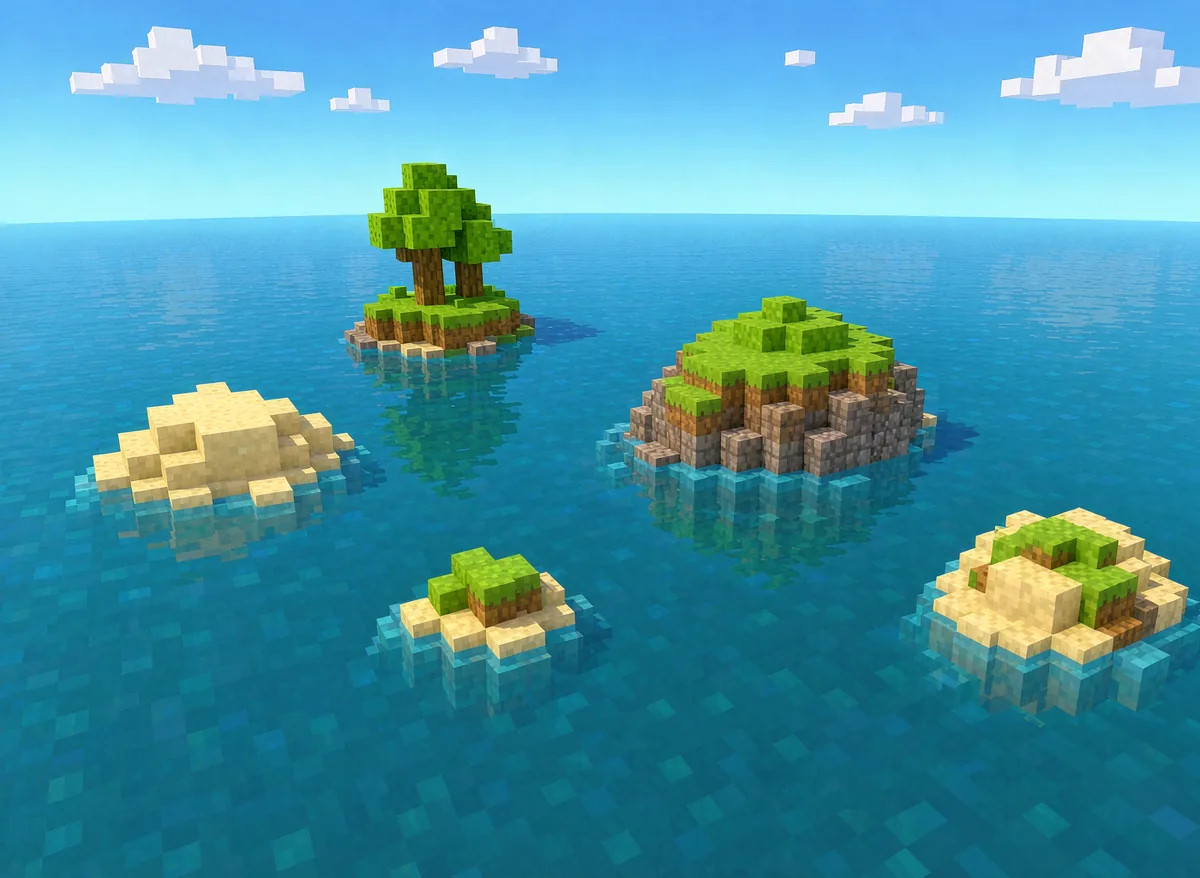
The short answer
Eleven of the 48 distinct seed codes we hold describe a world with more than one island in it. Of those eleven, only two carry a distance between the landmasses, only one says which island you land on, and not one gives you all three. If you want the answer in one line: load -706198004 on Bedrock for the clearest layout, and load 2016000 on Bedrock for the only measured gap.
- The clearest layout:
-706198004— Bedrock, two islands, one large and one small, you start on the small one with one tree and a ruined portal. Two islands Lands on the small island One tree No distance - The only measured gap:
2016000— Bedrock 1.20.5, ocean spawn at 0, 62, 0 with a mushroom island at -300, 64, 0, exactly 300 blocks west. 300 blocks, measured No trees at spawn Shipwreck at 120 blocks - The only number without a count:
-1276503895— Bedrock, several small islands within 500 blocks, with a ruined portal on a neighbouring island. 500 blocks, measured No island count Not on Java - The most complete word-code record:
ilovepotatoes— Minecraft 1.1, a pair of islands side by side, exposed stone on the smaller one. A pair of islands Coal and iron early Minecraft 1.1 only
Every number on this page came out of a record we actually hold. Where a record says a thing without a number, we say the same thing without a number, and where we derived a figure from recorded coordinates we label it as derived.
Every archipelago record we hold, in one list
Eleven seed codes name a second island. The column that matters is the last one: how much of the run can be planned before you load the world. This is the same shape as a numbered list of named variants, with the coordinates inline, because a list you can read in one glance beats a table you have to decode.
| # | Seed code | Edition and version | What the record says | Islands | Distance | Where you land |
|---|---|---|---|---|---|---|
| 1 | -706198004 |
Bedrock, no release recorded | Two islands, one large and one small. On the small one: exactly one tree and a ruined portal. The large island has a coastal cave with a mineshaft. A shipwreck further out holds planks and a treasure map. | Two | Not recorded | The small island |
| 2 | 2016000 |
Bedrock 1.20.5 | Ocean spawn at 0, 62, 0. Shipwreck at 0, 58, 120 with a treasure map, five iron ingots and two diamonds. Mushroom island at -300, 64, 0. Ocean monument at 0, 40, -400. | Not counted | 300 blocks, measured | Open water, no land |
| 3 | -1276503895 |
Bedrock, recorded as not working on Java | Barren island with a few trees and sugar cane. A diamond vein exposed to air beside a lava pool. A ruined portal on a neighbouring island, a glacier, an ocean monument, and a shipwreck in an underwater canyon. | Several, no count | 500 blocks, measured | Not recorded |
| 4 | -9147459640944998301 |
Java 1.18+ | Spawn at 0, -550. Mushroom island at 150, 750. Witch hut, ocean monument, pillager outpost, warm ocean, bastion and a quad ocean monument. Rejected for distance. | Not counted | Over 1,000 blocks, and the record does not say which gap | Not recorded |
| 5 | 4188583766222650532 |
Java 1.18+ | Witch hut, ocean monument, pillager outpost, warm ocean, mushroom island at -300, -500, two Nether fortresses, a bastion and a dual ocean monument. | Not counted | No spawn recorded, so no gap | Not recorded |
| 6 | ilovepotatoes |
Minecraft 1.1, posted 14 January 2012 | A pair of islands right next to each other. The smaller one has exposed stone, so coal and iron come early. | A pair | Not recorded | Not recorded |
| 7 | -1930813962 |
Posted 16 May 2013 | Two medium-sized islands right next to a single mountain. | Two | Not recorded | Not recorded |
| 8 | BubbleGum |
Minecraft 1.2, posted 24 April 2013 | Small island next to a much larger jungle island, with a rare pink sheep hiding in the jungle. | Two named, no count | Not recorded | The small island |
| 9 | lost |
Minecraft 1.0, posted 10 December 2011 | Small island to the left of a huge mushroom biome. Coordinates were written as (x=70, z=280). | Two named, no count | Position only, no spawn to measure from | The small island |
| 10 | 2013 |
Unknown edition, may be pre-1.13 | Ocean island with seven trees, no passive mobs, three wheat seeds from grass, a beach, an underground mineshaft, and a small sand-only neighbouring island. | Two named, no count | Not recorded | Not recorded |
| 11 | -442650539972332399 |
Beta 1.3–1.7, posted 7 March 2011 | Tall mountain ranges, huge caves, oddly shaped floating islands and overhangs. Floating islands in 2011 were a generator bug, not a biome. | Plural, no count | Not recorded | Not recorded |
Read the three right-hand columns as a coverage map, not a ranking. Only row 1 tells you how many islands there are and where you land, and it says nothing about the gap. Only rows 2 and 3 measure the gap, and neither tells you how many islands there are or which one you start on. Row 4 is the one place a distance number decided the outcome, and the record does not even say which of the seven structures the thousand blocks referred to.
The three numbers an archipelago needs, and how many of ours have them
An archipelago run is decided by three separate questions, and they are not the same question. On a single-island seed the difficulty knob is wood. On an archipelago the knob is reachability, and that splits into three parts.
- How many landmasses? If the record says “an island” and nothing else, you do not know whether you are on one landmass or five, and on an archipelago that is the whole run.
- How far apart? This is the number that decides whether you can reach the second island on day one, and it is the number our records almost never carry.
- Which one do you land on? A one-tree island and a twelve-tree island are completely different runs, and a record that never says which island you spawn on cannot tell you that.
Counting our eleven records against those three questions:
| Question | Records that answer it | Which ones |
|---|---|---|
| How many islands? | 3 of 11 | -706198004 (two), ilovepotatoes (a pair), -1930813962 (two medium) |
| How far apart? | 2 of 11 | 2016000 (300 blocks), -1276503895 (within 500 blocks) |
| Which one do you land on? | 3 of 11 | -706198004, BubbleGum, lost (all the small island) |
| All three at once | 0 of 11 | No record in our set answers all three. That is the finding. |
Two things fall out of that table, and both are worth reading twice.
First: the word “several” is not a count. Seed -1276503895 is the only record in our whole set that measures a gap between islands — several small islands within 500 blocks — and it still does not tell you whether that is three islands or thirty. The record that does give a count, -706198004, gives no distance at all. We have never caught a seed doing both in the same sentence.
Second: the record with the measured distance is the one where you start in the water. On 2016000 on Bedrock, your spawn is open ocean at 0, 62, 0 with no trees on it, the nearest land is a mushroom island 300 blocks west, and the only recorded structure between you and it is a shipwreck 120 blocks north. The layout is fully known and the gap is fully measured, and it is still the hardest of the three to start, because you have no wood to build a boat with until you have already crossed open water. That record is the reason this page exists: a number is not the same as a plan.
The one record that failed on distance, and what its number actually meant
Seed -9147459640944998301 on Java 1.18+ is the only record in our set where a distance number between two features decided the verdict, and the verdict was a rejection. The tester's line reads: “Slightly over 1000 blocks, has mushroom island and quad ocean monument.” Everything a seed list would put in a headline is on that row, and the distance took it out of contention anyway.
What the record does not say is which distance the thousand referred to. It has a spawn at 0, -550 and seven recorded features, so we can work it out from the coordinates, and the answer is that three separate features sit beyond a thousand blocks:
| Feature | Recorded coordinate | Straight-line from spawn |
|---|---|---|
| Witch hut | 150, -950 | About 427 blocks |
| Ocean monument | 200, -350 | About 283 blocks |
| Pillager outpost | 600, -900 | About 695 blocks |
| Bastion remnant | -300, 50 | About 671 blocks |
| Warm ocean | -850, -1250 | About 1,101 blocks |
| Mushroom island | 150, 750 | About 1,309 blocks |
| Quad ocean monument | 450, 950 | About 1,566 blocks |
Those three lower figures are derived, not recorded: they are straight-line distances on the X and Z axes from the recorded spawn point, and the record itself uses two-axis coordinates. The numbers above are the only ones on this page that we calculated rather than read off the tester’s notes, and we are showing them because they settle a question the record leaves open — the thousand blocks could have been any one of three things, and only the derived figures tell you that the mushroom island was the most likely candidate. The record does not confirm it, so we are not claiming it.
One more thing about this row: the mushroom island itself is the reason the seed looks attractive. A mushroom biome beside your spawn is a genuine prize, and on this seed it is also the thing that put it out of reach. Rarity and reachability are not the same axis, and the full rejection reasoning is on the rejected seed page.
The first-day rule for an archipelago seed
A single-island run and an archipelago run need different orders, because the second landmass changes what the first one is for. On a single island the first tree is the ceiling on everything. On an archipelago the first question is whether you can reach the second island at all, and that question comes before the pickaxe.
- Count the islands before you plan anything. Stand on your spawn island and walk the shoreline in both directions. On
-706198004that walk is what tells you a large island exists and a cave with a mineshaft is on it. On a single-island seed the same walk is wasted time, which is why the order changes. - Get a boat before you get a pickaxe. The tree is your first priority only if the tree is on the island you start on. On
2016000on Bedrock there is no tree at spawn, so planks from the shipwreck 120 blocks north are the first wood you will ever hold, and a boat is the first thing you craft with them. - Read the neighbouring island as a separate budget. The
-1276503895record puts a ruined portal on a neighbouring island inside 500 blocks. If a portal is on the other side of the water, obsidian is a voyage and not a pickup, and every minute you spend on the far island is a minute you are not on the safe one. - Decide which island you are farming before you start farming. With one tree on the small island, the large island with the coastal cave is where the iron and the stone are. The record that names the tree count also names where the cave is, which is exactly the pair of facts you need and exactly the pair most records leave you guessing.
- Do not assume a second island means a second chance. On
-1276503895the neighbouring island is a barren island with few trees and sugar cane. A second landmass can be a worse island, and a count of islands is not a count of resources.
The verdict field, and why an archipelago needs one more than a single island does
Every seed record on this site carries a Challenge field, and it is worth looking at what is actually in it: of the records that have the field, most of them say “not recorded” or “not rated by the tester”, and only a handful carry a verdict anyone can act on. The verdicts we do have use a very small vocabulary — brutal, barren, survivable, none, too far to be worth it, no land at spawn.
For a single-island seed that is survivable, because a difficulty word and a tree count tell you roughly what the run feels like. For an archipelago seed it is not enough, because the difficulty is not a property of the island, it is a property of the gap between two of them. The record that says “brutal” and the record that says “barren, but stocked” are both about the island you start on. Neither of them tells you whether the second island is a rescue or a trap.
Which is why the three numbers in the section above are the ones worth insisting on. They turn an adjective into a plan: three landmasses means three supply runs, 300 blocks means one voyage, and “you land on the small one” means the big island is a trip rather than your base.
Running an archipelago on a server
If more than one player is landing on the same archipelago, the reachability question gets sharper rather than softer, because two players cannot share one tree. The server-grade standard we use is four structures inside a 256-block radius plus a warm ocean, and it was written for single-island server seeds. For an archipelago the same four checks need a fifth question attached to them: is the second landmass inside the same radius, or is it a second base that nobody can reach on foot?
Two practical consequences fall out of the records above. First, a 300-block gap with no trees at spawn is a solo problem, not a server problem, because the second player has no way to reach the supply boat either. Second, the record that has both a named landing island and a mineshaft on the large island — -706198004 — is the shape that works for two players: one settles the small island, the other works the cave on the large one. It is also the only record in the set that names that split explicitly.
One more practical note. Because these records are old, check the edition before you plan a shared world around them. Six of the eleven archipelago records are Bedrock or pre-1.13 rows, and the one clean comparison in the set shows why that matters: the same code is a village 27 blocks from spawn on Java and open ocean on Bedrock. If you are hosting, Shockbyte is a low-cost host that sets up in minutes. Use code LAUNCH for 25% off your first month. If you sign up through that link, I may receive a commission at no extra cost to you. It does not change what you pay.
Frequently asked questions
What is the best archipelago seed in Minecraft for a survival island?
The one to load first is -706198004 on Bedrock, because it is the only record in our set that tells you both how many islands there are and which one you start on: two islands, one large and one small, and you spawn on the small one with exactly one tree and a ruined portal. The catch is that it gives you no distance between them, so you are choosing between a named layout and a blind swim. If a number matters more than a layout, load 2016000 on Bedrock instead, because it is the only record with a measured gap: a mushroom island at -300, 64, 0, exactly 300 blocks west of an ocean spawn that has no trees on it at all.
How many Minecraft archipelago seeds are there?
In our record, 11 of the 48 distinct seed codes we hold name a second island or a second landmass of some kind. Three of them name a mushroom island, three are 2011 to 2013 word codes from the old forum era, two are Bedrock rows with a ruined portal on a nearby island, and three are the flying-island and satellite-island oddities. The count does not include the 29 cards on the 2011-2019 page that describe a single island and nothing else.
What is the difference between an archipelago seed and an island seed?
An island seed is one landmass with a number of trees on it. An archipelago seed is a run where the second landmass is part of the plan, and that changes what you need on day one. A single-island run is limited by wood, because the trees on the island are the whole supply. An archipelago run is limited by reachability, because the second island may hold the food, the dungeon or the obsidian, and if you cannot get to it the run is over regardless of how good the first island is. The three numbers that decide it are how many landmasses there are, how far apart they are, and which one you land on.
Do archipelago seed coordinates work the same in Java and Bedrock?
No, and this page is a clean proof of it. The code 2016000 puts a village and a stronghold 27 blocks from spawn on Java, and open ocean with a mushroom island 300 blocks west on Bedrock. The mushroom-island record -9147459640944998301 is a Java row and the neighbouring-island record -1276503895 is a Bedrock row that explicitly does not work on Java. A seed list that does not split the archipelago rows by edition is handing you a layout from one generator and a distance from the other.
How far apart are the islands in an archipelago seed?
Only two of our 11 records carry a distance between landmasses, and they are two different kinds of number. Seed -1276503895 is recorded as several small islands within 500 blocks, with no count. Seed 2016000 on Bedrock puts a mushroom island 300 blocks west of spawn, and the record says it plainly: the spawn is open water with no trees on it, so 300 blocks of ocean is a swim you cannot build a boat for. The other nine records describe a second island with no gap at all, and no way to work out the gap from the record as written.
Can you build a boat early on an archipelago seed?
On seed 2016000 on Bedrock, no, and that is the point worth taking from it. The spawn is open ocean with no trees, the nearest land is a mushroom island 300 blocks west, and the only recorded structure between you and it is a shipwreck 120 blocks north. Planks from a wreck chest are the only wood on the map. So the practical first-day rule for an archipelago is that you need a boat before you need a pickaxe, which is the opposite of the order on a single-island seed.
Which island do you spawn on in a two-island seed?
Only one of our records says, and it is -706198004 on Bedrock: two islands, one large and one small, and you start on the small one with exactly one tree and a ruined portal. The large island has a coastal cave with a mineshaft, and a shipwreck sits further out with planks and a treasure map. On every other two-island record the landing island is never stated, which means the difference between a generous start and a brutal one is a detail you only find out by loading the world.
Are the old word-code archipelago seeds still worth loading?
Treat them as untested. Four of the 11 archipelago records are word codes from 2011 to 2013, including ilovepotatoes, BubbleGum, lost and -1930813962, and every one of them was posted against Minecraft 1.0, 1.1 or 1.2. The terrain generator changed more than once since, so a code that produced a pair of islands on 1.1 can produce open water today. ilovepotatoes is the example that still reads well: a pair of islands side by side, with exposed stone on the smaller one so coal and iron come early. That is a description, not a promise.