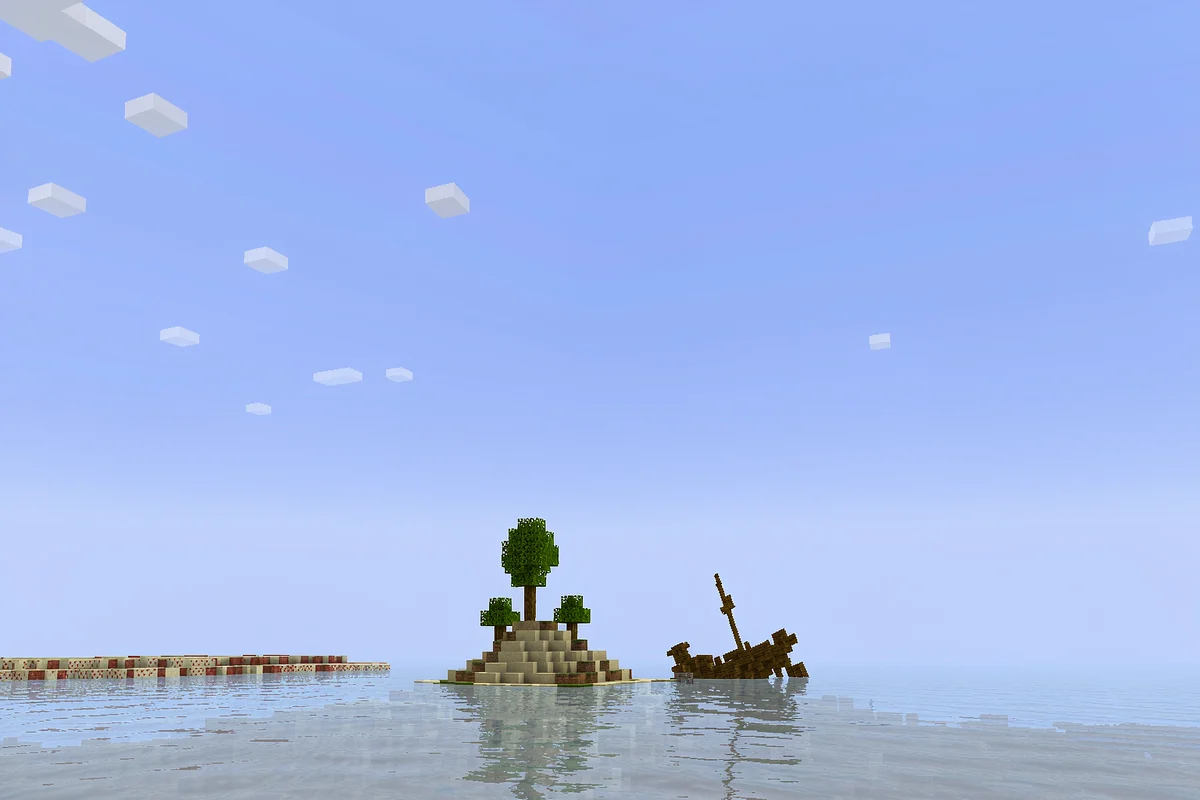
The short answer
Eleven of the twenty tested island seeds on this site run on Bedrock. Eight of those eleven carry a version number, and three carry nothing but the word Bedrock. Of the eight numbers, five are the same open-ended string that names no upper bound, one is a single pinned release, one is a range with two ends, and one more is a second pinned release. And across all eleven rows, exactly one has coordinates that were measured on Bedrock — the ocean spawn of 2016000.
- The one row with Bedrock-measured coordinates:
2016000, Bedrock 1.20.5, spawn 0, 62, 0 in open ocean, shipwreck at 0, 58, 120, mushroom island at -300, 64, 0, ocean monument at 0, 40, -400. Pinned to one release Ocean spawn, no trees Only Bedrock-measured coordinates - The only range with a ceiling:
39720048960— Bedrock 1.18 to 1.21.50, the widest Bedrock span in the table. One island with six biomes on it: ice peaks, dark forest, jungle, bamboo, stony shore and a lush cave. Closed range Six biomes on one island Teleport target has x and z only - The only one-tree Bedrock island:
-706198004— a small island with a single tree and a ruined portal, with a cave and a shipwreck carrying planks and a treasure map on the larger island next to it. One tree Ruined portal No version number - The one that needs no mainland trip:
-1276503895— a barren island with a diamond vein exposed to open air and a lava pool next to it, which is a complete portal kit without leaving the water. Diamond exposed to air Lava pool beside it No version number - The simplest code on the list:
32— a small grass island with a few trees, sheep, and a cave system with a spawner underneath. Two-character code Sheep on the island Open-ended version
Bedrock codes on this page — 2016000; -706198004; -665393669; -1276503895; 39720048960; 2589021139; 32; 354089350; -1103547699; 6390326396262027557
The eleven Bedrock rows, with the version tag each one actually carries
This is the whole set. Nothing here is a recommendation table — it is a reading of the version column, which is the one field that decides whether a code means anything on the build you are playing. Four tiers exist in the data, and the tier decides how much the tag can promise you.
| Seed code | Edition | Bedrock version as recorded | What that tag is | What the record says is on the island | Tags |
|---|---|---|---|---|---|
2016000 |
Java + Bedrock | 1.20.5 | Pinned to one release | The Java side of this code is a plains village spawn with a stronghold under the well, a desert temple, a jungle temple and diamonds at 11. The Bedrock side of the same code is an ocean spawn. | Same code, two different worlds Only row with both columns numbered Coordinates measured on Java |
2016000 |
Bedrock only | 1.20.5 | Pinned to one release | Spawn 0, 62, 0 in an ocean. Shipwreck at 0, 58, 120. Mushroom island at -300, 64, 0. Ocean monument at 0, 40, -400. | Only coordinate set measured on Bedrock Ocean spawn, no trees Mushroom island 300 blocks out |
-706198004 |
Bedrock | Bedrock (no number) | Edition word only | Two islands. The small one has a single tree and a ruined portal. The large one has a cave and a shipwreck carrying planks and a treasure map. | One tree Ruined portal Rejected nowhere, but no version number No coordinate given |
-665393669 |
Bedrock | Bedrock (no number) | Edition word only | More trees than the previous island. Land-based ocean ruins with a chest holding a stone axe and a treasure map, iron ore and two overlapping chests below, and a badlands with a ruined portal. | Ocean ruins generated on land Stone axe in the chest No version number No coordinate given |
-1276503895 |
Bedrock | Bedrock (no number) | Edition word only | A barren island with a few trees and some sugar cane. Underground, a diamond vein exposed to open air and a lava pool. A ruined portal on a neighbouring island, a glacier, an ocean monument and a shipwreck in an underwater canyon. | Diamond exposed to air Lava pool beside it Sugar cane on the beach No version number |
39720048960 |
Java + Bedrock | 1.18–1.21.50 | Closed range | One island holding six biomes at once: ice peaks, dark forest, jungle, bamboo, stony shore and a lush cave. Reached by teleport to -576, with the height left to fill in. | Widest Bedrock range we hold Six biomes on one island Teleport target has x and z only |
2589021139 |
Java + Bedrock | 1.18+ | Open floor, no ceiling | A large jungle island with cocoa beans and bamboo, a shipwreck and ocean ruins nearby. | Jungle island Cocoa beans at spawn Open-ended version |
32 |
Java + Bedrock | 1.18+ | Open floor, no ceiling | A small grass island with a few trees and sheep, and a cave system underneath holding a spawner. | Two-character code Sheep on the island Spawner in the cave below Open-ended version |
354089350 |
Java + Bedrock | 1.18+ | Open floor, no ceiling | A resource-rich island with dense trees and animals, and a cave with redstone, diamonds and a lava lake. | Animals at spawn Redstone in the cave Open-ended version |
-1103547699 |
Java + Bedrock | 1.18+ | Open floor, no ceiling | An extra-large island with a mineshaft, gold, a shipwreck, ocean ruins and a lava pool. | Extra-large island Mineshaft below Open-ended version |
6390326396262027557 |
Java + Bedrock | 1.18+ | Open floor, no ceiling | A mountain island with rich starting resources and an underground ancient city with a warden in it. | Ancient city underground Warden inside it Open-ended version |
The tags in the last column are read off the record, not scored. There is no rating on this page, because a rating needs a comparison and these eleven rows have not been measured against each other. What the tags do tell you is which rows carry a position you can walk to and which ones are a description and nothing more.
Four kinds of version tag, and only one of them is worth what it looks like
Strip the wording away and the Bedrock version column on this site contains eight numbers and three words. The eight numbers break down into three distinct strings. Here is what each one entitles you to assume.
- Pinned to one release (2 of 11).
2016000is recorded on Bedrock 1.20.5. A pinned version is the strongest claim in the table, because it is a claim about a specific build rather than a range of them. It is also the narrowest: it tells you exactly one build was checked, and says nothing about the build you are on. Two rows in our table are pinned like this, and they are the same code seen from two editions. - Closed range (1 of 11).
39720048960is recorded on Bedrock 1.18 to 1.21.50, the only row in the table where a Bedrock version has both ends. It is the single most useful Bedrock version field we hold, and it took twelve of the twenty rows before anyone wrote one down. - Open floor, no ceiling (5 of 11).
2589021139,32,354089350,-1103547699and6390326396262027557all say 1.18+ and nothing more. This is the most common tag in the Bedrock column and the weakest one, because it names the oldest release the code was loaded on and stops there. A floor is not a promise about the newest build. Five of these sit on rows recorded in one batch, so the string is one batch's habit rather than five independent confirmations. - Edition word only (3 of 11).
-706198004,-665393669and-1276503895have the word Bedrock in the version column and no number. There is no release to match against, which makes these the only rows on this page where the version tag gives you nothing at all.
Two things follow from that list, and both of them are the reason this page exists.
The Java side of the table does not have this problem. Fifteen rows are Java-capable and every single one of them carries a Java version number. Not one Java row in twenty is missing a version. On the Bedrock side the same table drops three of eleven. So the honest headline is not that Bedrock seeds are worse. It is that the Bedrock records were written down with less precision than the Java ones, and that is a fact about how the data was collected rather than about the seeds themselves.
The Bedrock column counts in a different number system. The two version strings that name a single Bedrock release are 1.20.5 and 1.21.50 — four numbers, two of them a patch counter. The Java column uses two or three: 1.20, 1.21.2, 1.15. That is why a row saying Bedrock 1.21.50 is not the same release as a row saying Java 1.21.2, and why matching a Bedrock seed by typing "1.21" into a search is not going to work.
The other half of the problem: only one coordinate set was measured on Bedrock
Version tags are only half of a Bedrock record. The other half is the position, and here the number is worse than it looks.
Only three of the twenty rows in the table carry a full x, y, z coordinate at all. Of those three, one is a Java row. That leaves two Bedrock-capable rows with a full coordinate, and only one of those two was measured in a Bedrock world — the 2016000 row. Every other Bedrock row on this page is prose: a ruined portal, a shipwreck, an ancient city, a cave, a lava pool, a badlands. You get a description and no position.
One row, 39720048960, is the near miss. It carries a teleport target of -576 with the height left as a placeholder, so you can be sent to the right column of the map but not the right height, and the record does not say whether that number was read off a Bedrock run or a Java one.
This is the trap that catches people. Take the village coordinate from the Java side of 2016000 — -24, 64, 12 — and paste it into a Bedrock world and you are not visiting a village. You are standing in open ocean, because on Bedrock that code spawns you at 0, 62, 0 with no land in sight. The number is real. The number is simply an answer to a different question.
The judgment standard: what a Bedrock version tag is worth before you paste the code
Four checks, in the order that saves you the most time. These are the checks this page would fail on five of its own eleven rows.
- Read the tag, and name its tier out loud. A pinned number, a closed range, an open floor or a bare word. If the tag is a bare word, the row tells you the edition and nothing else, so treat the seed as untested on your build no matter how good the island sounds.
- Check that the version string belongs to your edition's numbering. Bedrock releases count in four parts and Java in two or three. A row tagged 1.21.50 is Bedrock; a row tagged 1.21.2 is Java. They are different builds of the same name and they do not accept each other's numbers.
- Ask whether the coordinates were measured on Bedrock. If the record does not say, assume they were not. There is exactly one row on this page where they were, and the answer on that row is ocean, not island.
- Look for a closed range before you commit a whole playthrough. One of eleven rows has one. If the code you are excited about says 1.18+, the cost of being wrong is a wasted world, and the fix is cheap: load a throwaway copy in creative, walk to the spawn, and see what is actually there before you build anything on it.
The rule we would apply to our own page: a version tag with a ceiling is worth a commitment, a version tag with a floor is worth a test load, and a version word with no number is worth nothing at all until you have looked at the spawn yourself.
First-day strategy on the two Bedrock records that actually give you a position
Almost every Bedrock record on this site is a description, which means there is no distance to plan around. Two rows are not like that, and they sit at opposite ends of what a Bedrock start can be. Use them as the two extremes.
The starting point: 2016000 on Bedrock 1.20.5.
Bedrock 1.20.5: 2016000
You come up in the water at 0, 62, 0. There is no land, no tree and no village, because this is the Bedrock half of a code whose Java half is a village — the two halves of this seed do not know about each other. Three positions matter, and they are all measured from where you start:
- Shipwreck at 0, 58, 120 — 120 blocks along one axis, and it is the nearest thing on the map that is not ocean. It holds a treasure map, iron and diamonds. This is your wood, your iron and your first diamond, and it is the reason this seed is worth starting on Bedrock at all.
- Mushroom island at -300, 64, 0 — 300 blocks the other way. A mushroom field spawns no hostile mobs, which makes it the one piece of ground on this list you can stand on at night without a fight. It is a farm and a safe room, not a base.
- Ocean monument at 0, 40, -400 — 400 blocks past the shipwreck in the third direction, and it sits at y=40, which is under water. That is a mid-project, not a first-night errand.
The first hour is therefore not about the island, because on this code there is no island. It is about the 120 blocks to the shipwreck, which means a boat, which means the first thing you do with your hands is collect wood from a wreck you have to find. The mushroom island is the answer to night one, not day one, and the ocean monument is a diamond-pickaxe errand.
The other end: -706198004.
Bedrock, no version number recorded: -706198004
No coordinate here at all, so the plan is the opposite one: you are on the island, and the map is the search. The small island has a single tree and a ruined portal, and the larger island next to it has a cave and a shipwreck with planks and a treasure map. Two rules follow directly from the record. First, the shipwreck is your wood, and on a one-tree island you cannot afford to chop that tree before you have planks — the record notes the ruined portal chest on the small island was checked and held useful items, so the portal room is a starting point and not a detour. Second, neither of the two shore plants the record names is food you can pick here — sugar cane cannot be eaten and kelp is not named in the row — so the standing rule is to leave one sapling standing before the last tree goes.
What to skip on either of them. Do not plan around a structure you have not seen. On 2016000 the coordinates are exact and the island is not there; on -706198004 the island is described and the position is not. Either way the record is a claim about where something is, and the first job is confirming it, not exploiting it.
Where the rest of the Bedrock data lives
The version column is one field of one table, and the rest of the table is worth reading next to it. The Bedrock island seeds page holds the spawns that were loaded and played on Bedrock, with the supply situation noted for each. The side-by-side page puts one code across both editions, which is where the coordinate trap in this page comes from. The Bedrock checklist is the six checks to run before you load a code, and the version check on this page is the same idea turned into a field you can read off a table.
And if your question is the wider one — not Bedrock specifically, but which records on this site are actually complete enough to plan around — then the rarity page counts every named structure across all forty-nine records, and the coordinate page lists every record that has a position at all.
Running one of these with other people
If you want to check any of these coordinates with friends on Bedrock, Shockbyte is a low-cost host that sets up in minutes — use code LAUNCH for 25% off your first month. If you sign up through that link, I may receive a commission at no extra cost to you. It does not change what you pay.
Frequently asked questions
Do Java island seeds work on Bedrock?
No. Java and Bedrock do not share a world generator, so the same code builds two different worlds. Seed 2016000 is the clean proof on this site: on Java 1.20 to 1.21 it puts you in a plains village with a stronghold underneath, and on Bedrock 1.20.5 the same code drops you in an ocean at 0, 62, 0 with no village and no trees. A code only travels between the two editions if it was tested on both.
Why does a Bedrock island seed give me an empty ocean when the screenshots show an island?
Almost always an edition or version mismatch, not a broken seed. Two different things have to match: the edition and the game version. The record that started this guide reads: he told me 2016000 would give me a village, I got an ocean, we compared versions and saw the problem. Before blaming the code, check which edition the record was made on and which version it names.
What does 1.18+ mean on a Bedrock seed listing?
It is a floor with no ceiling. It records the oldest release the seed was loaded on and says nothing about the newest one, so it cannot tell you whether the code still works on the build you are running. Five of the eight version numbers in our Bedrock column are exactly this string, which is why five of eight rows on this page carry a version number that does not actually pin the seed to a version.
How many of these Bedrock seeds have a version number at all?
Eight of the eleven. The other three carry only the word Bedrock in the version column, with no number of any kind. That is not a rounding error in our table, it is the shape of the data: 11 rows on this site run on Bedrock, 8 of them can be tied to a release, and 3 of them cannot.
Do the coordinates on a Bedrock seed work on Java as well?
No, and this is the single most expensive mistake in the table. Coordinates are edition-specific because the terrain they point into was built by a different algorithm. The clearest case is seed 2016000, where the Java record gives a village at -24, 64, 12 and the Bedrock record gives an ocean spawn at 0, 62, 0. Match the edition before you copy a single number.
Can I convert a Java seed so it works on Bedrock?
No, and there is nothing to convert. The part that differs is not the number, it is the generator that reads the number. To get a world on Bedrock you need a code that was loaded on Bedrock. Of the eleven codes on this page, ten were recorded on Bedrock and one, 2016000, was recorded on both.
Do any of these Bedrock seeds have a shipwreck?
Five of the eleven do, and only one of the five gives you a position for it. The Bedrock row of 2016000 puts a shipwreck at 0, 58, 120, and it is the only shipwreck on this page you can walk to from a number. The other four are prose: -706198004 records a shipwreck carrying planks and a treasure map, -1276503895 one in an underwater canyon, 2589021139 one nearby with ocean ruins, and -1103547699 one on an extra-large island that also has a mineshaft, gold, ocean ruins and a lava pool. If the wreck is your plan for wood, four of these five rows tell you it exists and not where it is.
How many of these eleven Bedrock rows give you a position you can actually use?
Only one row on this page prints a set of complete positions, and it is the Bedrock half of 2016000: spawn 0, 62, 0, shipwreck 0, 58, 120, mushroom island -300, 64, 0 and ocean monument 0, 40, -400. A second row gives a column but no height, 39720048960 at -576, with the Y left blank. The other nine print no complete position at all, which is why the rest of this page has to talk about distance in words.