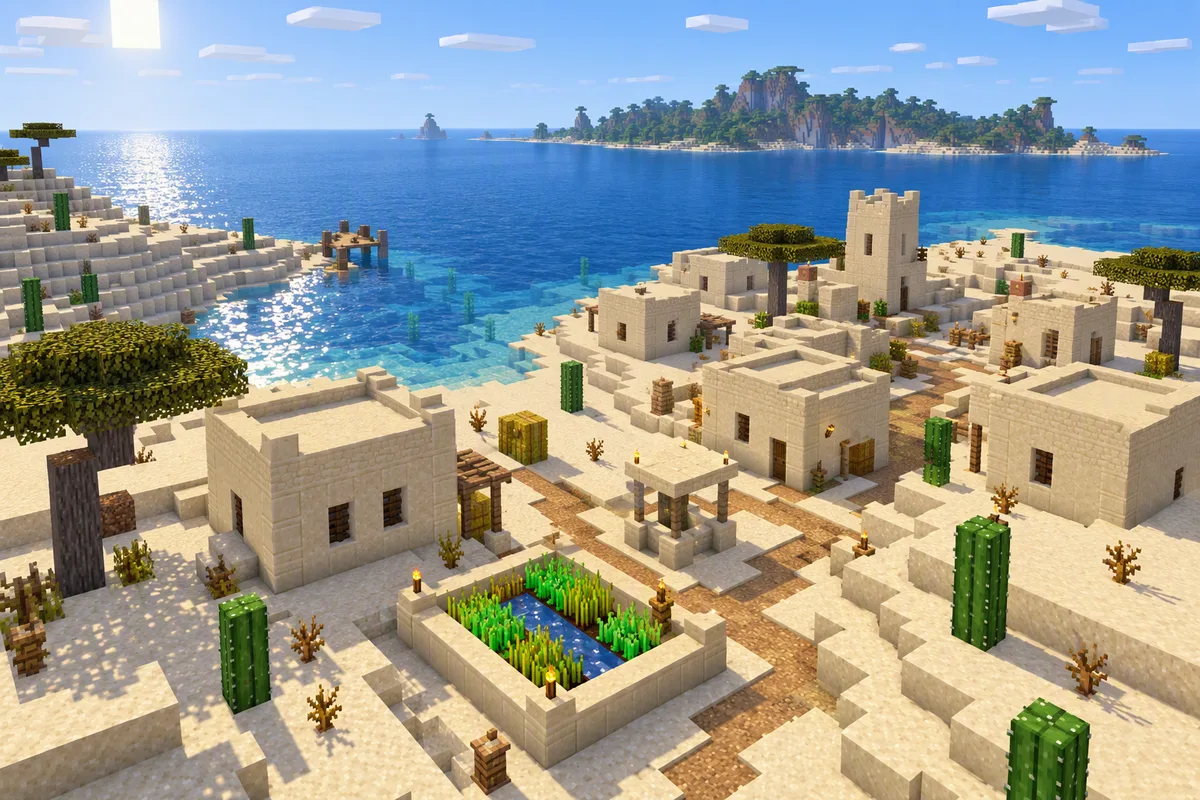
Desert Village Minecraft: 0 Desert Villages in 49 Records, One Distance of 27 Blocks
The short answer
This site publishes 49 seed records — twenty rows in the coordinate table and twenty-nine archive cards from 2011 to 2019. Two of the forty-nine mention a desert at all.Zero of the forty-nine call anything a desert village. One of the two can give you a number: on 2016000 the village sits about 27 blocks from the recorded spawn, and it is the only village-to-spawn distance in the whole set that can be worked out. The desert structure on that same row is a temple about 367 blocks from spawn and about 340 from the village — a different place entirely.
The only row with a village, a spawn and a desert structure together:2016000 — Java 1.20–1.21. Spawn 0, 63, 0; village -24, 64, 12, about 27 blocks away; desert temple -320, 64, 180, about 367 blocks away. Village at spawnDistance: about 27 blocksDesert temple, not desert village
The only card that puts a desert pyramid and a village in one line:-7492801512473941435 — posted 26 July 2013. Terrain as written: desert pyramid, NPC village, two surface spider dungeons linked together, jungle with bays at the desert edge. The card calls the pyramid and the village “the same short walk” apart and gives no number, no spawn and no edition. Desert and village, same lineDistance in words onlyNo spawn recorded
The Bedrock row that does not count:-665393669 — recorded with a ruined portal out in badlands. Badlands is its own biome name, so it does not enter the desert count. Badlands, not desertNo village named
Both desert records, and the one code that can produce a distance — 2016000; -7492801512473941435
A desert village beside open water — the thing the search term asks for. This site holds forty-nine written-down seed records, two mention a desert, and not one of the forty-nine attaches the word desert to a village.
How we counted, before you read any number on this page
Every figure below counts records, not worlds. That distinction decides the whole page, so here is the rule in full, before any of the arithmetic.
What a record is. Forty-nine of them. Twenty rows in the coordinate table, each one a seed somebody wrote down after loading it, with a seed code, an edition, a version and whatever structures they found. Twenty-nine archive cards from 2011 to 2019, each one a seed code plus the terrain the person who found it described. Forty-nine records, and no invented entries among them.
What counts as mentioning a desert. The word desert has to appear on the record, either as a biome word or inside the name of a desert structure — desert temple, desert pyramid. Two records qualify: table row 1, which names a desert temple, and one 2013 archive card, which names a desert pyramid. A badlands biome does not count, because badlands is a different biome with a different name, and we are counting the words people wrote rather than the shapes they resemble.
What counts as a desert village. Strictly this: the record has to name a village and attach the desert biome to it, or state outright that the village is a desert village. Zero of the forty-nine do. Two name a village at all — one table row and one archive card — and neither gives the village a biome label of any kind. A desert structure sitting on the same record as a village is not the same thing as a village in the desert, and this page is largely about the gap between those two sentences.
What counts as a distance. Two coordinates with an X and a Z on the same record, one of them a spawn or landing point. Where both exist we work out the horizontal distance and say plainly that it is ours. Where a record says “nearby” or “a short walk” and gives no second point, we print what it says and leave the number blank, because estimating it would be inventing the one figure this page exists to be honest about.
The two desert records, one row each
One of the two lives in the coordinate table and one is an archive card. This is the complete set — there is no third.
#
Record
Code
What the record says about the desert
Edition and version
1
Table row 1, Speedrun God Seed
2016000
Desert temple at -320, 64, 180, listed alongside a village, a stronghold, diamonds and a jungle temple
Java 1.20–1.21
2
Archive card, posted 26 July 2013
-7492801512473941435
Desert pyramid and NPC village in the same terrain line, with jungle bays at the desert edge
None recorded
Two records, and they fail in opposite directions. The table row has every number you could want and never once says the word desert about a village. The archive card says desert and village in the same breath and has almost no numbers at all. If you came here for a code to paste, the first one is loadable tonight and the second one is a 2013 note you would have to load to find out about.
Every distance row 1 can produce, and whose number each one is
Only one record in the set carries a spawn point and five other coordinates, so it is the only place where distance is answerable at all. Here is all five, worked the same way every time: horizontal distance, the square root of the X difference squared plus the Z difference squared. Y is left out because a stronghold forty blocks down and a temple at surface height are both the same walk.
From spawn 0, 63, 0 to
Coordinate on the row
Horizontal distance
Whose number is it?
Village
-24, 64, 12
About 27 blocks
Ours — the square root of 24 squared plus 12 squared is 26.8. Both points are on row 1.
Stronghold
-21, 42, 18
About 28 blocks
Ours — the square root of 21 squared plus 18 squared is 27.7.
Diamond ore
-32, 11, 25
About 41 blocks
Ours — the square root of 32 squared plus 25 squared is 40.6.
Desert temple
-320, 64, 180
About 367 blocks
Ours — the square root of 320 squared plus 180 squared is 367.2.
Jungle temple
450, 63, -270
About 525 blocks
Ours — the square root of 450 squared plus 270 squared is 524.8.
Read the first row and the fourth row together, because that pairing is what a desert village search actually runs into. The village is a two-minute walk. The desert temple is a fourteen-times-longer walk in a different direction, roughly 340 blocks from the village as the crow flies. Whatever the row is offering, it is not a village in the desert — it is a village near spawn with a desert structure a long way off.
And every one of those five numbers is our arithmetic on two written coordinates, not a measurement anyone took in a world. Nobody on this site walked 367 blocks with a counter running. We are printing the sum so you can check it, not so you can treat it as field data.
The distance field: 1 of 2 village records, and 0 distances written down
Now the field this page was actually built to audit. Two of the forty-nine records name a village. One of those two can produce a distance. Neither of them states one.
Field
Records out of 49
Which record
What it actually tells you
Names a village at all
2
2016000 (table row 1) and -7492801512473941435 (2013 card)
That a village is there
Gives the village its own coordinate
1
2016000, village at -24, 64, 12
Where to walk
Records a spawn or landing point
1
2016000, spawn at 0, 63, 0
Where you start
Has both, so a distance can be worked out
1
2016000, at about 27 blocks
How far. Once, in the whole set.
States a distance in numbers
0
None
Nothing. Not one record writes a distance figure down.
Says something about distance in words
1
-7492801512473941435, “the same short walk”
That it felt close — and no number behind the feeling
Calls the village a desert village
0
None
Nothing. Zero of forty-nine name a village type at all.
Those last three rows are the finding. The record that can be measured does not measure itself; the record that describes the walk does not say how long it was; and neither of them ever labels the village. So the distance question and the desert question fail in the same place, on the same missing field.
The card that says desert and village in one breath, and still cannot be measured
The 2013 archive card is the closest thing this site has to what the search term asks for, and it is worth reading in full, because it shows exactly which field is missing.
What the card says
What the card does not say
Desert pyramid
Whether the village is a desert village. The pyramid and the village share a terrain line and are never linked.
NPC village
What type the village is, and where inside the terrain it stands. It has no coordinate of its own.
“A village and a pyramid inside the same short walk”
How long the walk is. There is no spawn point on the card, so there is no second end to measure.
Coordinates (x=-400, z=280)
Which of the four features that coordinate belongs to. It is one point for the whole terrain.
Jungle with bays at the desert edge
Which edge, and how far from the village. The jungle is placed relative to the desert, not to you.
Posted 26 July 2013
The edition or version. Neither appears anywhere on the card.
So the honest reading is: somebody in 2013 found a pyramid and a village close enough together to call it overpowered, wrote down one coordinate for the whole area, and never said which version they were on. It is a genuine record of a desert-and-village spawn. It is also unmeasurable, and we are not going to turn “a short walk” into a number.
What we will not claim
We do not have a desert village seed. Zero of the forty-nine records attach the word desert to a village, so there is no record here we can honestly label that way. We are not going to build one out of a desert temple that sits 340 blocks from the village.
We are not saying the village on 2016000 is or is not a desert village. The row never names a village type. Distance is not a biome label, and a temple 367 blocks away does not tell you what the village is built from.
We are not saying the other forty-seven records have no desert. A record that never mentions desert has said nothing about desert. Silence is not a negative result, and we are not going to read one into it.
Our distances are arithmetic, not measurement. All five come from two written coordinates on one row. Nobody walked them, and the game may place things differently on a release we have not tested.
We have not re-loaded either desert record on a current release. The 2013 card carries no edition and no version at all. Row 1 was recorded on Java 1.20–1.21 and has not been re-tested here since.
We are not ranking these seeds. No score, no tier, no ordering. Two desert records, one measurable distance, zero written distances — those are counts, and a count is not a grade.
Five checks before you call a code a desert village seed
Five checks, in the order we run them on a record before repeating anything off it. Each one is answerable from the record itself, in about a minute, without loading a world. The point is to separate a code that puts you in a desert village from a code that has both words somewhere on it.
Check
The question
What it catches
How our record scores
1
Does the word desert describe the village, or a structure somewhere else on the record?
Desert temples and pyramids sold as desert villages
0 of 2 pass — both desert records fail this
2
Does the record name a village at all?
Desert records with no settlement on them
2 of 2 pass — 2016000 and -7492801512473941435
3
Does the record give both a spawn point and a village coordinate?
Villages you cannot plan a route to
1 of 2 passes — 2016000, at about 27 blocks
4
Does the record state a distance rather than describing one?
“A short walk” with nothing behind it
0 of 2 pass — zero of forty-nine, in fact
5
Does the record name an edition and a version you can match to the game you run?
Records from a terrain generator that no longer exists
1 of 2 passes — the 2013 card names neither
Checks 1 and 4 are the ones that fail everywhere, and both fail on a field rather than on a world. Check 3 is the one that decides whether you can plan: with a spawn and a village coordinate you know the walk before you load, and without them you are guessing at someone else's idea of short.
The three records, in full
Speedrun God Seed — 2016000
Edition and version: Java 1.20–1.21, with a second row for Bedrock 1.20.5. Desert: a desert temple at -320, 64, 180, about 367 blocks from the recorded spawn at 0, 63, 0 and about 340 blocks from the village. Village: -24, 64, 12, about 27 blocks from spawn, described on the row as 12 houses, 2 blacksmith forges, 1 church and 2 farms, with no type named. Other structures: stronghold -21, 42, 18, about 28 blocks; diamonds -32, 11, 25, about 41 blocks; jungle temple 450, 63, -270, about 525 blocks. Why it is here: it is the only record in the whole set where a village, a spawn and a desert structure all carry coordinates, which is exactly why it can show you how far apart the desert and the village really are. Village at spawnDesert temple with coordinatesVillage type unrecorded
Desert Pyramid and Village — -7492801512473941435
Edition and version: not recorded, on either count. Desert: a desert pyramid, named in the terrain line with no coordinate of its own. Village: an NPC village, in the same line, also without a coordinate and without a type. Distance: described on the card as a village and a pyramid inside the same short walk, with no number and no spawn point to measure against. Coordinates: x=-400, z=280, one point for the whole terrain rather than a landing point. Why it is here: it is the single record in forty-nine that puts a desert and a village in the same sentence, and the clearest example of a distance that exists in words and nowhere else. Desert and village, same lineDistance in words onlyNo version
Badlands Portal — -665393669
Edition and version: Bedrock, with no version number on the row. Why it is not a desert record: what the row names is a badlands biome with a ruined portal, and badlands is a separate biome with its own name. Counting it as desert would inflate the count from two to three on a word nobody wrote. What it does have: more trees than the island size suggests, ocean ruins generated on land with a chest holding a stone axe and a treasure map, iron ore and two overlapping chests below. Village: none named. Badlands, not desertNo village namedNo version number
First ten minutes when the desert is not at your spawn
A desert temple 367 blocks out and a village 27 blocks out are two different worlds to start in, and the one you actually get is decided before you punch anything. Here is the order we would run it in, using the numbers row 1 gives us.
Go to the village first, because at 27 blocks it is the only thing on the row you can reach before nightfall. On 2016000 the village is closer than the stronghold, the diamonds and both temples combined. Beds, food and a trading hall beat loot you have to walk to.
Treat the desert temple as a second-day trip, not a spawn feature. About 367 blocks from spawn, and about 340 from the village. That is a boat or a horse and a bed in your inventory, not a first-ten-minute walk, and the number is our arithmetic rather than a walk anyone took.
Do not read the temple as evidence about the village. A desert temple says what generated 367 blocks away. It says nothing about the biome under the village 27 blocks from spawn, and this row never names a village type at all.
Check the edition before you check the loot. Row 1 is Java 1.20–1.21; the Bedrock row for the same code is a different world with a shipwreck, a mushroom island and an ocean monument and none of the six Java coordinates. Same code, and the desert temple is not on the Bedrock side.
If you load the 2013 card, write down two things before anything else: the version and a spawn coordinate. The card has neither. It is the only desert-and-village record we hold, and it is unmeasurable for exactly that reason.
Write the distance down, not just the direction. Zero of our forty-nine records state a distance in numbers, which is why this page has to do arithmetic to answer a question the game answers instantly. If you load one of these codes, the single most useful thing you can add is the number of blocks it actually was.
Playing a desert-edge start with other people
Everything on this page is an audit of written records, and it stays true on a shared world with one addition: the two things people want from a desert start are far apart, and on a server that distance becomes somebody's job. On row 1 the village is 27 blocks from spawn and the temple is about 367 — close enough that half a group will settle in the village while the other half is still walking, and far enough that the walkers need a bed and a route agreed before they leave rather than after dark.
If you want to run one of these with other people, on Java or Bedrock, Shockbyte is a low-cost host that sets up in minutes — use code LAUNCH for 25% off your first month. If you sign up through that link, I may receive a commission at no extra cost to you. It does not change what you pay.
Frequently asked questions
Do you have a desert village seed?
No. We publish forty-nine seed records and not one of them attaches the word desert to a village, so there is no record here we can honestly label a desert village seed. Two of the forty-nine mention a desert at all: 2016000, which has a desert temple on it, and a 2013 archive card with a desert pyramid on it. Neither says the village is a desert village.
How many of your records mention a desert?
Two out of forty-nine. One is table row 1, 2016000 on Java 1.20–1.21, which records a desert temple at -320, 64, 180. The other is an archive card posted 26 July 2013, -7492801512473941435, whose terrain line reads desert pyramid, NPC village, two surface spider dungeons linked together, jungle with bays at the desert edge. Badlands on a Bedrock row does not count, because it is a different biome name.
How far is the desert temple from spawn on seed 2016000?
About 367 blocks. Row 1 records a spawn at 0, 63, 0 and a desert temple at -320, 64, 180, so the horizontal distance is the square root of 320 squared plus 180 squared, which is 367.2. Both coordinates are written on the same row, so you can redo the sum. It is arithmetic on a record, not a measurement taken inside a world.
How far is the village from spawn on seed 2016000?
About 27 blocks, and it is the only village-to-spawn distance in our whole set that can be worked out. Row 1 records a spawn at 0, 63, 0 and a village at -24, 64, 12, so the horizontal distance is the square root of 24 squared plus 12 squared, which is 26.8. The other village record, the 2013 card, names no spawn point, so nothing on it can be measured.
Is the village on seed 2016000 a desert village?
No, and the record does not say either way. The village sits about 27 blocks from spawn while the desert temple on the same row sits about 367 blocks from spawn and about 340 blocks from the village, so the two are not in the same place. But distance is not a biome label, and the row never names a village type at all.
Do any of your records state a distance in numbers?
Zero out of forty-nine. Not one record we publish writes down a distance figure. Two of the forty-nine say something about distance in words — the 2013 card calls a village and a pyramid the same short walk apart — and one row, 2016000, carries enough coordinates for us to work five distances out ourselves. We print those as our arithmetic and label them as such.